
-erc-, -erci-
(Latin: [from arcere] to restrain, to enclose, to confine; to keep off)
boxercise
A form of aerobic exercise which incorporates many aspects of boxing without actually hitting anyone.
Boxercisers generally find themselves punching empty air, punchbags, speedballs, or pads held by another person.
coerce (verb), coerces; coerced; coercing
1. To force or cause to act or think in a certain way by use of pressure, threats, or intimidation; to compel: Thomas, who was quite lazy at home and had nothing really to do, was coerced into getting a job by his wife.
2. To dominate, restrain, or control forcibly by physical, moral or intellectual means: It is sad that some parents coerce their children by punishing them severely when they accidentally do something wrong.
3. Etymology: from about 1451, from Middle French cohercer, from Latin coercere "to control, to restrain"; from com-, "together" plus arcere, "to enclose, to confine, to contain, to ward off".
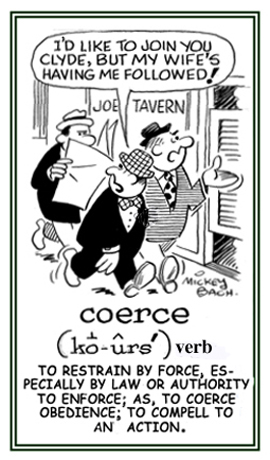
© ALL rights are reserved.
Go to this Word A Day Revisited Index
2. To dominate, restrain, or control forcibly by physical, moral or intellectual means: It is sad that some parents coerce their children by punishing them severely when they accidentally do something wrong.
3. Etymology: from about 1451, from Middle French cohercer, from Latin coercere "to control, to restrain"; from com-, "together" plus arcere, "to enclose, to confine, to contain, to ward off".
Go to this Word A Day Revisited Index
so you can see more of Mickey Bach's cartoons.
coercer
1. Someone who compels by force, intimidation, or authority; especially, without regard for individual desires or volition.
2. A person who dominates or controls; especially, by exploiting fear, anxiety, etc.
2. A person who dominates or controls; especially, by exploiting fear, anxiety, etc.
coercible, coercibly
That which may or ought to be restrained or compelled.
coercimeter
An instrument used for the measurement of coercive force.
coercion
1. The process of compelling a person to act, or refrain from acting, contrary to his or her free choice often by use of threat of physical or moral force.
2. Force or threats used to make someone do something against his or her will.
2. Force or threats used to make someone do something against his or her will.
coercive (adjective), more coercive, most coercive
1. Characterized by the practice of making a person do something in an involuntary manner by use of intimidation or threats or some other form of pressure: Simon was sent to the principal at school because of his coercive behavior on the playground towards his classmates.
2. A reference to using force or threats to make someone do something against his or her will: Greg was very coercive towards his sister, making her keep his secret of stealing money from the principal’s office, otherwise he would hide her cell phone.
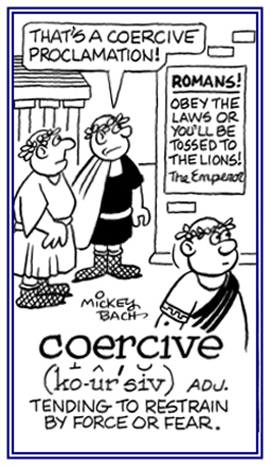
© ALL rights are reserved.
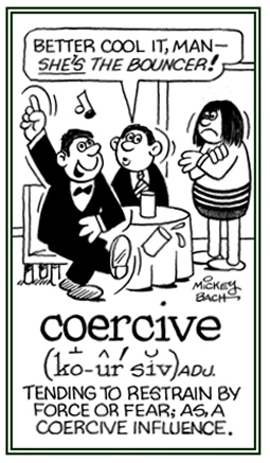
© ALL rights are reserved.
Go to this Word A Day Revisited Index
2. A reference to using force or threats to make someone do something against his or her will: Greg was very coercive towards his sister, making her keep his secret of stealing money from the principal’s office, otherwise he would hide her cell phone.
Go to this Word A Day Revisited Index
so you can see more of Mickey Bach's cartoons.
coercively
1. By constraint.
2. Characterized by or inclined to coercion.
2. Characterized by or inclined to coercion.
dancercise
Energetic dancing done for the purpose of aerobic exercise.
exercisable (adjective), more exercisable, most exercisable
Disposed to being used or exerted: In Bob's physical fitness class the instructor showed the students how well their legs and arms were exercisable with the equipment available.
exercise
1. An act of employing or putting into play; the free exercise of intellect; the exercise of an option.
2. The discharge of a duty, function, or office.
3. Activity that requires physical or mental exertion, especially when performed to develop or maintain fitness: "She took an hour of vigorous daily exercise at the local sports center.
4. A task, problem, or other effort performed to develop or maintain fitness or increase skill: a piano exercise; a memory exercise.
5. An activity having a specified aspect; such as, an undertaking that was an exercise in futility.
6. Etymology: about 1340, "condition of being in an active operation" from Old French exercice, from Latin exercitium, from exercitare, frequentative of exercere, "to keep busy, to drive on"; literally, "to remove restraint", from ex-, "off" plus arcere, "to keep away, to prevent, to enclose".
2. The discharge of a duty, function, or office.
3. Activity that requires physical or mental exertion, especially when performed to develop or maintain fitness: "She took an hour of vigorous daily exercise at the local sports center.
4. A task, problem, or other effort performed to develop or maintain fitness or increase skill: a piano exercise; a memory exercise.
5. An activity having a specified aspect; such as, an undertaking that was an exercise in futility.
6. Etymology: about 1340, "condition of being in an active operation" from Old French exercice, from Latin exercitium, from exercitare, frequentative of exercere, "to keep busy, to drive on"; literally, "to remove restraint", from ex-, "off" plus arcere, "to keep away, to prevent, to enclose".
The original sense may have been "driving farm animals to the field to plow"; meaning "physical activity". This was first recorded in English about 1386.
exercised
exerciser
exercitation
incoercible
1. Not to be coerced or compelled.
2. That which cannot be forced.
2. That which cannot be forced.

Showing page 1 out of 2 pages of 16 main-word entries or main-word-entry groups.