
prob-, proba-, probat-, prov-
(Latin: upright, good, honest; to try, to test, to examine; to demonstrate)
Aliudque cupido, mens aliud suadet. Video meliora proboque, deteriora sequor. (Latin statement)
Translation: "Desire persuades me one way, reason another. I see the better and approve it, but I follow the worse."
From Publius Ovidius Naso (43 B.C. - c. A.D. 17).
approbate, approbates, approbated, approbating (verbs)
To approve officially.
approbation
1. An expression of warm approval; praise; commendation.
2. Official approval or sanction.
3. Obsolete: conclusive proof.
2. Official approval or sanction.
3. Obsolete: conclusive proof.
approbative, approbatory
Approving; expressing approbation.
approbativeness
The quality of being approbative; that is, expressing or manifesting praise or approval.
approvable (adjective), more approvable, most approvable
1. Capable of being confirmed: The newly revised and approvable plan was put into practice immediately.
2. Worthy of being accepted; commendable: An approvable letter of praise was sent to JoLynn for her performance at the recital for being the most improved violist.
2. Worthy of being accepted; commendable: An approvable letter of praise was sent to JoLynn for her performance at the recital for being the most improved violist.
approval
1. The act of approving; approbation.
2. Formal permission or sanction.
3. On approval, without obligation to buy unless satisfactory to the customer upon trial or examination and, otherwise, returnable: "They ship merchandise on approval."
2. Formal permission or sanction.
3. On approval, without obligation to buy unless satisfactory to the customer upon trial or examination and, otherwise, returnable: "They ship merchandise on approval."
approve (verb), approves; approved; approving
1. To speak or think favorably of; pronounce or consider agreeable or good; to judge favorably: The city officials had to approve the policies of the administration.
2. To consent or agree to.
3. To confirm or sanction formally; to ratify: The Senate finally approved the bill.
4. To speak or consider favorably; to demonstrate; to show.
2. To consent or agree to.
3. To confirm or sanction formally; to ratify: The Senate finally approved the bill.
4. To speak or consider favorably; to demonstrate; to show.
approver
1. Someone who approves.
2. Old English Law: An accomplice to a felony who confessed his or her guilt and gave evidence against his or her confederates.
2. Old English Law: An accomplice to a felony who confessed his or her guilt and gave evidence against his or her confederates.
approvingly
In an approving manner.
A surgical instrument for conducting intense cold to small areas of body tissues in order to destroy those areas: While at the dermatologist's, Dr. Small used a cryoprobe to apply liquid nitrogen to a small unhealthy spot on Virginia's arm in order to remove it completely.
1. A moral disapproval or condemnation: Most church ministers present disapprobations to their congregations about right and wrong behaviors.
2. An expression of a strong unfavorable opinion: As the mayor of his city, Chris was finding it difficult to tolerate the constant disapprobation of his critics.
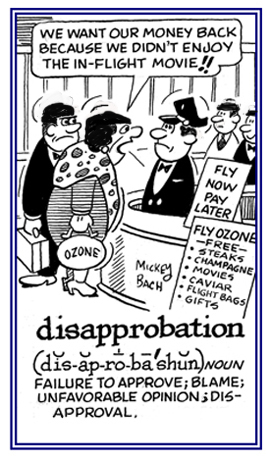
© ALL rights are reserved.
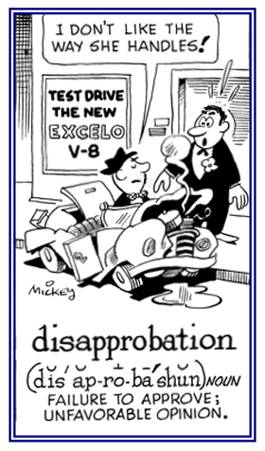
© ALL rights are reserved.
Go to this Word A Day Revisited Index
2. An expression of a strong unfavorable opinion: As the mayor of his city, Chris was finding it difficult to tolerate the constant disapprobation of his critics.
Go to this Word A Day Revisited Index
so you can see more of Mickey Bach's cartoons.
disapproval
1. The act of disapproving or condemning; censuring.
2. The expression of disapproval.
3. A feeling of disliking something or what someone is doing.
4. An inclination to withhold approval from some person or group.
5. A feeling of disliking something or what someone is doing.
2. The expression of disapproval.
3. A feeling of disliking something or what someone is doing.
4. An inclination to withhold approval from some person or group.
5. A feeling of disliking something or what someone is doing.
disapprove (verb), disapproves; disapproved; disapproving
1. To think that something is wrong or reprehensible; to censure or to condemn in opinion.
2. To withhold approval from; to decline, to sanction: Henry's father disapproved of his behavior.
3. To have an unfavorable opinion: Shirley disapproves of drinking alcohol to an excess.
4. To refuse to approve; to reject.
2. To withhold approval from; to decline, to sanction: Henry's father disapproved of his behavior.
3. To have an unfavorable opinion: Shirley disapproves of drinking alcohol to an excess.
4. To refuse to approve; to reject.
disapprovingly
Showing disapproval.
