
merit-, meri-, mere-
(Latin: to deserve; to earn, to acquire, to gain; entitled to)
2. Absence of merit; the quality of being inadequate or falling short of perfection.
3. A mark made against a person's record for a fault or for misconduct: The soldier received a demerit for his failure to do his assignment as ordered.
Go to this Word A Day Revisited Index
so you can see more of Mickey Bach's cartoons.
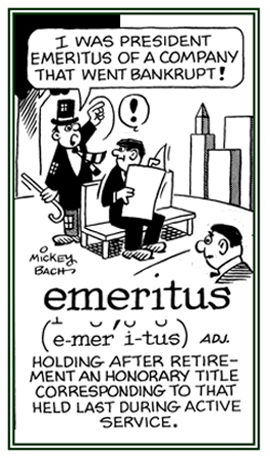
The origin of this word comes from Roman military tradition with the meaning of "a soldier who has served his time honorably". Modern usage usually refers to a university officer who is rewarded for faithful service with the position, for example, professor emeritus.
The title of emeritus may allow the person so honored to continue to use the facilities of the institution and to attend ceremonies as an honored member of the academic community.
Motto of Isothermal Community College, Spindale, North Carolina, USA.
2. Plausible but false or insincere; specious: "He had a meretricious argument."
3. Of or relating to prostitutes or prostitution: "They had meretricious relationships."
Believe it or not, but this word is related to the origins of merit; literally, "one who earns money" from Latin mereri, "to earn". The result is that the Latin meretricius (modern, meretricious) means "pertaining to harlots; someone who earns money by means of prostitution".
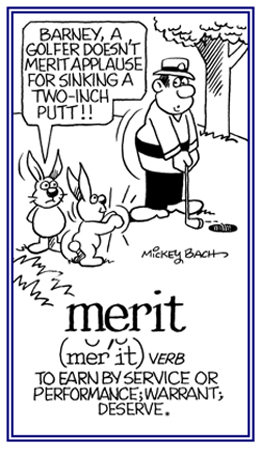
2. A quality deserving praise or approval; virtue: Tom thought that the proposal to invest his money had some merits for a closer inspection.
3. A demonstrated ability or achievement: The promotions of the employees were based on merit alone.
4. A good or praiseworthy characteristic that someone or something has.
5. Christianity: Spiritual credit granted for spiritual worthiness achieved by doing good works.
6. In law: a party's strict legal rights, excluding jurisdictional, personal, or technical aspects.
2. To earn or acquire approval or disapproval as a result of a person's behavior: Some people feel the award to the politician wasn't merited.
3. Etymology: from Latin merere, "to deserve".
Go to this Word A Day Revisited Index
so you can see more of Mickey Bach's cartoons.
2. Having the quality of deserving praise, or having a good quality.
