
cupid-
(Latin: desirous, desiring, to desire, desired)
Aliudque cupido, mens aliud suadet. Video meliora proboque, deteriora sequor. (Latin statement)
Translation: "Desire persuades me one way, reason another. I see the better and approve it, but I follow the worse."
From Publius Ovidius Naso (43 B.C. - c. A.D. 17).
1. A strong physical desire for intimacy which is associated with Cupid, the Roman god of love.
2. Powerful or ardent feelings for close personal relationships.
2. Powerful or ardent feelings for close personal relationships.
concupiscent (adjective), more concupiscent, most concupiscent
Relating to being eagerly or amorously lustful and desirous.
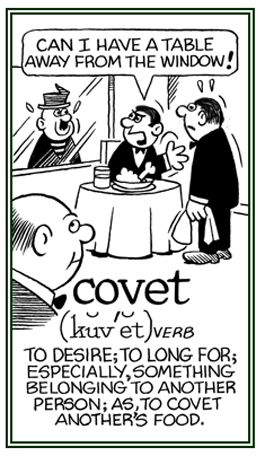
covet (verb), covets; coveted; coveting
1. To have a strong wish to possess something that belongs to another person or people: The cripple covets the same ability to walk as other people can.

© ALL rights are reserved.
© ALL rights are reserved.
Go to this Word A Day Revisited Index
Shirley has been coveting the same pay as the men receive who are doing the same kind of work as she is.
Jim's religion emphasizes seeking spiritual objectives and it warns people not to covet or to be greedy for material things.
2. Etymology: from Old French coveitier; ultimately from Latin cupiditas, "passionate desire"; from cupidus, "very desirous", from cupere, "to long for, to desire".Go to this Word A Day Revisited Index
so you can see more of Mickey Bach's cartoons.
covetable (adjective), more covetable, most covetable
Pertaining to strongly wanting or yearning for something: The poverty stricken man had covetable wishes for a financial situation that would make it possible for him to have a better life!
covetous (adjective), more covetous, most covetous
1. Excessively and culpably desirous of the possessions of another person or people: When Bernard drove his expensive car into his driveway, he noticed that his neighbors were giving him covetous looks.
2. Marked by an extreme desire to acquire or possess something: Karen had covetous aspirations to get a university degree which would qualify her for a profitable career as a company executive.

© ALL rights are reserved.
Go to this Word A Day Revisited Index
2. Marked by an extreme desire to acquire or possess something: Karen had covetous aspirations to get a university degree which would qualify her for a profitable career as a company executive.
Go to this Word A Day Revisited Index
so you can see more of Mickey Bach's cartoons.
covetously (adverb), more covetously, most covetously
1. A reference to an avariciously greedy manner.
2. Descriptive of a strong or an inordinate desire to obtain and possess something eagerly.
2. Descriptive of a strong or an inordinate desire to obtain and possess something eagerly.
An insatiable desire or extreme greed for material possessions or wealth: Covetousness is considered to be one of the deadly sins.
1. In Roman Mythology: The god of love; the son of Venus.
2. The ancient Roman god of love, represented by a young naked boy who has wings and shoots arrows at people to make them start to desire or to love each other.
3. When seen as cupid (lower case), it is shown as a representation of Cupid as a naked cherubic boy usually having wings and holding a bow and arrow, used as a symbol of love and longing for someone.
2. The ancient Roman god of love, represented by a young naked boy who has wings and shoots arrows at people to make them start to desire or to love each other.
3. When seen as cupid (lower case), it is shown as a representation of Cupid as a naked cherubic boy usually having wings and holding a bow and arrow, used as a symbol of love and longing for someone.
cupidate (verb), cupidates; cupidated; cupidating
An action that takes place when someone strongly wants that a particular person is hit by Cupid's arrow and thereby falls in love with the one who is desiring the action.
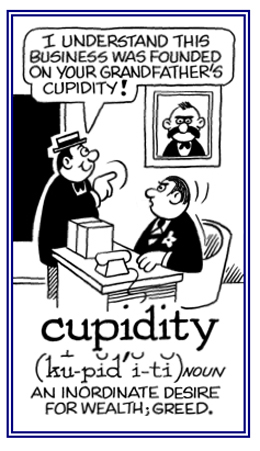
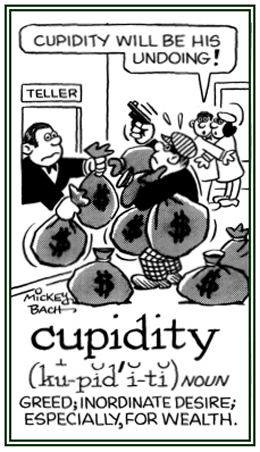
A strong feeling of wanting much more than a person needs: Jake had a cupidity for wealth and powerful influences over other people.
© ALL rights are reserved.
© ALL rights are reserved.
Go to this Word A Day Revisited Index
Cupidity, not cherub cute,
It smells, rather, of ill-repute,
Though passion its seed,
It connotes bad greed,
Or avarice quite absolute.
It smells, rather, of ill-repute,
Though passion its seed,
It connotes bad greed,
Or avarice quite absolute.
Go to this Word A Day Revisited Index
so you can see more of Mickey Bach's cartoons.
Ignoti nulla cupido.
No desire [exists] for a thing unknown.
Ovid's thought in Ars Amatoria: "We don't want what we can't see."
Radix omnium malorum est cupiditas.
The love of money is the root of all evil.
These words are not concerned with wealth, as such, but with avarice. Money per se is not considered the root of evil, but the excessive love of money to the exclusion of morals, philanthropy, character, the well-being of others, etc.
<img src="/img/left_arrow_sm.gif" alt="" /> <img src="/img/right_arrow_sm.gif" alt="" />
Showing 1 page of 13 main-word entries or main-word-entry groups.