
omen
(Latin: foreboding; anything perceived or happening that is believed to portend or to suggest that something is going to happen which may be a good or an evil event or circumstance in the future)
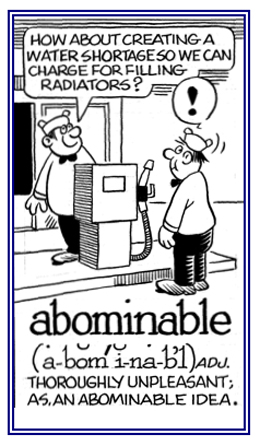
Nathan had the abominable habit of chewing his fingernails in public.
2. Extremely unpleasant or of very bad quality, or very unpleasant to experience: The abominable food that was served in the restaurant tasted terrible and Jim told the manager that he could be sure that he and his wife would never go there again.The abominable weather during the summer was the worst that people had experienced in a long time.
3. Referring to a bad omen; nasty and disgusting; vile; loathsome: The flood included abominable sewerage that had flowed into the basements and ground floor rooms of the houses.4. Pertaining to a statement that describes something that is deplorable, shocking, or awful: That the homeless were forced out of the shelter this winter was an abominable decision.
5. Etymology: derived from Latin abominari, "to detest something as an ill omen".
From the 14th until the 17th century, the word was spelled abhominable because people thought it came from the Latin phrase ab homine, meaning "away from man", and so, "inhuman, beastly".
Go to this Word A Day Revisited Index
so you can see more of Mickey Bach's cartoons.
Greg's mother was upset with him because he was abominably cruel to their cat.
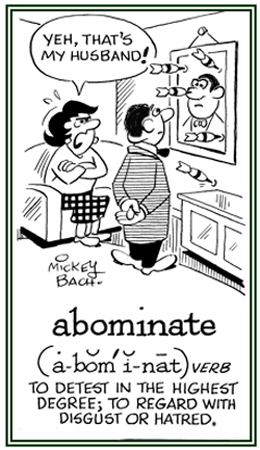
Allen has always abominated loud music and could not be tempted to attend a rock concert in the local park.
A politician who is revered by his supporters is also often abominated by his opposition.
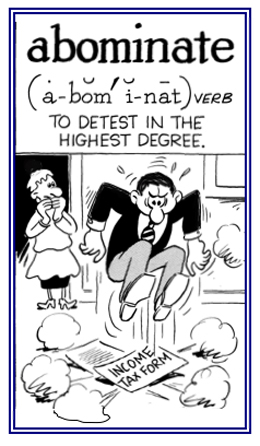
2. To detest thoroughly; to abhor: There is nothing that abominates Nellie more than the thought of eating raw meat.The crowd will be abominating the imposition of an early curfew by the local authorities.
The farmers have been abominating the hot and extremely dry weather.
Go to this Word A Day Revisited Index
so you can see more of Mickey Bach's cartoons.
For the ancient Romans, an omen was a sign from the gods or a promise of good or a warning of evil.
Naturally, they turned away in fear from an evil omen. To express this aversion, they combined ab, "away" + omen, "a foreboding, foretelling", into the verb abominari, meaning "to deprecate as ominous", "to abhor"; with a past participle abominatus, the source of English abominate. The word has largely lost its original connotation of dread and has come to mean "to loathe, to hate, to despise".
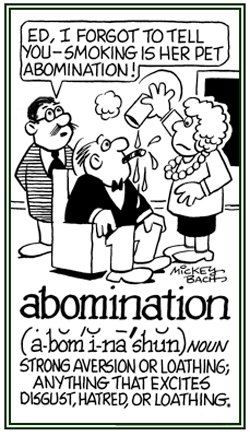
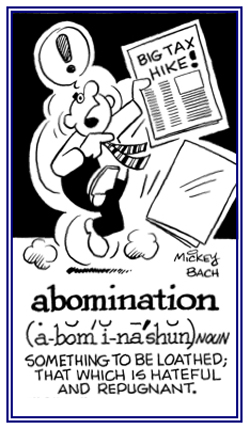
Stacey's grandfather still has a strong feeling of abomination for the concentration camps that existed in Germany during the Second World War.
2. An emotion of horror, loathing, or shame: Teressa's feeling of abomination for terrorist killings has never changed.3. Something that is perceived as disgusting, awful, or ill conceived: Some people see the sculpture in the museum exhibition as art, while others see it as an abomination.
Go to this Word A Day Revisited Index
so you can see more of Mickey Bach's cartoons.
2. People who thoroughly detest or abhor other people, things, systems, etc.: An experienced team of abominators meet every month to plan protests and rallies against the laws protecting civic inequality.
2. Marked by or promising some kind of bad fortune: The ill-omened snow, ice and freezing weather resulted in Hayden falling and breaking his wrist when he went outside.
2. A prognostic or foreboding of what will happen: When the black cat crossed in front of him, Manfred thought it would be a sign of some evil omen.
3. A prophetic significance; presage: Henry accidentally broke a mirror and he believed that it was an omen or an unfavorable sign that something terrible was about to happen.
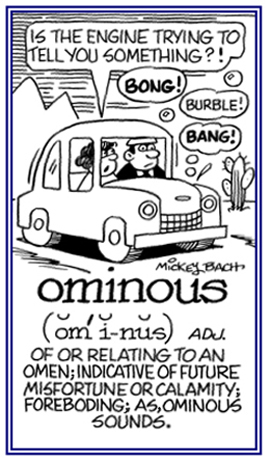
Mrs. Jackson told her students that the ominous weather meant that they might have to go home earlier than usual.

Go to this Word A Day Revisited Index
so you can see more of Mickey Bach's cartoons.
2. That which is threatening or foreshadowing evil or tragic developments: There was an ominousness of the weather that made Dina and her friends change their minds about going shopping in town.
There was an ominousness of silence when Bert asked his supervisor whether his contract was going to be extended.
Cross references of word families that are related directly, or indirectly, to: "divination, diviner; seer, soothsayer, prophecy, prophesy, prophet": augur-; auspic-; fa-, fate; Fates in action; futur-; -mancy; -phemia; sorc-, sorcery; vati-.