
Latin Proverbs, Mottoes, Phrases, and Words: Group O
(classical-language maxims, slogans, adages, proverbs, and words of wisdom that can still capture our modern imagination)
Expressions of general truths: Latin to English maxims, proverbs, and mottoes
Word entries are from Latin unless otherwise indicated.
Originally from Ovid's "Amore" (Liber I, XIII, Line 40: Lente currite noctis equi) with reference to horses pulling Time’s chariot, and he wants the night to stretch out so he can spend more time with his mistress. Later used in Dr. Faustus by Christopher Marlowe, metaphorically spoken by Faustus who is awaiting the appearance of Lucifer, who is expected to collect Faustus' soul when the clock strikes midnight.
The basis of the Faust story is that Faustus sold his soul to the Devil in return for twenty-four years of further life during which he was to have every pleasure and all knowledge at his command; but, then he had to surrender his soul to Lucifer. At eleven o'clock, the last hour of his life, Faustus tried to conceive of every way to escape hell. For one thing, he commanded the sun to stay still, so that the hour would not pass; as seen in O lente, lente currite noctis equi!.
"When an obiter dictum is stated by a judge, it can be an opinion that may have some influence over the jury and the lawyers present; so, it is an opinion based on experience and wisdom but which has not been thoroughly researched, is not entered into a judgment, and so it has no legal force."
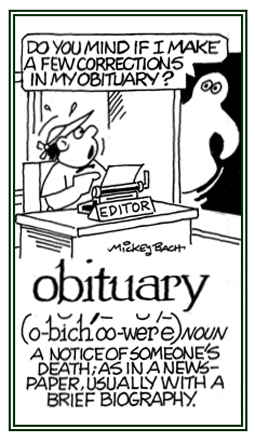
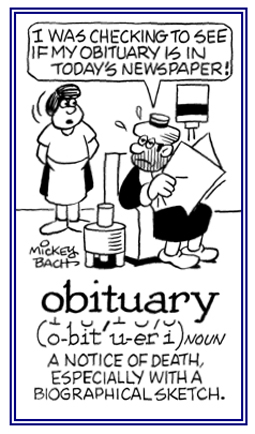
2. A death list or an inscription found on tombstones and in church records: Obiit is found on many tombstones, abbreviated as "ob.": "nasc. 1901, ob. 1933"; and the English word obituary comes from this Latin element. 3. Etymology: from 1706, "register of deaths"; from Middle Latin obituarius, "a record of the death of a person"; literally, "pertaining to death", from Latin obitus, "departure, a going to meet, an encounter" (a euphemism for "death"); from the stem of obire, "to go, to meet"; such as, in mortem obire "to meet death"; from ob, "to, toward" + ire, "to go".
Since the Latin verb obire means "to go to" or "to go over"; it is thought to be a reference to the River Styx and certainly it is no less euphemistic than our modern expression "to pass over".
Go to this Word A Day Revisited Index
so you can see more of Mickey Bach's cartoons.
A description of the physical effects of fear, from Virgil's Aeneid; with an equivalent meaning of, "I was scared stiff."
Another translation: "Strike while the iron is hot."
Go to this Word A Day Revisited Index
so you can see more of Mickey Bach's cartoons.
1. "To move every stone."
2. "To leave no stone unturned."
By extension: "Keep trying to do your best when working on a project or an enterprise."
Motto of Harrods's Department Store (of London).
This motto, written by Marcus Tullius Cicero (106-43 B.C.), is also reproduced in a shorter version in the entrance foyer of the Museum of Hungarian Agriculture: Nihil melius nihil homine libero dignius, quam agricultura.
This phrase could be useful when you are interrupted by the phone and you respond with, "Hello, you just caught me opere in medio." Pronounced as [AW puh ruh in MEH dee oh].
 Units of mottoes and proverbs listed by groups: A to X.
