
coife, cofea, cuphia
(Latin: a helmet, a cap; head dress, hair style)
BR> 2. A tight-fitting cap worn under a veil: A coif, or "skullcap" was worn by a nun in the photo in the magazine which was covered by a veil.
3. A white skullcap formerly worn by English lawyers: A coif was an official headdress worn by certain judges in England.
4. A heavy skullcap of steel or leather: A coif was formerly worn under a helmet or mail hood.
5, A hairdo: Sally went to the hairdresser's to have a coif done before she went to the ball.
2. To cover with or as if with a coif: Before she went out, she coifed her head with a nice hat.
2. Etymology, from a French word for "hairdresser," from coiffer "to dress hair," from Old French coife, originally, "inner part of the helmet".
Coiffeuse is the french, feminine form of "coiffeur".
One can say that a coiffure is.a style of arranging or combing the hair.
2. A head covering; a headdress. Some coiffures that women wear are symbols of a specific religion.
Far from being merely an expression of personal style, hairdos can reflect their wearer's culture, class, religious, and political beliefs.
Those who rebel against society often begin with outlandish hairstyles and it is no accident that armies and prisons often initiate new members by cutting off their hair to encourage conformity.
Hair through the centuries
Coiffures or hair dressing through the centuries have had a variety of styles.
- The art of hairdressing in ancient Egypt involved the search for beauty where baldness was remedied in its early stages by liberal applications to the thinning hair areas which included lion, hippopotamus, crocodile, cat, and snake fat; all mixed together.
- Gray hair could be covered up with black calf's blood cooked in fat.
- On special occasions, prominent Egyptians would turn to wig workshops for some highly complex replacements and additions.
- Curls and braids were initially popular with both men and women.
- By the Middle Kingdom (1978-1640 B.C.), men tended to decide on wigs that covered much of the forehead, hanging in heavy tresses on either side of the face, where they could be tucked behind the ears.
- In the early days of ancient Rome, a woman's hair was dressed in a manner according to her social status.
- Their styles included ringlets, kinks and ribbons as well as the coif itself differentiated free women from slaves, virtuous matrons from prostitutes, and matres familias from priestesses.
- Such firm categories began to dissolve toward the end of the first century B.C., when Octavia, the sister of the Emperor Augustus, introduced style for style's sake.
- Trendsetting was born, nursed into being by the ornatrix or servant hairdresser.
- The men turned to the tonstrinae, or beauty salons, set up in Rome by expert Sicilian barbers.
- The newfound interest in individual appearance required special aids; including, not only unguents, dyes, pins, and combs; but also, curling tongs consisting of a cane or metal pipe to be heated on the fire then enwrapped with a lock of hair to create a coil.
- Such coifing practices were no doubt the prerogative of the patrician classes.
- Obviously, every noble man and woman was not blessed with abundant hair, again it was the creators of wigs, hairpieces, and toupees who provided the desired decorative results.
- In the 18th century, towering constructs for women certainly imposed restrictive movement because their necks must have been in pain.
- Imagine the problems these women had when they tried to sleep with these hair styles for some days because these coiffures required such extensive styling by a coiffurist or a coiffeuse!
- In both countries, the fear of big hair coincided with renewed interest in classical styles, ever-fresh on statues.
- Women revived the Greek "lampadion" and "melon" styles (lampadion, hair piled to look like a beacon, and the melon, with hair sectioned and gathered behind in a bun). As for men, the entire English army cut off one another's ponytails in ten minutes in 1808.
- In France, Napoleon wore his hair short and combed forward; Roman emperor style.
- Apparently we still perceive hair to be more of a personal expression of the inner person than clothes.
- Obviously all hairdos are not elegant, but they are often eloquent.
- Even in our modern era, eloquence of coiffures requires discipline in the use of razors and scissors, rigor with colors and gels; all of which continue their various trends from times past to the present.
Upper economic classes in Rome had their special hair styles
In the 18th century, they obviously over did it
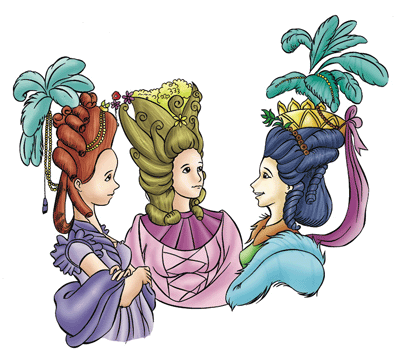
Of paste and pomatum a pound
Ten yards of gay ribbon to deck her sweet scull
And gauze to encompass it round.
Let her gown be tucked up to the hip on each side
Shoes too high for to walk or to jump
And to deck sweet charmer complete for a bride
Let the cork cutter make her a rump
Thus finished in taste while on Chloe you gaze
You may take the dear charmer for life
But never undress her, for out of her stays
You’ll find you have lost half your wife.
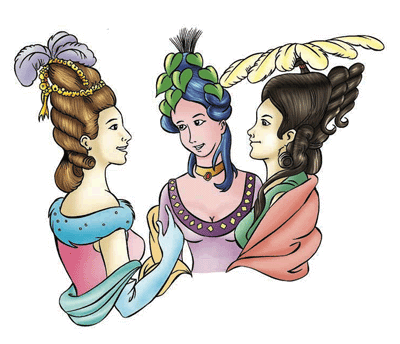
In 1775-1788, France, and then in England, women's hair reached dizzying heights. Hair was curled and then piled on top of wire structures, with padding for extra height. The mass was then powdered and decorated with feathers, blown glass, even recreations of gardens or fruit plates. The crowning touch on top of everything else: a hat.
In 1789, a "close cut" took on a new meaning during the French Revolution, when aristocrats lost their hair to jailers and their heads to the guillotine. Suddenly, short hair was in. The passion for hair cropped "à la victime" traveled from France to England.
Even in these modern days, coiffures come in a wide variety of styles
Links to other hair-related units: alopec-; barba-; Beards; capillaro-; chaeto-; cirro-; crino-; Hair & Beard Styles; hirsute; pilo-; pogo-; tricho-; villi-.