
ob-5 +
(Latin: completely, totally)
Before c, ob- becomes oc-; before f, ob- becomes of-; before g, ob- becomes og-; before p, ob- becomes op-; before m, ob- becomes o-
observe
1. To see, watch, perceive, or notice: "He observed the passersby in the street."
2. To regard with attention; especially, so as to see or learn something: "I want you to observe her reaction to the judge's question."
3. To watch, view, or note for a scientific, official, or other special purpose: "She wanted to observe the eclipse of the moon."
2. To regard with attention; especially, so as to see or learn something: "I want you to observe her reaction to the judge's question."
3. To watch, view, or note for a scientific, official, or other special purpose: "She wanted to observe the eclipse of the moon."
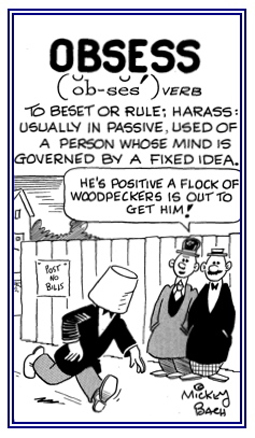
obsess, (verb) obsesses; obsessed; obsessing
1. To dominate or to occupy the thoughts, feelings, or desires of someone; to beset, to trouble, or to haunt persistently or abnormally: Suspicions about his neighbor's honesty obsessed Matthew.
2. To occupy someone's thoughts constantly, compulsively, and exclusively: The desire for revenge about the way she was treated so badly by her fellow workers obsessed Marge's sister for a long time.
3. Etymology: from Latin obsessus, past participle of obsidere, "to besiege, to occupy". Literally, "to sit opposite to", from ob, "against" + sedere "to sit".
© ALL rights are reserved.
Go to this Word A Day Revisited Index
2. To occupy someone's thoughts constantly, compulsively, and exclusively: The desire for revenge about the way she was treated so badly by her fellow workers obsessed Marge's sister for a long time.
3. Etymology: from Latin obsessus, past participle of obsidere, "to besiege, to occupy". Literally, "to sit opposite to", from ob, "against" + sedere "to sit".
Of evil spirits, "to haunt", is from 1540. Obsession was originally (1513), "the act of besieging", then "hostile action of the devil or an evil spirit" (1605). The meaning "persistent influence or idea" is first recorded in 1680.
Go to this Word A Day Revisited Index
so you can see more of Mickey Bach's cartoons.
obsolete (adjective), more obsolete, most obsolete
1. A reference to being old; no longer beneficial, valid, or fashionable.
2. Relating to something that is superseded by a newer item, although the previous one is possibly still in use.
3. A description of a part or organ of an animal or plant that is undeveloped or no longer functional.
4. Pertaining to words, equipment, etc., that are no longer active are gone into disuse: There are obsolete things which are replaced by something that is newer.
5. Synonyms of obsolete: ancient, antiquated, antique, archaic, disused, neglected, old, old-fashioned, out of date, discontinued, defunct, outmoded, and superannuated.
6. Etymology: from Latin obsoletus, "grown old, worn out"; past participle of obsolescere, "to wear out, to grow old, to fall into disuse"; probably from ob-, "away" + solere, "to be accustomed to".
© ALL rights are reserved.
Go to this Word A Day Revisited Index
2. Relating to something that is superseded by a newer item, although the previous one is possibly still in use.
3. A description of a part or organ of an animal or plant that is undeveloped or no longer functional.
4. Pertaining to words, equipment, etc., that are no longer active are gone into disuse: There are obsolete things which are replaced by something that is newer.
5. Synonyms of obsolete: ancient, antiquated, antique, archaic, disused, neglected, old, old-fashioned, out of date, discontinued, defunct, outmoded, and superannuated.
6. Etymology: from Latin obsoletus, "grown old, worn out"; past participle of obsolescere, "to wear out, to grow old, to fall into disuse"; probably from ob-, "away" + solere, "to be accustomed to".
Go to this Word A Day Revisited Index
so you can see more of Mickey Bach's cartoons.
obsoletely (adverb), more obsoletely, most obsoletely
1. Relating to being no longer in use or no longer functional; of a kind or style no longer current; old-fashioned.
2. With reference to a plant or animal part, indistinct or imperfect as compared with a corresponding part in related organisms; that are too small or imperfectly developed in comparison to others that are more fully developed in an earlier stage of the individual, in a past generation, or in closely related forms.
2. With reference to a plant or animal part, indistinct or imperfect as compared with a corresponding part in related organisms; that are too small or imperfectly developed in comparison to others that are more fully developed in an earlier stage of the individual, in a past generation, or in closely related forms.
A condition in which something is out of date and is no longer in current service.
occupy (verb), occupies; occupied; occupying
1. To take or fill up (space, time, etc.): "I occupied my evenings reading novels."
2. To engage or employ the mind, energy, or attention of: "He will occupy the children with a game while I prepare dinner."
3. To be a resident or tenant of; to dwell in: "We occupied the same house for 20 years."
4. To take possession and control of (a place), as by a military invasion.
5. To hold (a position, office, etc.).
6. Etymology: "to take possession of"; also, "to take up space or time, to employ (someone)"; from Old French occuper; from Latin occupare, "to take over, to seize, to possess"; which came from Latin, ob, "over" + a form of capere, "to grasp, to seize".
2. To engage or employ the mind, energy, or attention of: "He will occupy the children with a game while I prepare dinner."
3. To be a resident or tenant of; to dwell in: "We occupied the same house for 20 years."
4. To take possession and control of (a place), as by a military invasion.
5. To hold (a position, office, etc.).
6. Etymology: "to take possession of"; also, "to take up space or time, to employ (someone)"; from Old French occuper; from Latin occupare, "to take over, to seize, to possess"; which came from Latin, ob, "over" + a form of capere, "to grasp, to seize".
<img src="/img/left_arrow_sm.gif" alt="" /> <img src="/img/right_arrow_sm.gif" alt="" />
Showing 1 page of 6 main-word entries or main-word-entry groups.