
ob-3 +
(Latin: across, over, upon)
Before c, ob- becomes oc-; before f, ob- becomes of-; before g, ob- becomes og-; before p, ob- becomes op-; before m, ob- becomes o-
obfuscate (AHB fuhs kayt") (verb), obfuscates; obfuscated; obfuscating
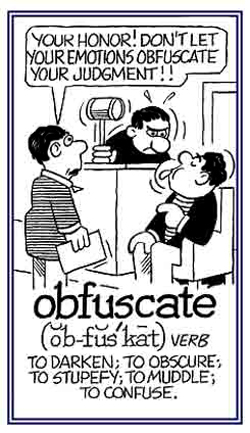
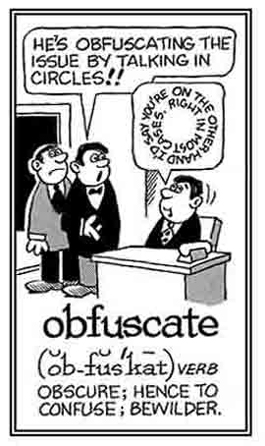
1. To confuse, to bewilder, or to stupefy: A person's mind may be obfuscated by liquor.
2. To darken, to make obscure, or to make something more difficult to understand: Bill tried to obfuscate his drunken driving with extraneous information about taking medication; however, the odor of alcohol on his breath was not obfuscating his real condition.
© ALL rights are reserved.
© ALL rights are reserved.
Go to this Word A Day Revisited Index
2. To darken, to make obscure, or to make something more difficult to understand: Bill tried to obfuscate his drunken driving with extraneous information about taking medication; however, the odor of alcohol on his breath was not obfuscating his real condition.
Politicians tend to keep obfuscating issues in an attempt to satisfy the various viewpoints of their political parties.
3. Etymology: from Latin obfuscatus and obfuscare, "to darken," from ob, "over" + fuscare, "to make dark"; from fuscus, "dark".
Go to this Word A Day Revisited Index
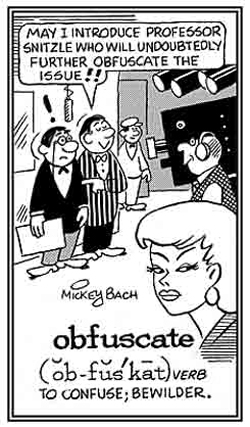
so you can see more Mickey Bach illustrations.
obscure (verb), obscures; obscured; obscuring
1. To conceal by confusing the meaning of a statement, a poem, etc.: Timmy, the suspect, tried to obscure the case that was brought against him by the police.
2. To make dark, dim, or indistinct: The sun was obscured by the storm clouds.
3. To make less visible, to hide; prevent from being seen or heard: Since those two new skyscrapers were built, they have obscured the view that the Jone's family once had from their apartment.
4. To intentionally make something difficult to understand or to know: Mr. Jackson, the car manufacturer, was accused of trying to obscure the fact that his company's air bags were not functioning properly because they were exploding and causing numerous deaths.
5. Etymology: from Latin obscurus, "dark, unknown"; literally, "covered over" from the base scurus, "covered over".
2. To make dark, dim, or indistinct: The sun was obscured by the storm clouds.
3. To make less visible, to hide; prevent from being seen or heard: Since those two new skyscrapers were built, they have obscured the view that the Jone's family once had from their apartment.
4. To intentionally make something difficult to understand or to know: Mr. Jackson, the car manufacturer, was accused of trying to obscure the fact that his company's air bags were not functioning properly because they were exploding and causing numerous deaths.
5. Etymology: from Latin obscurus, "dark, unknown"; literally, "covered over" from the base scurus, "covered over".
<img src="/img/left_arrow_sm.gif" alt="" /> <img src="/img/right_arrow_sm.gif" alt="" />
Showing 1 page of 2 main-word entries or main-word-entry groups.