
ob-2 +
(Latin: against)
Before c, ob- becomes oc-; before f, ob- becomes of-; before g, ob- becomes og-; before p, ob- becomes op-; before m, ob- becomes o-
Trina's obdurate little girl refused to eat her vegetables at dinner.
2. Hardened in feelings or heart; not repentant: Bob's cousin was an obdurate criminal who refused to change his ways.3. Etymology: from Latin ob-, "against" + durus, "hard", therefore "hardened against".
The Latin durus, "hard", has also given English such words as "durable" and "duration" (the period of time during which anything is hard enough to last), and "duress" (hard treatment, or coercion, which forces a person to do something even when he or she doesn't want to do it).
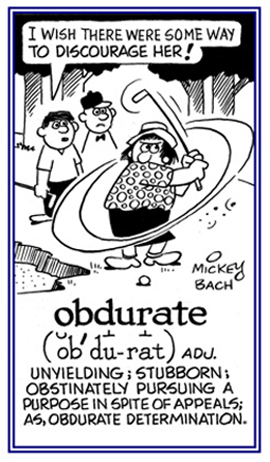
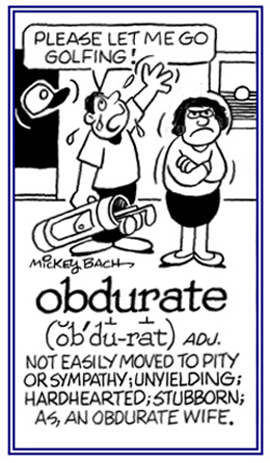
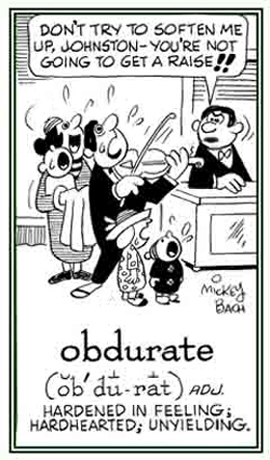
Go to this Word A Day Revisited Index
so you can see more Mickey Bach illustrations.
2. To express or feel disapproval, dislike, or distaste; be averse to.
3. To refuse or attempt to refuse to permit some action, speech, etc.
4. Anything that is visible or tangible and is relatively stable in form.
2. A thing, person, or matter to which thought or action is directed: "It was an object of medical investigation."
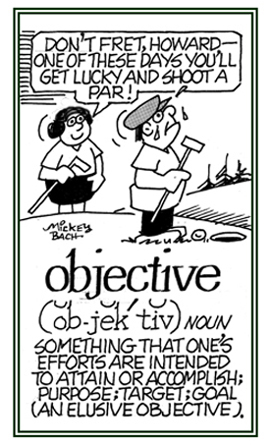
3. The end toward which effort or action is directed; a goal; a purpose: "Profit is the object of any business."
2. The act of objecting.
3. A ground or cause for objecting.
4. A feeling of disapproval, dislike, or disagreement.
The objective of the recent fund-raising drive was to help the hurricane victims.
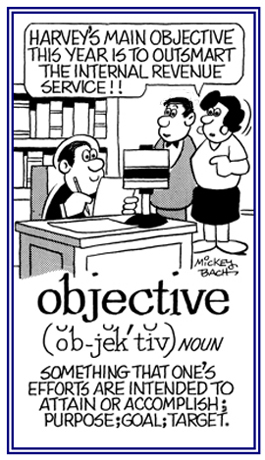
Go to this Word A Day Revisited Index
so you can see more of Mickey Bach's cartoons.
2. Evil-speaking directed against a person or thing; abuse, detraction, calumny, or slander: The newspapers engaged in vicious obloquies against the corrupt city official.
3. Evil reputation, bad repute; a disgrace: The gangster tried to make up for his history of obloquies by donating great sums of money to charities.
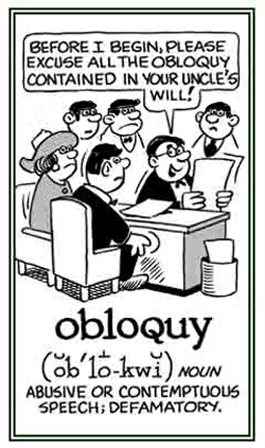
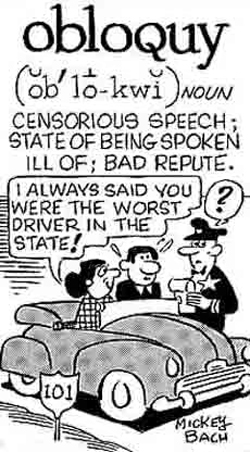
Go to this Word A Day Revisited Index
so you can see more Mickey Bach illustrations.
2. Annoying or objectionable due to being a showoff or attracting undue attention to oneself: Brian's little boy was an obnoxious little brat.
3. Etymology: from Latin obnoxius, "exposed to harm" was the original meaning of obnoxious in English, in the sixteenth century.
The current meaning dates from the seventeenth century, and came to develop its sense because of its association with noxious so that for a time it actually meant "harmful", as noxious does.
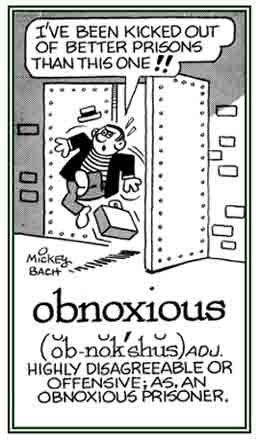
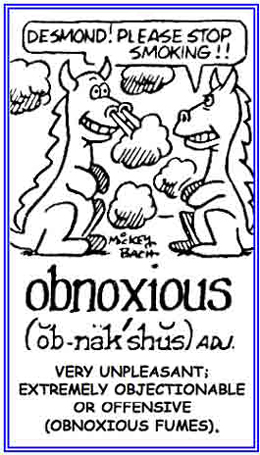
Go to this Word A Day Revisited Index
so you can see more of Mickey Bach's cartoons.
"Whatever people in general do not understand, they are always prepared to dislike; the incomprehensible is always the obnoxious."
2. To occupy someone's thoughts constantly, compulsively, and exclusively: The desire for revenge about the way she was treated so badly by her fellow workers obsessed Marge's sister for a long time.
3. Etymology: from Latin obsessus, past participle of obsidere, "to besiege, to occupy". Literally, "to sit opposite to", from ob, "against" + sedere "to sit".
Of evil spirits, "to haunt", is from 1540. Obsession was originally (1513), "the act of besieging", then "hostile action of the devil or an evil spirit" (1605). The meaning "persistent influence or idea" is first recorded in 1680.
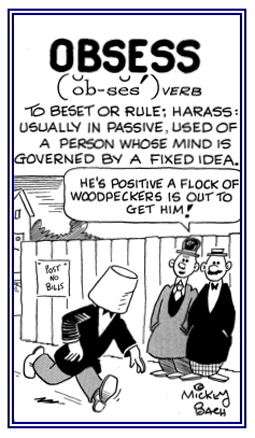
Go to this Word A Day Revisited Index
so you can see more of Mickey Bach's cartoons.
2. To impede, to retard, or to interfere with; to hinder: "A lack of money obstructed the project."
3. To be in the way and to prevent a clear view of something: "A big spectator obstructed our view of the stage."
4. Etymology: from the Latin prefix ob-, "before" + struere, "to build, to pile up"; hence, to build or to pile up an obstacle in front of something.
2. To render unnecessary: to eliminate the risk of serious injury: Jack decided to obviate the problem of a plague of insects in his kitchen by keeping it as clean as possible!
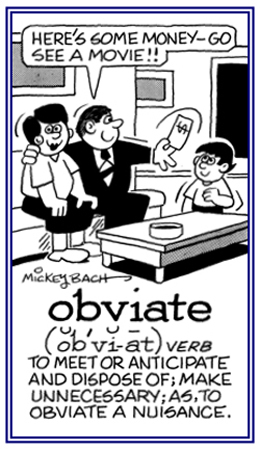
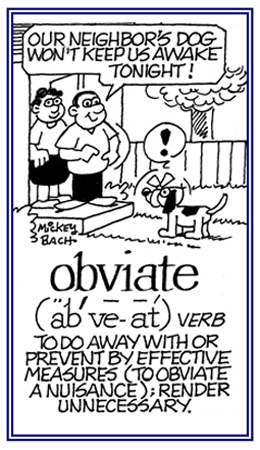
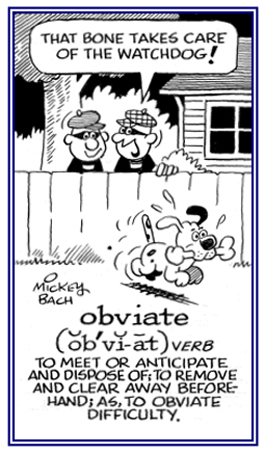
Go to this Word A Day Revisited Index
so you can see more of Mickey Bach's cartoons.
2. Eeasily perceived by the senses or grasped by the mind.
2. To stand in the way of; to hinder; to obstruct: The change is opposed by many of the town's business leaders.
3. To set as an obstacle or an adversary: Sharon met the candidate who will be opposing her in the next election.
4. To be hostile or adverse to, as in opinion: Henry strongly opposed the resolution in the proposal to increase local taxes.
5. To determine as an impediment or a hindrance: The group that opposes the mayor is trying to find a candidate who might be able to successfully oppose her in the upcoming election.
