
ob-1
(Latin: toward, to, before)
Before c, ob- becomes oc-; before f, ob- becomes of-; before g, ob- becomes og-; before p, ob- becomes op-; before m, ob- becomes o-
oblige (verb), obliges; obliged; obliging
1. To require or constrain, as by law, command, conscience, or force of necessity.
2. To bind morally or legally, as by a promise or contract.
3. To place under a debt of gratitude for some benefit, favor, or service.
4. Etymology: "to bind by oath", from Old French obligier, from Latin obligare, from ob-, "to" + ligare, "to bind".
2. To bind morally or legally, as by a promise or contract.
3. To place under a debt of gratitude for some benefit, favor, or service.
4. Etymology: "to bind by oath", from Old French obligier, from Latin obligare, from ob-, "to" + ligare, "to bind".
Main modern meaning "to make (someone) indebted by conferring a benefit or kindness" is from 1567; be obliged, "be bound by ties of gratitude" is from 1548. Obliging, "willing to do service or favors" is from 1632.
obsequious (adjective), more obsequious, most obsequious
1. Characterized by someone who is excessively obedient or who is too willing to comply with the wishes of other people: Jane and Jim were served in the hotel by obsequious employees who were striving to fulfill all the desires that they indicated.
2. A reference to those who are overly eager to help or to obey anyone who is important or well-known: The famous singer was surrounded by obsequious fans who were willing to do almost anything that she wanted them to accomplish.
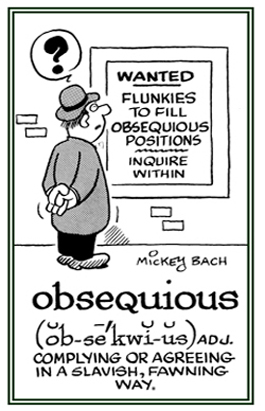
© ALL rights are reserved.
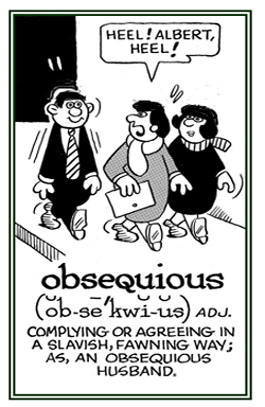
© ALL rights are reserved.
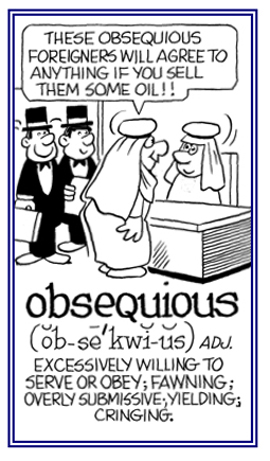
© ALL rights are reserved.
Go to this Word A Day Revisited Index
2. A reference to those who are overly eager to help or to obey anyone who is important or well-known: The famous singer was surrounded by obsequious fans who were willing to do almost anything that she wanted them to accomplish.
Go to this Word A Day Revisited Index
so you can see more of Mickey Bach's cartoons.
1. The branch of medical science concerned with pregnancy and childbirth: Grace decided she wanted to become a midwife and so she centered her studies on obstetrics and gynaecology.
2. Etymology: from about 1819, from obstetric, 1742; from Modern Latin obstetricus, "pertaining to a midwife"; from obstetrix (genitive of obstetricis), "midwife". Literally, "one who stands opposite (the woman giving birth)"; from obstare, "to stand opposite to".
2. Etymology: from about 1819, from obstetric, 1742; from Modern Latin obstetricus, "pertaining to a midwife"; from obstetrix (genitive of obstetricis), "midwife". Literally, "one who stands opposite (the woman giving birth)"; from obstare, "to stand opposite to".
obverse (adjective) (not comparable)
1. The side of a coin, medal, flag, etc., that bears the principal design (opposed to reverse).
2. The front or principal surface of anything.
3. A counterpart.
4. Facing or turned toward the observer: "The obverse side of a statue."
2. The front or principal surface of anything.
3. A counterpart.
4. Facing or turned toward the observer: "The obverse side of a statue."
obvert (verb), obverts; obverted; obverting
To turn something so in order to show a different surface.
1. The act of giving a person, or people, the opportunity to accept something: James received a job offer to work with a computer company as a programmer.
2. An amount of money which someone is willing to pay for something: Roland decided to wait for a better offer for his newly constructed house.
3. An opportunity to buy something at a price that is lower than it usually is: The store said that there was a special offer for the items which is good only while they last.
2. An amount of money which someone is willing to pay for something: Roland decided to wait for a better offer for his newly constructed house.
3. An opportunity to buy something at a price that is lower than it usually is: The store said that there was a special offer for the items which is good only while they last.
offer (verb), offers; offered; offering
1. To give someone an opportunity to accept or to take something: Sharon was offered a job in the bank; for which she was very grateful.
3. To say or to express something as an idea to be thought about or to be considered: Mr. X, the author of the book, offers another possible explanation for the economic situations that exist today.
4. To say or to give something; such as, a prayer, or a sacrifice, as a form of religious worship: The minister, Mr. Lacy, asked his congregation to bow their heads and to offer a prayer of thanks to God.
5. Etymology: from Old English ofrian, "to offer, to show, to exhibit, to sacrifice, to bring an oblation"; from Latin offerre, "to present, to bestow, to bring before"; in Late Latin, "to present in worship"; from ob "to" + ferre, "to bring, to carry".
The insurance company was offering John and his wife Susan, the victims of the car accident, a significant sum of money as compensation for their injuries.
2. To make something available or to provide and to supply something: When James and Jane were tourists in New York, they couldn't find their way back to their hotel; so, a man offered to help them.3. To say or to express something as an idea to be thought about or to be considered: Mr. X, the author of the book, offers another possible explanation for the economic situations that exist today.
4. To say or to give something; such as, a prayer, or a sacrifice, as a form of religious worship: The minister, Mr. Lacy, asked his congregation to bow their heads and to offer a prayer of thanks to God.
5. Etymology: from Old English ofrian, "to offer, to show, to exhibit, to sacrifice, to bring an oblation"; from Latin offerre, "to present, to bestow, to bring before"; in Late Latin, "to present in worship"; from ob "to" + ferre, "to bring, to carry".
1. Money that members of a congregation donate during their religious services: Leonora made her regular financial offering each Sunday as a regular contribution to support the needs of her church.
2. Something that is proposed or suggested during the course of a meeting or negotiation: The union member's offering for a wage increase was being considered by the management.
2. Something that is proposed or suggested during the course of a meeting or negotiation: The union member's offering for a wage increase was being considered by the management.
1. Part of a religious service in some Christian churches during which the officiating individual may invite the attendees to eat and to drink bread and wine, often accompanied by prayers and music: Sister Katherine knelt by the altar to participate in the offertory.
2. Music that is presented during church services: The offertory, which was being played on the organ, was inspirational and caused Janson to smile with happiness.
2. Music that is presented during church services: The offertory, which was being played on the organ, was inspirational and caused Janson to smile with happiness.
<img src="/img/left_arrow_sm.gif" alt="" /> <img src="/img/right_arrow_sm.gif" alt="" />
Showing 1 page of 9 main-word entries or main-word-entry groups.