
Zoopraxography
(origin and background of the study of animals in motion)
Source of the word zoopraxography
The creation of this word is credited to Eadweard Muybridge in his photographic studies of animals in which he mapped animal movement by developing time-lapse series photography, which itself led to the development of motion pictures. At any rate, there is a book titled: Descriptive Zoopraxography or the Science of Animal Locomotion by Eadweard Muybridge, University of Pennsylvania; Philadelphia, 1893.
The book was published to commemorate a course of two lectures delivered by Muybridge at the University of Pennsylvania and illustrated with engravings of athletes and animals running, jumping etc.
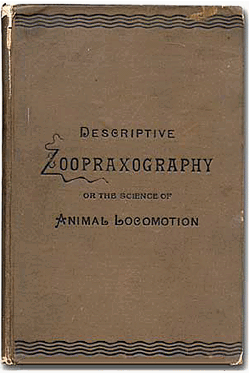
This volume reproduced on several preliminary pages the signatures of those who originally subscribed to the author's landmark work of animal locomotion. Muybridge's history of his own photographic studies of animal movement, which he initiated at the behest of Governor Leland Stanford, who wanted to win a bet as to whether all four of a horse's feet were off the ground while trotting.
Muybridge, a government photographer assigned to the Pacific Coast, ingeniously set up a track with a series of still cameras along the edge, with their shutters attached to strings. As the horse ran past, each string would break, releasing the shutter.
Governor Stanford, of California, won the $25,000 bet, but more importantly, Muybridge further refined his technique for capturing and displaying motion through photography, working from 1884 through 1887 at the University of Pennsylvania. In addition to providing this crucial link between still photography and motion pictures, Muybridge actively promoted this new technology through lecture tours and commercial offerings.
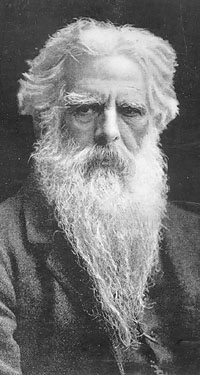
With the financial backing of Stanford, Muybridge obtained more action photographs of animals culminating in the publication of The Horse in Motion (1877) and The Attitudes of Animals in Motion, A Series of Photographs Illustrating the Consecutive Positions Assumed by Animals in Performing Various Movements (1878). In 1878, Scientific American and La Nature published reproductions of photographs in the Horse in Motion.
Subscribers were able to place these reproductions in their zoetrope to view the stop motion photographs in rapid succession. Muybridge took the animating capability of the zoetrope further by inventing the zoopraxiscope in 1879.
The zoopraxiscope projected images of slides placed on a large disk onto a screen. Muybridge spent most of 1881-1882 in Paris and London exhibiting the zoopraxiscope and lecturing on animal motion.
Different zoopraxography styles
Zoopraxography is the study of the way quadrupeds move because quadrupeds have many unique methods of motion.
- The movement of an elephant is called the "lateral couplet walk" in which it moves its hind left leg, its front left leg, its hind right leg, then its front right leg.
- The "trot" is a movement in which the front left and hind right legs move in tandem followed by the front right and hind left legs.
- An animal like the giraffe uses the "pace" in which both left legs move and both right legs follow.
- The rabbit uses a "half bound" in which the front legs move left then right before the hind legs jump together.
- The "bound" is a movement of a squirrel where the front legs jump followed by the hind legs.
- Then there is the "pronk" which is used by the gazelle when all four legs leave the ground simultaneously in its jumping action.
 Here is a unit of hundreds of zoo-, -zoan words and definitions that can expand your word knowledge of animals.