
plag-, plagu-, plague-
(Greek > Latin: strike, stroke, blow, wound; beat the chest; lament loudly [while beating the chest]; pestilence)
Bubonic plague usually starts one to five days after infection with a fever, shivering, and a severe headache.
Sometimes, septicemia (blood poisoning) is an early complication and it may cause death before other signs of the disease appear.
The plague may have three clinical forms: bubonic, pneumonic (pneumonia), or septicemic (blood poisoning). The misleading use of the word bubonic (which means that it is characterized by buboes, or inflammatory swellings of lymph nodes) has developed into the mistaken idea that the real plague is necessarily bubonic and that non-bubonic types are a different disease altogether.
The mild forms of plague infections are bubonic while the other forms are severe and almost always fatal, unless properly treated; and the bubonic plague consists of about three-fourths of the total kinds of plague cases.
2. An acute ailment of rodents due to the bacterium, "Yersinia pestis", transmitted to humans through the bite of infected fleas, or by inhalation: The epidemiologist, Dr. Robinson, was trying to find a way to restrict the plague in the rural areas of the country.
3. Any widespread affliction, calamity, or evil; especially, one regarded as a direct punishment by God: The medieval peasants were often afraid of plagues of war and desolations.
4. Any cause of trouble, annoyance, or vexation: Uninvited guests, especially relatives, are sometimes considered to be a plague by Tom and June White.
More Details about Plagues
A plague is a serious infectious disease which primarily affects rodents; however, it is also transmissible to humans by the bites of rodent fleas.
Plagues have been a scourge to people since early history. One of the largest pandemics (world-wide epidemics) was the "black death" of the 14th century, which killed an estimated 25 million people in Europe alone.
Today, the human plague occurs sporadically in various parts of the world (including the U.S.), but it can be treated with antibiotics.
The bacterium responsible for the disease, yersinia pestis, circulates among rodents and their fleas in many parts of the world. The great pandemics of the past were caused by the spread of the plague from wild rodents to rats in cities and then to humans (via rat fleas) when the rats died.
The designated countries were plagued by widespread fraud, corruption and organized crime.
2. To annoy, bother, or pester: Locusts plagued the farmers as their crops disappeared.3. To smite or attack with pestilence, death, etc.; a scourge: The mosquitoes were beginning to plague the low lying towns, bringing illness and misery.
4. To cause an epidemic in or among men, women and children: The doctors were afraid that smallpox would begin to plague the rural communities if the medicines were not distributed immediately.
5. To afflict with any kind of evil: Henry was plagued by allergies that caused his skin to itch all his life.
6. Etymology: "affliction, calamity, evil, scourge"; also, "malignant disease", from Middle French plague, from Late Latin plaga, used in the Vulgate for "pestilence"; from Latin plaga, "stroke, wound"; probably from the root of plangere, "to strike, to lament (by beating the breast)".
The meaning of an epidemic disease that causes many deaths was first recorded in 1548-49, in the Book of Common Prayer, where the introduction of the spelling plague was first found.
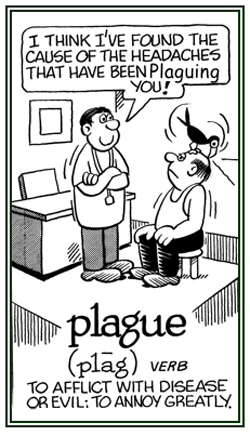
Go to this Word A Day Revisited Index
so you can see more of Mickey Bach's cartoons.
Ants are often plaguers of those who go on picnics.
2. Causing irritation or annoyance: Henry was tapping an annoying plaguey rhythm on his glass with his fork.
Aircraft noise is a particularly plaguey irritation for those who live near an airport.
One of the most plaguey insects are mosquitoes.
Some people have to put up with plaguey swarms of pestering gnats.
3. In a disagreeable manner: Shirley went home sweating and complained that the plaguey temperature was too hot today!2. In a manner to vex, to harass, or to embarrass: The politician was accused of being plaguily dishonest and telling lies, of which very few people believed or were willing to consider.
2. A reference to something that causes a strong irritation or an unpleasant condition: This room is just too plaguy cold in this winter weather.
2. Etymology: from late Latin plangere, "to strike, to beat one's breast, or to lament"; also, from Anglo French plaint, "lamentation".

Go to this Word A Day Revisited Index
so you can see more of Mickey Bach's cartoons.
2. Etymology: from Latin planctus, "lamentation"; from plangere, "to lament, to beat the chest".
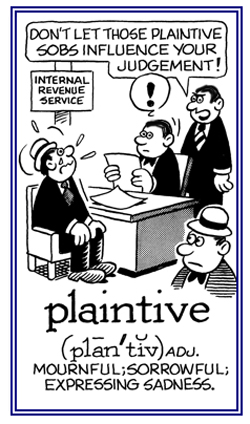
Go to this Word A Day Revisited Index
so you can see more of Mickey Bach's cartoons.
In pneumonic plague, there is severe coughing that produces a bloody, frothy sputum (a thick unpleasant substance that is produced in the throat and lungs when someone has an infection) and there is also labored or very difficult breathing that exists for the person.
Death is almost inevitable unless the pneumonic plague is diagnosed and treated early.