
gods and goddesses from Greek and Latin Myths
(mythology for all seasons)
Greek and Roman gods
Knowledge about Greek deities came primarily from Greek drama and the epic verse that was performed at public festivals. The most significant early epics about the Olympian gods were composed about the eighth century B.C. Centuries before the conquest of Greece in 146 A.D., the Romans had adopted many of the Greek gods to supplement their own rather insignificant, formless pantheon of divinities.
The Romans didn't stop at importing Greek gods; in fact, they adopted the gods and goddesses of several of the other people that they conquered.
Latin: Ceres (goddess)
Goddess of agriculture. Symbols: sheaf of wheat, poppies, and the cornucopia (the horn of peace and plenty).
Latin: Fortuna (goddess)
Latin: Vertumnus (goddess)
Odysseus, was the main character in Homer's epic poem, the Odyssey, and he played a key role in the Iliad. He is known for his guile and resourcefulness, and was most famous for the ten years it took him to return home after the Trojan War.
In Greek mythology, Circe or Kírkē (Greek Κίρκη) was a goddess (or sometimes a nymph or a sorceress) living on the island of Aeaea.
Circe invited Odysseus' crew to a feast, but the food was laced with one of her magical potions, and she turned them all into pigs with a wand after they gorged themselves on the food.
Only Eurylochus, suspecting treachery from the beginning, escaped to warn Odysseus and the others who had stayed behind at the ships.
Odysseus went to rescue his men, but was intercepted by Hermes and told to procure some of the herb moly to protect him from the same fate as his men.
When Circe's magic failed, Odysseus was able to force her to return his men back into their human forms.
Later Circe fell in love with Odysseus and assisted him in his quest to reach his home after he and his crew spent a year with her on her island during which Odysseus and Circe made love in her "flawless bed of love".

Go to this Word A Day Revisited Index
so you can see more of Mickey Bach's cartoons.
When not capitalized, circe (s) and circes (pl) are common nouns.
Such nouns refer to an enchanting, bewitching, and a captivating woman, or women; as, indicated in the cartoon shown above as "a dangerously or irresistibly fascinating woman".
Latin: Aurora (goddess)
Latin: Mors (god)
Latin: (no equivalent)
Latin: Tellus (goddess)
Latin: Faunus (god)
The god of nature. Symbols: goats and satyrs.
Latin: Vulcan (god)
The god of fire and of workers in metal. Symbols: anvil and forge.
Latin: Flora (goddess)
Latin: Pomona (goddess)
Latin: (no equivalent)
Various spellings: Hygeia, Hygea, Hygia; personification of health and healthy. We now have the derived word hygiene, the science of health, pertaining to health, healthful, living well; the science that deals with the upkeep of health; system of principles or rules for preserving and/or promoting health.
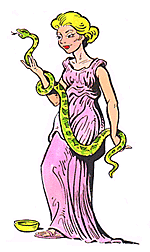
Latin: Vesta (goddess)
Goddess of hearth and home. Symbols: the hearth fire.
Winners of the Ancient Olympic events visited the Temple of Zeus to sacrifice to the gods, and half of every animal was delivered to the priests to be prepared for the Olympic feast. That feast, held on the third day of the Games, was marked by a procession. Priests scooped up glowing embers from the fire of Hestia, goddess of the hearth, then carried those embers past spectators singing a hymn to Zeus. Arriving at the Temple of Zeus, the priests mounted the steps and lit the fire in the altar with the embers. There, the priests slaughtered and sacrificed 100 bulls—one at a time—after which the feasting began.

The Olympic flame is one of the most visible symbols of the modern games. It is a tradition from ancient Greece. During the ancient Games, in Olympia, a sacred flame ignited by the sun burned continually on the altar of the goddess, Hera.
The modern Olympic flame was first seen in the 1928 Amsterdam Olympics where it burned constantly throughout the games. The Olympic flame symbolises purity, the endeavour for perfection, and the struggle for victory. It also represents peace and friendship.
The tradition of the Modern Olympic Torch began in 1936 at the Berlin Games, to represent a link between the ancient and modern Olympics, and has since remained as an Olympic custom.
In 2004, the torch was ignited, as it was in ancient times, by the sun at Olympia, Greece; and then passed from runner to runner in a relay to the host city. There it was used to light a flame in a cauldron at the Olympic Stadium during the opening ceremony. The flame burned continuously throughout the Games and was extinguished at the closing ceremony.
Latin: Justitia (goddess)
 The mythico- words unit.
A cross reference of word units that are related, directly or indirectly, to the: "moon": Calendar, Moon Facts; Chemical Element: selenium; luna, luni-; Luna, the earth moon; menisc-; meno-; Planets in Motion; plano-; seleno-.
