
Hands: Mechanical Marvels
(a personal presentation by a pair of hands)
Vital Assets in a Body's Existence
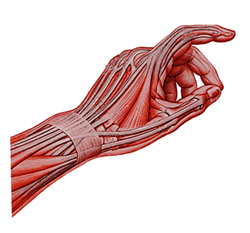
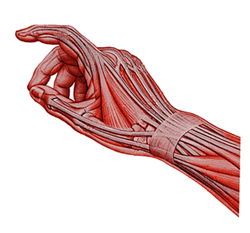
Sinistro Cheiro and Dextro Manual want everyone to know more about their contributions to the successful functions of our bodies!
Together, we hands make a team or we can even work individually. We are appearing without our epidermal covering so you can have a better understanding of our structure and functions. Don't try to do this with your hands. It should be enough for us to show you what we look like under the skin.
If you are a human being with "normal" physical appendages and functions, we are representing your hands; regardless of gender, race, nationality, or chronological existence (age, that is).
We are so sensitive that we can perform brain surgery (with proper medical training), and we are so strong that one of us can twist a screw deep into wood with a little support from the other partner; or working together, we can pick up heavy bags, sew minute threads into cloth, button clothes, tie shoe laces, type on a computer key board, and even quickly manipulate computer-game control mechanisims; plus many other functions.
Our Physical Characteristics
Under our palms, we have five cylinder-shaped metacarpal bones, which extend from our wrist areas to our knuckles. From the metacarpals rise the finger bones; the fourteen jointed, flexible phalanges. In all, there are 27 bones in each of us and the bridges between us and the forearms are the wrists, each of which have collectons of eight small bones fitted together in a glove-like structure of strong ligaments.
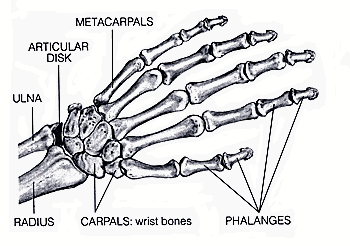
The medical name for the "thumb" is polex which means "strong" in Latin. The "pinky", or little finger, is minimus, meaning "least". The ring finger is annulary for "ring". Not surprisingly, the middle finger is medius, meaning "middle". Next is the index finger, which is Latin for "pointer".
Each finger bone is called a phalanx (plural: phalanges) perhaps because it reminded someone of the soldiers that made up the most effective formation in warfare, the Greek phalanx.
Our fingers, or digits, are controlled primarily by strong muscles in the body's forearms. These muscles connect with tendons, which are on our palm sides, and are embedded in long sheaths that extend along each finger. When the forearm muscles contract, they tug on the tendons and their sheaths, and the fingers bend as directed by the control center in the head.
The thumbs contribute to our flexibility as hands because they are opposed in positions to the other fingers, which means we can easily grip a small object between one of our thumbs and index fingers and pick it up. Since our thumbs have two separate flexor muscles that move the thumb in opposition they also make grasping easier to accomplish. Try to do that with any of the other two fingers on either one or the other of us. No cheating, we didn't say with a finger from each of us. Just try to pick up a small pin with the middle and index finger, for example, with just one of us.
The Hands Speak Out
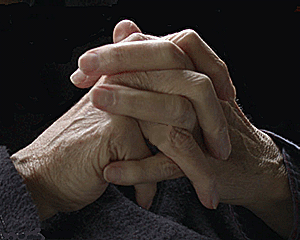
We can't initiate chemical miracles like the liver, or direct the electrochemical performances as done by the brain, and in fact we are managed by that central computer you call the brain. We exist as important mechanical entities of wondrous levers, hinges, and power sources usually ready to obey the commands sent to us.
Someone has described us as versatile, tireless, swift, and essential for so many operations that make it possible for people to exist and to enjoy their lives. Of course, we can also be directed to function in many destructive ways, but it entirely depends on what the incorporated computer of the body instructs us to do whether it be for good or for evil.
If you continue reading, we will list some of the functions we are equipped to perform under "normal conditions" just so you can appreciate our contributions to your well being:
- The area of the brain that is reserved for any body part indicates how important that element is to the over all functioning of that body.
- We hands have two of the biggest spaces in the area of the brain known as the "motor cortex".
- Thousands of messages from the brain are utilized for the simple act of rotating our thumb parts.
- This one activity requires thousands of messages which direct this muscle to contract, that one to relax; thus causing this tendon to pull and that one to rest.
- Every activity of any of the digits requires coordinations via the nerves and muscles which people can't even begin to realize.
- During the lives of most people, we and our fellow armies of hands will extend and flex finger joints at least 25 million times.
- Legs, arms, shoulders, feet, and other parts of the body experience fatigue because of extensive activities, but how often do bodies complain about tired hands?
- We hands can substitute for eyes to some degree; for example, if our body is deaf, we can "speak" by using sign language.
- Structurally, we are the most intricate components of our body.
- In no other part of the body is so much machinery packed into so small a space.
- We each have eight wrist bones, five bones in each of our palms, fourteen in each of our digits for a total of twenty-seven. Added together, we have more than a fourth of the bones in our body.
- Our supply of nerves to detect heat, touch, and pain is one of the most elaborate in the body.
- We have thousands of nerve endings per square inch, most heavily concentrated in our fingertips.
- Sensitivity in these areas allows our body to feel around in the dark and to do a thousand other things that it considers commonplace instead of recognizing them as true wonders.
- Since we play a part in just about everything our body does, it should be no surprise that we are involved in a significant number of accidents that happen to the body.
- Our fingers are burned, mashed, pinched, cut, and bruised. We are infected by fungus infections, dermatitis, psoriasis, and allergies.
- Our tendons can be pulled and torn and our muscles may go into spasms. Arthritis and many other diseases can attack our joints.
- Our movements are accomplished by two sets of muscles and tendons: the flexors, for bending the fingers and thumb, and the extensors, for straightening out the digits.
- The flexor muscles are located on the underside of the forearm and are attached by tendons to the phalanges of our fingers. The extensor muscles are on the back of the forearm and are similarly connected.
- If something is physically wrong with us, there are skilled hand specialists who are partly plastic surgeons, partly orthopedists, partly neurosurgeons, and partly vascular specialists who can fashion a cosmetically acceptable and satisfactorily workable replacement for us.
- Most of the people who have us become fully aware of our real importance only when something goes wrong! Instead, both of us should be regarded as the remarkably sophisticated and indispensable parts of body machinery that we are.
- Appreciate the wonderful mechanism and value of your hands!
Related "hand" units: cheiro-, chiro-; Dextro and Sinsitro History; Hands as Objects of Art; manu-; palm.