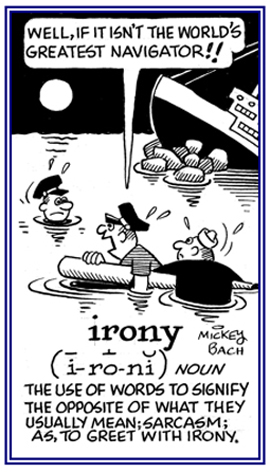
iron-, ironi-
(Greek > Latin > Old French > French: pretended ignorance; saying the opposite of what a person really means)
From Greek eironeia to Latin ironia to Old French to French ironie which signified "deliberately pretending ignorance, particularly as a rhetorical device to get the better of one's opponent in an argument".
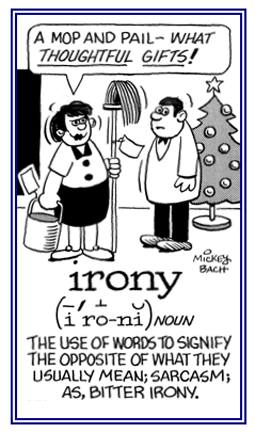
Go to this Word A Day Revisited Index
so you can see more of Mickey Bach's cartoons.
2. Description of the outcome of events contrary to what was, or might have been, expected: Jill thought it was ironic that computers break down so often since they are supposed to be a faster way of getting written materials completed.
The news article Hank was reading described the ironic crashing of the robber's car into a police station.
It was an ironic turn of events when Bessie and Bert became close friends after their marital divorce.
Irony differs from deception in that the ironist intends for the listener to reconstruct his or her attitude from the ironic words that are spoken.
It has long been noted that ironic statements are frequently spoken with a marked intonation, often termed "the ironic tone of voice".
It is ironic luck when a man gets wonderful poker hands when he plays bridge.
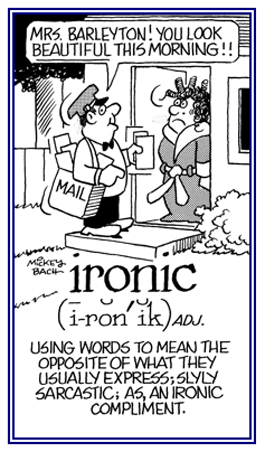
Go to this Word A Day Revisited Index
so you can see more of Mickey Bach's cartoons.
Lee made an ironical statement when he said: "It's raining cats and dogs, but it's lovely weather we're having, isn't it?"
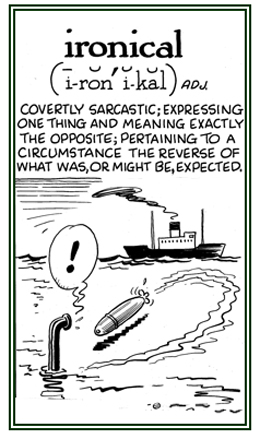
Go to this Word A Day Revisited Index
so you can see more of Mickey Bach's cartoons.
One ironically disturbing experience was when my neighbor Alfred, who had been poor all his life, inherited a fortune after becoming too old and too ill to enjoy it. Such a situation may be characterized as "the irony of fate", or "one of life's little ironies" and here the word "little" is itself being used ironically.
Herbert is an ironist who brushes his teeth with "tongue in cheek".
Ironists are people who strike when the irony is hot.
Irony is an insult presented in the form of a compliment.
2. An expression or utterance marked by a deliberate contrast between apparent and intended meaning: Irony is a literary style that employs various contrasts for humorous or rhetorical effects.3. Something that happens that is inconsistent with what might be expected to happen; especially, when this seems absurd or laughable: It was with a sense of irony that Richard turned down the job that he was striving so hard and for so long to obtain.
What irony to be offered three jobs after having been turned down every time for over two months.
Irony is an expression of something which is contrary to the intended meaning; the words say one thing but mean something else. Here is a classical example of an ironic statement as seen in William Shakespeare's Julius Caesar when Mark Antony ironically stated: "Yet Brutus says he was ambitious; And Brutus is an honorable man."
Irony is saving something for many years and then getting rid of it just before it is needed.