
muse
(Latin: musum, "muzzle, snout"; Old French muser "to meditate, to ponder", perhaps literally "to go around with one's nose in the air" from muse "muzzle, snout")
2. To divert or to please with anything light or cheerful.
3. To amuse someone with an anecdote, by telling him or her a story; to amuse oneself with a puzzle, with, by, or in sketching; to be amused with a toy or whimsical person, by telling a story about an incident.
4. To cause (time) to pass pleasantly, to entertain agreeably; to "beguile", to while away the time, to enliven.
5. Etymology: from Middle French (1400-1600) amuser, "divert, cause to muse;" from à, "at, to" + muser, "ponder, stare fixedly".
The current meaning "divert, entertain" did not emerge into usage until the 17th century, and the most common application of the verb in the 17th and 18th centuries was to "deceive, cheat". Such meanings seem to have developed from an earlier "bewilder, puzzle", and pointed back to an original sense of "make someone stare open-mouthed". This is thought to link with the probable source of muser, namely muse, an "animal's mouth", from medieval Latin musum from which the English word muzzle came.
Everyone should keep in mind that there is no connection with this muse and the mythological muse from which music and museum are derived.
The sense of "divert from serious business, tickle the fancy of" is recorded from 1631, but through the 18th century, the primary meaning was "deceive, cheat" by first occupying the attention of a person, or people.
2. Passing from an idle time-wasting diversion, or entertainment.
3. Recreation, relaxation, the pleasurable action upon the mind of anything light and cheerful.
4. Pleasant excitement of the risible faculty by anything droll or grotesque, tickling of the fancy.
5. Anything which lightly and pleasantly diverts the attention, or beguiles the time; a pastime, a play, a game, or a form of recreation.
2. In the past, someone who put people in a muse; that which arrests or distracts attention; especially, with trifling or insignificant things.
3. A person who trifles with people's attention or expectations; a deceiver or a cheater.
2. Relating to engaging the attention of someone.
3. Pertaining to tickling someone's fancy or causing exciting laughter.
2. To cause to be emotionally confused or to put into a stupid stare, to stupefy: Since Mildred usually appeared to have an opinion about everything, her silence on this particular subject bemused her husband.
3. To cause someone to be preoccupied or lost in thought: The news about Jim's ex-wife getting married again bemused her former husband.
Since he thought of himself to be an ordinary student, James was bemused by all of the attention that he was getting from the members of the psychology class.
2. Someone or something that provides the enthusiasm and determination for an artist, poet, musician, etc. to create something artistic: When an artist pleonastically asked her husband if she should paint a still life or a portrait, or both of them on the same canvas; his response was, "Are you trying to amuse your muse with redundancy?"
2. To consider or to say thoughtfully: Steve mused that it might take longer to drive than to walk through the park.
3. To think about something in a deep and serious, or dreamy, and abstracted way: Henry mused about the possibility of changing jobs.
4. To say something in a thoughtful or a questioning way: "I think we could sell our house," Lester mused, "but then where would we move to?"
5. To gaze at someone or something thoughtfully or abstractedly: Margaret was musing what her new-born son would grow up to be.
6. Etymology: from Old French muser, "to meditate", and perhaps literally "to go around with one's nose in the air", from muse, "muzzle, snout", from medieval Latin musum source of the English word muzzle.
Muse comes with the meanings of "ponder, meditate," and implies focused attention, but it suggests a less intellectual purpose.
It often implies "absorption" and a "languid turning over of a topic as if in a dream or in some kind of remembrance."
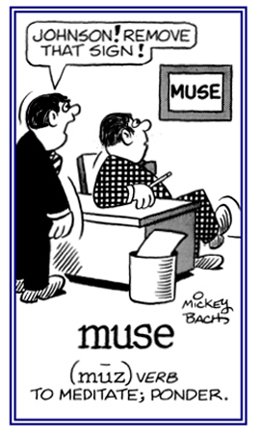
Go to this Word A Day Revisited Index
so you can see more of Mickey Bach's cartoons.
2. To place something over the nose and jaws of an animal; such as, a dog to keep it from biting someone: Owen's dog has a tendency to bite strangers who walk near him, so he needs to be muzzled; in fact, his owner muzzles him whenever he takes him out for a walk.
3. To prevent a person or group from publicly expressing their views or opinions: The company tried to muzzle its employees by forbidding them to speak to the press about the accident.
2. The front open end of the barrel of a firearm.
3. Something that is meant to prevent free expression: To muzzle the press when reporting on a military operation.
4. Etymology: from Middle English mosel, from Old French musel, from Medieval Latin musellum, diminutive of musum, "muzzle, snout".
2. To become weary or to bewilder oneself by excessive thinking: Sometimes Monica overmuses herself and doesn't know what is going on.