
foren-, fore-
(Latin: forensis of a forum, place of assembly; public, public speaking; foras, foranus, outside, residing outside, out of doors)
afforest (verb), afforests; afforested; afforesting
To convert bare or uncultivated land into a forest, originally for the purpose of hunting: Currently ground can be afforested by planting trees, or their seeds, on a big scale for commercial use.
The action or process of planting trees in order to produce a large area covered primarily with woody perennial plants: Money was set aside by the local government for the afforestation of the wasteland in order to make the region available for recreational purposes.
A form of land use in which woody perennials thrive on the same piece of land and are integrated along with conventional harvest-producing plants and livestock: Modern applications of agroforestry is the intentional growing of trees on the identical unit of ground as agricultural crops and with pastures for farm animals that are raised to produce commodities, such as meat, milk, leather, and wool.
coafforest (verb), coafforests; coafforested; coafforesting
To alter, to change, or to make an addition to a woodland: After the fire swept through their area and destroyed half of the pine trees, Tim and his family had to coafforest the area and so they planted many more trees in order to supplement what they had lost.
deforest (verb), deforests; deforested; deforesting
To remove trees from an area of land: The pines were deforested from Tim's neighborhood because a new freeway was to be built there.
disafforest (verb), disafforests; disafforested; disafforesting
To clear a wooded area from a section of land: Because the erection of a shopping center was agreed upon, the ground behind Greg’s house had to be disafforested of most of the trees.
disforest (verb), disforests; disforested; disforesting
To clear or to deprive of the tall woody plants which are perennial, have a main trunk and branches: So that the new residential area could be built, some of the woodland had to be disforested, or stripped of the trees.
The clearance of trees in a certain area: The disforestation of the Amazon rainforest speeded up between 1991 and 2004, causing the remaining forest land to decrease.
foreign (adjective), more foreign, most foreign
1. A reference to being located away from one's native country: Ivan was on a business trip to a foreign nation to arrange the sale of his company's production of children's shoes.
2.Characteristic of being from a location other than the one being considered: It was a foreign custom for a man to kiss a woman's hand when he was introduced to her.
3. Descriptive of being involved with other nations or governments; not domestic: Nancy's company was increasing its foreign trade with France and Germany.
4. Situated in an abnormal or improper place in the body and typically introduced from outside: The doctor said that Sherman had a foreign object in his eye.
5. Subject to the jurisdiction of a different political unit: When Ed decided to stay in Spain longer as a foreign resident, he had to renew his U.S. passport.
6. Etymology: from Latin foras, "outside"; Late Latin foranus, "on the outside"; Old French forain; Middle English foreine.
2.Characteristic of being from a location other than the one being considered: It was a foreign custom for a man to kiss a woman's hand when he was introduced to her.
3. Descriptive of being involved with other nations or governments; not domestic: Nancy's company was increasing its foreign trade with France and Germany.
4. Situated in an abnormal or improper place in the body and typically introduced from outside: The doctor said that Sherman had a foreign object in his eye.
5. Subject to the jurisdiction of a different political unit: When Ed decided to stay in Spain longer as a foreign resident, he had to renew his U.S. passport.
6. Etymology: from Latin foras, "outside"; Late Latin foranus, "on the outside"; Old French forain; Middle English foreine.
1. Someone who is from outside a particular group or community; a stranger: The small group of villagers noticed a foreigner walking along the road past the store.
2. A person who has been born abroad or of another nation; an outlander: Cathy, who was a foreigner visiting in Germany, bought a new car which she planned to ship to her home in Canada.
3. Something produced or brought from a different country: The Volkswagon that James bought was considered to be a foreigner in his hometown in California.
4. Anyone from one nation, parish, etc. living in a different town or country: As a foreigner going to a university in Italy, Mike was learning much more about Rome and its history than he could if he had stayed home in Texas.
2. A person who has been born abroad or of another nation; an outlander: Cathy, who was a foreigner visiting in Germany, bought a new car which she planned to ship to her home in Canada.
3. Something produced or brought from a different country: The Volkswagon that James bought was considered to be a foreigner in his hometown in California.
4. Anyone from one nation, parish, etc. living in a different town or country: As a foreigner going to a university in Italy, Mike was learning much more about Rome and its history than he could if he had stayed home in Texas.
1. The imitation of what is unfamiliar or alien: The foreignism of having Judy’s fake vase on the table was quite strange after viewing the original one in the museum.
2. An idiom, phrase, custom, mannerism, or term imported from overseas: After returning from their trip to England, Jane adopted the foreignism of having tea with crumpets in the afternoon.
2. An idiom, phrase, custom, mannerism, or term imported from overseas: After returning from their trip to England, Jane adopted the foreignism of having tea with crumpets in the afternoon.
foreignize (verb), foreignizes; foreignized; foreignizing
1. To grow or to become unfamiliar; to take after, or to display a resemblance to remote types: The spaghetti sauce that Tim made was foreignized with different spices he had brought back with him from India.
2. To provide from outside; to refashion after external models; to give an exotic air to: The grocery store in Mike's town wanted to foreignize their products with cheeses and wines from Europe.
2. To provide from outside; to refashion after external models; to give an exotic air to: The grocery store in Mike's town wanted to foreignize their products with cheeses and wines from Europe.
forensic (adjective) (not comparable)
1. Relating to the use of scientific knowledge or methods in solving various problems and pertaining to the people who are involved in solving such situations: Examples of forensic procedures or activities include forensic anthropology, forensic dentistry, forensic lawyers, forensic medicine, forensic pathology, etc.
2. Etymology: from Latin forensis a "forum".
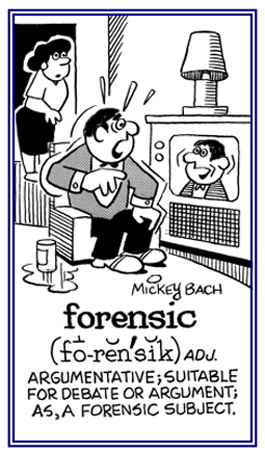
© ALL rights are reserved.
Go to this Word A Day Revisited Index
2. Etymology: from Latin forensis a "forum".
In ancient Rome the forum was a marketplace where people gathered, not just to buy things, but also to conduct all kinds of business, including that of public affairs.
The meaning of forensic later came to be restricted to the courts of law. The word entered English usage in 1659.
Go to this Word A Day Revisited Index
so you can see more of Mickey Bach's cartoons.
The investigation of embezzlement or fraud and the inspection of financial information to use in legal processes: Mr. Smith specialized in forensic accounting in order to prosecute criminals.
The branch of physical studies of humans in which data, criteria, and techniques are used to determine the sex, age, genetic population, or parentage of skeletal or biological materials in questions of civil or criminal law: Forensic anthropology may also help determine the length of life, gender, stature, and unique features of the deceased people from their remains.
