
pedo-, paedo-, ped-, paed-, paido-, paid-
(Greek: child, boy; infant)
The British tend to use paed- while those in the United States tend to use ped-. Remember that the Greek ped- means "child" while the Latin ped- means "foot". Don't confuse this Greek element with another Greek pedo- which means "ground, soil, earth".
Any time a student refers to a teacher as a pedagogue he or she is not suggesting that the teacher has feet which are a foot-and-a-half (sesquipedalian) long.
The Greek ped used in English is a shortened form of the Greek pais (paid-), which means a "child", usually a "boy" because, in old Grecian times, boys were considered "more important" than girls.
Actually, pedagogue means "a child's guide" or "guiding a child". In ancient Athens, the pedagogue was a slave who led his master's children (boys) to school or provided private tutoring. In the U.S., the equivalent of "guiding a child" is now "home schooling". In time, the word became known as a "teacher".
This Greek ped is used primarily in technical terms; such as pedagogics, which refers to the "science of teaching". There is more information about pedoagogue, pedagog on this page.
Another derivative from the Greek ped is a word meaning "education" or the results of "education"; such as, "knowledge" or "learning". The Greek element pedia is found in other Greek words; such as, cyclopedia and encyclopedia, "circles of knowledge".
2. A book containing extensive information about all branches of knowledge: A cyclopedia can give facts about all of the areas of some particular art, science, and can also give detailed and specialized information, all of which are arranged alphabetically.
2. An elaborate and exhaustive repertory of information on all the branches of some particular art or department of knowledge: Albert's teacher told her students that they could find lots of information for their projects in encyclopedias at the local library.
3. Etymology: from Greek egkukiopaideia, "general education"; from egkuklios, "general" + paideia, "education"; from pais, "boy, child"; however, literally "training in a circle" from enkyklios, "circular" + paideia, "education, child-rearing", from pais, "boy, child".
The term encyclopedia is said to be an erroneous form (a false reading) occurring in manuscripts of Quintilian, Pliny, and Galen, for "encyclical education", the circle of arts and sciences considered by the Greeks as essential to a liberal education.
2. Etymology: from Greek hypnos, "sleep" + paideia "child".
2. Etymologe: from Greek meaning "small" and "instruction".
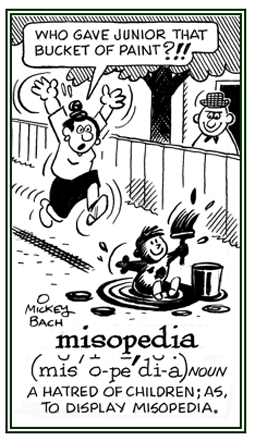
Obviously there are many examples of misopedias taking place in some societies, because every once in a while, there are news reports that reveal information about some adults being prosecuted for not taking care of their children or because they were mistreating them.
Go to this Word A Day Revisited Index
so you can see more of Mickey Bach's cartoons.
2. Concerning a special bed in a ward for those people with disorders of the bones, joints, and associated muscles: An orthopedic bed is normally one individually designed to relieve specific skeletal symptoms and generally with a very firm mattress or board.
It also refers to orthopedic bedding, divan, etc.
3. Pertaining to special footwear designed to ease or to correct deformities of the feet: Dr. Toe told Raymond that he needed orthopedic shoes to relieve pain in his feet and to correct the disorder in his arches.
