
chrono-, chron-
(Greek: time, times; sequence of times)
An instrument for recording the time required for the perception of a painful stimulus: Algesichronometer is a device used to determine the time needed to cause an unpleasant or agonizing effect.
allochronic (adjective), more allochronic, most allochronic
1. Relating to the condition of not being contemporary, or existing at different times: There have been allochronic populations of species living, growing, or reproducing during different seasons of a year.
2. Pertaining to different segments of geologic time: Susie wanted to know what plants occurred in the allochronic periods of the Earth's history.
2. Pertaining to different segments of geologic time: Susie wanted to know what plants occurred in the allochronic periods of the Earth's history.
A form of organic evolution starting from a life-giving reproduction that happens due to a change in time of breeding which lessens or stops gene flow between two groups of a species: Allochronic speciation is the process of developing different biological groups as a result of members of the population that have different breeding seasons or patterns, or differing in the use of time during the day or night, rather than through geographic separation.
anachronic (adjective), more anachronic, most anachronic
Descriptive of things, data, etc. being in the wrong position or order of a date: In the game, the dates of the kings and queens in England were in an anachronic succession which had to be brought into the correct sequence by the players.
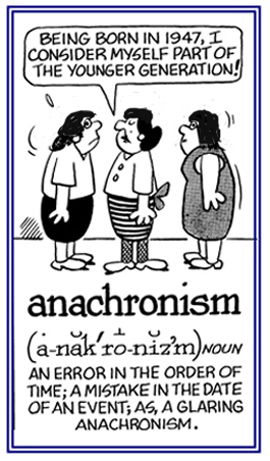
1. An error in computing time, or fixing dates; the erroneous reference of an event, circumstance, or custom to a wrong date: When Jane’s grandmother wanted to use her cell phone at the party, she used the term “to dial”, which was a funny anachronism and everybody laughed at her.
2. Anything done or existing out of date, hence anything that was proper to a former age but is, or if it existed, would be out of harmony with the present: In the novel, which took place in the 16th century, the main character used the term “taboo”, which entered the language much later, an anachronism that the author evidently forgot to delete!
3. A situation which depicts a person or something that is not placed in the correct historical or chronological period, especially a thing or individual that belongs to an earlier age of existence: A portrait of Abraham Lincoln sitting in front of a computer would be an example of an anachronism.
© ALL rights are reserved.
Go to this Word A Day Revisited Index
2. Anything done or existing out of date, hence anything that was proper to a former age but is, or if it existed, would be out of harmony with the present: In the novel, which took place in the 16th century, the main character used the term “taboo”, which entered the language much later, an anachronism that the author evidently forgot to delete!
3. A situation which depicts a person or something that is not placed in the correct historical or chronological period, especially a thing or individual that belongs to an earlier age of existence: A portrait of Abraham Lincoln sitting in front of a computer would be an example of an anachronism.
Go to this Word A Day Revisited Index
so you can see more of Mickey Bach's cartoons.
anachronistic (adjective), more anachronistic, most anachronistic
1. Referring to a wrong time; not applicable to the time: In the video about Shakespeare, the main character looked at his anachronistic digital wrist watch too see what time it was!
2. Pertaining to a person who prefers things of the past: Mr. Jones was quite anachronistic because he wanted to live in a simple way with only candles, a fire in the fireplace, which was also the place to prepare his meals, and a supply of water from a nearby stream. He had no need of a car, a TV, or even a cell phone!
2. Pertaining to a person who prefers things of the past: Mr. Jones was quite anachronistic because he wanted to live in a simple way with only candles, a fire in the fireplace, which was also the place to prepare his meals, and a supply of water from a nearby stream. He had no need of a car, a TV, or even a cell phone!
anachronize (verb), anachronizes; anachronized; anachronizing
To put something into a wrong chronological position: The murderer changed the time, or anachronized, the victim's watch so that it was not accurate in order to make the investigation for the police more difficult.
anachronous (adjective), more anachronous, most anachronous
Regarding something that is misplaced chronologically; out of proper chronological position, out of date; not in its proper or historical time; anachronistic: It used to be that telegrams were the quickest way to send important messages, but they are quite anachronous in the 21st century!
anachronously (adverb), more anachronously, most anachronously
Concerning how something is presented without regard to correct chronology; anachronistically: Mr. Mason had his reasons for anachronistically placing the end of the detective story at the very beginning.
antichronical (adjective), more antichronical, most antichronical
Descriptive of something varying from the correct order of time: When Susan wrote a thank-you card to her friend, she accidentally wrote down the antichronical date of the year before!
archaeological chronology, archeological chronology (s) (noun); archaeological chronologies; archeological chronologies (pl)
An archaeological timeline or timescale: An archaeological chronology is an establishment of the temporal sequences of human cultures by the application of a variety of dating methods of cultural remains.
astrochronological (adjective) (not comparable)
Pertaining to the chronology and periods of the heavenly bodies: Since Judy was interested in astrochronological concepts, she decided to take courses in astrochronology and learn more about the different phases of the natural objects visible in the sky.
1. Relating to something that is operating at a rate determined by the system rather than at a regular rate of chronological time; without a fixed time pattern: The injection of the new medication was supposed to correct the asynchronism of Kim's nerve impulses.
2. Describing the relationship of two or more systems that run at their own rates and interact at unpredictable times: Despite practicing for weeks, Sharon's jumping jack, or toy figure of a man with jointed limbs that could be moved by pulling attached strings, appeared to be resulting in asynchronisms or uncoordinated movements.
2. Describing the relationship of two or more systems that run at their own rates and interact at unpredictable times: Despite practicing for weeks, Sharon's jumping jack, or toy figure of a man with jointed limbs that could be moved by pulling attached strings, appeared to be resulting in asynchronisms or uncoordinated movements.
asynchronous (adjectivre), more asynchronous, most asynchronous
Conveying something that is not coinciding in time or not corresponding in time: In answering letters or emails, Mrs. Smith wrote back or replied in an asynchronous way. First the letter arrived in the mail, and then she answered it later.
An instrument for the instantaneous self-recording or printing of time: An autochronograph is a rarely used term for a device that can record time instantly.
Related "time" units: aevum, evum; archaeo-, archeo-; Calendars; horo-; pre-; Quotes: Time; tempo-.
