
-ose
(Latin: full of, abounding in, having the qualities of, characteristic of something)
acerose (adjective) (not comparable)
Referring to plant foliage that is sharply pointed and slender: Some Christmas trees that are pines have acerose needles, so children have to be very careful when they decorate them!
acetose, acetous (adjective); more acetose, most acetose; more acetous, most acetous
1. Concerning something sour like vinegar: Jane mixed some olive oil with some acetous liquid to make the salad dressing.
2. Regarding something that tastes like vinegar: Not only was the acetose beverage Susan tried to drink extremely tart and bitter, but it also smelled quite strong.
2. Regarding something that tastes like vinegar: Not only was the acetose beverage Susan tried to drink extremely tart and bitter, but it also smelled quite strong.
acinose, acinous (adjective) (not comparable)
Referring to something consisting of acini, or minute granular concretions as in acinose or acinous glands: Acinose glands are those that compose the concentration of many tiny grainy secretory organs.
Acinous glands resemble a grape-shaped structure.
adenose (adjective) (not comparable)
Relating to a gland; adenous: Susan read in her biology book that some severe ailments in the organs of a person's body can be adenose, full of glands, or adenomatous.
In biochemistry, cellulose with a large amount of suberin: Adipocellulose is found in the tissues of the walls of cork and of similar plants (suberin is a waxy substance developed in a thickened cell wall).
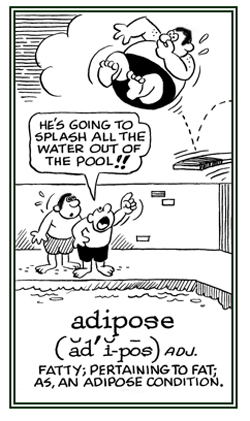
adipose (adjective), more adipose, most adipose
1. Denoting fat or containing animal fat: The adipose tissues consist of fat in the bodies of animals, including humans.
2. A reference to a fatty nature: There are some people who have adipose bodies known as obesity.

© ALL rights are reserved.
© ALL rights are reserved.
Go to this Word A Day Revisited Index
2. A reference to a fatty nature: There are some people who have adipose bodies known as obesity.
The adipose tissue, just below the skin and surrounding major organs, provides an energy reserve and insulation and protection for the body.
3. Etymology: from modern Latin adiposus, "fatty"; from adeps, adip, "fat".Go to this Word A Day Revisited Index
so you can see more of Mickey Bach's cartoons.
albopruinose (adjective), more albopruinose, most albopruinose
In botany, regarding something covered with a fine white powdery: In Susan's garden, she noticed the albopruinose grapes and plums all with a whit kind of dust covering the surfaces.
algos (pl) (noun)
A painful spasm or crisis caused by a disease: Various origins of conditions regarding algos include fatigue, muscle pain, or even anxiety or stress that cause muscles to twitch in the face.
amylose
anchylose
anginose (adjective), more anginose, most anginose
Outdated, descriptive of a serious inflammation, such as severe sore throat: Anginose conditions can cause spasmodic attacks of suffocating pain in which the patient has extreme difficulty drinking anything.
ankylose
anthracnose
appose (verb), apposes; apposed; apposing
1. To place side by side or in close proximity; to juxtapose: Jane placed the two boxes so that they were apposing each other on the shelf.
2. To be put near something, or to place by moving one object next to another one: Susan apposed the pictures in her album so they would be in the sequence in which she took them.
2. To be put near something, or to place by moving one object next to another one: Susan apposed the pictures in her album so they would be in the sequence in which she took them.
araneose (adjective), more araneose, most araneose
Regarding something that bears a resemblance to a spider's web: Jane's grandmother had a very old coat that was so thin in parts, with araneose or web-like spots, and no wonder that she wouldn't wear it anymore!
