
testi-, test-
(Latin: a witness, one who stands by)
Ab intestato (Latin phrase)
Translation: "From or by a person dying intestate"; that is, without a valid will.
A reference to someone who has died and left no will or testament.
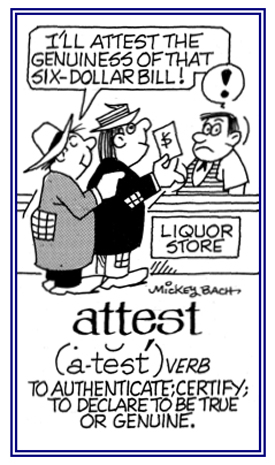
attest (verb), attests; attested; attesting
1. To show, to substantiate, or to state that something exists and is true and valid: Bill's lawyer attested the validity of his father's will.
© ALL rights are reserved.
Go to this Word A Day Revisited Index
The success of the medical operation attests the skill of Manfred's surgeon.
2. Etymology: from Latin attestari, literally, "to bear witness to"; from ad-, "to" + testari, "to bear witness"; from testis, "witness" and it is related to "testify" and "testimony".
Go to this Word A Day Revisited Index
for a list of additional Mickey Bach illustrations.
attestable (adjective), more attestable, most attestable
1. A reference to that which can be authenticated, affirmed to be true, genuine, or correct, in an official capacity: Mary gave her teacher attestable proof of being sick on the day of the test by giving her a statement written by her doctor.
2. Relating to anything that can establish or verify the usage of something: This entry word was not attestable until about 1500 A.D.
3. Pertaining to the possibility of providing evidence for; standing as proof of; showing by one's behavior, attitude, or external attributes: The blemishes on Mary's skin were attestable to poison ivy.
2. Relating to anything that can establish or verify the usage of something: This entry word was not attestable until about 1500 A.D.
3. Pertaining to the possibility of providing evidence for; standing as proof of; showing by one's behavior, attitude, or external attributes: The blemishes on Mary's skin were attestable to poison ivy.
1. Anyone who affirms or vouches for the correctness, or truth, or genuineness of something.
2. A person who attests to the genuineness of a document or signature by adding his or her own signature.
2. A person who attests to the genuineness of a document or signature by adding his or her own signature.
1. A formal statement which a person can make and officially say is true.
2. The act of witnessing something in writing which is made at the request of the party making it, and subscribing the name of the witness as a testimony of such a fact.
2. The act of witnessing something in writing which is made at the request of the party making it, and subscribing the name of the witness as a testimony of such a fact.
Someone who affirms or vouches for the correctness or truth or genuineness of something.
Anyone who vouches to the genuineness of a document or another person's signature by adding his or her own name.
1. A struggle between a rival or opposing individuals, organizations, or forces for victory or control: One form of a contest is obviously taking part in a sports competition.
2. Etymology: from Latin contestari (litem), "to call to witness, to bring action" from com- "together" + testari, "to bear witness" from testis, "a witness".
2. Etymology: from Latin contestari (litem), "to call to witness, to bring action" from com- "together" + testari, "to bear witness" from testis, "a witness".
contestable (adjective), more contestable, most contestable
Pertaining to that which may be disputed, questioned, or debated; disputable; controvertible: The football referee's penalty-call was contestable and therefore was challenged by the team's player and the coach.
1. The possibility of being challenged as in a race, a conflict, or other competition between rivals; as for a prize, a struggle for victory or superiority.
2. A strife in argument; a dispute or a controversy: The marriage of Ted and Mary was marred by perpetual contestablenesses.
2. A strife in argument; a dispute or a controversy: The marriage of Ted and Mary was marred by perpetual contestablenesses.
1. Someone who takes part in a competition of sports, or other activities.
2. Any one who enters a formal challenge to something; such as, a will, a verdict, or any decision.
2. Any one who enters a formal challenge to something; such as, a will, a verdict, or any decision.
1. A contentious speech or action.
2. A dispute where there is strong disagreement.
3. The controversy, debate, strife, or dispute that takes place between people; such as, with politicians.
2. A dispute where there is strong disagreement.
3. The controversy, debate, strife, or dispute that takes place between people; such as, with politicians.
contested (adjective), more contested, most contested
Descriptive of being disputed or made the object of contention: If anyone has a contested statement or a claim about a judge's decision, or a legal case; than it can be formally said that it was wrong or unfair and those involved can try to have it changed.
Ted's company had contested claims which were made by some customers against the safety of its products.
Anyone who challenges an outcome of something; such as a race, an election, a referee's sports decision, etc.: The tennis player was a contester of a sports judge who penalized her for hitting the ball out of the court when she claimed it was in.
contesting (s) href="http://getwords.com/unit/188/ip:1/il:G">noun), contestings (pl)
A competition in which people strive to do better than others: One example is of a contesting to win a prize or to achieve a position of leadership or power: James and Jane had a marriage that was marred by perpetual contestings.
