
sal-, sali-
(Latin: salt)
Don't confuse this sal-, sali-; "salt" unit with another sali-, salt- unit which refers to "jumping" and "leaping".
2. A colorless gas that is about one half as dense as air at ordinary temperatures and pressures.
It has a characteristic pungent, penetrating odor and it forms a minute proportion of the atmosphere.
It is found in volcanic gases and as a product of decomposition of animal and vegetable matter.
Because ammonia was at one time developed with the destructive distillation of the horns and hooves of animals, its water solution was called "spirits of hartshorn". Ammonia has also been called "alkaline air" and "volatile alkali".
3. Etymology: the name ammonia is directly related to Amon, or Amen, the Egyptian god of life and reproduction and identified by the Romans with Jupiter.Deposits of ammonium chloride were found near the temple of Amon in Libya which were named sal ammoniac, "salt of Amon".
The gas known as nitrogen hydride comes from sal ammoniac; and in 1782, the Swedish chemist, Torbern Bergman, presented the term ammonia for this gas.
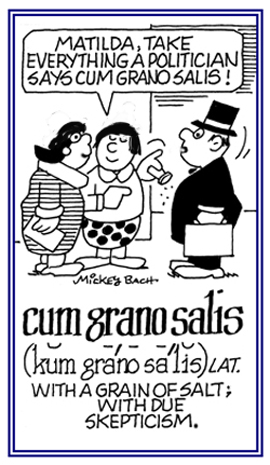
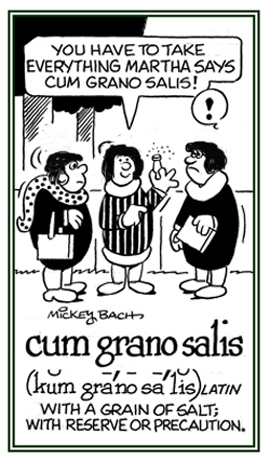
Referring to how certain things are doubted or questioned, either fully or literally: There is some truth in the statement, but we must be careful about accepting it as correct, take it cum grano salis.
A cum grano salis is said to be one of the most familiar Latin expressions available when a person does not fully believe something or someone and suggests a certain caution or reserve.
Salt was a valuable commodity in the ancient world, so a grain of salt is not to be taken as a trivial matter. The English word “salary” is derived from the Latin, salarium, which was the money allotted to Roman soldiers for purchases of salt; therefore, it was their pay.
Go to this Word A Day Revisited Index
so you can see more of Mickey Bach's cartoons.
2. The removal of dissolved salts from seawater and in some cases from the brackish waters of inland seas, highly mineralized ground waters; such as, geothermal water that is saturated or strongly impregnated with salt, and municipal waste waters.
The process of desalination includes removal of dissolved salts from sea water and from the salty waters of inland seas, highly mineralized ground waters, and municipal waste waters.
The process of desalinationmakes such otherwise unusable waters fit for human consumption, irrigation, industrial applications, and for other purposes.
2. Any of various methods used to remove mineral salt from ocean water or other brines; such as, flash desalting, reverse osmosis, or electrodialysis.
2. Characterized by increased or excessive salinity; used in the treatment involving the administration of large doses of sodium chloride.
This "salt" refers not to table salt (sodium chloride) but to "sparkling thought well expressed" or to some good conversation when eating.
2. Any of various dishes consisting of foods; such as, meat, seafood, eggs, pasta, or fruit, prepared singly or combined; usually cut up, mixed with a dressing, and served cold. Examples include: chicken salad; potato salad.
3. Any herb or green vegetable, as lettuce, used for salads or eaten raw. 4. Any mixture or assortment: "The usual salad of writers, artists, and musicians attended the meeting."
5. Originally, a "salted" dish.
The Romans were fond of dishes of assorted raw vegetables with a dressing, and this mixture often consisted of brine; hence, the name which is short for herba salata or "salted vegetables".
2. Receiving or eligible for compensation; that is, "Salaried workers."
3. That for which money is paid; including, "Salaried employment."
2. A fixed annual sum, paid at regular intervals, usually monthly or weekly, to an employee; especially, for professional or clerical work.
3. Etymology: from Anglo-French salarie, Old French salarie, from Latin salarium, "salary, stipend"; originally, "a soldier's allowance for buying salt" that was a valued commodity over which many wars were fought; from Latin salarius, "pertaining to salt"; from sal, salis, "salt".
From medieval Latin via Spanish meaning "salt pit".
