
-poly, -pole, -polism, -polist, -polists, -polistic, -polistically +
(Greek: used as a suffix; sale, selling; one who sells; pertaining to selling, to sell; trade, barter)
2. A condition in which there are only two suppliers of a particular commodity, service, etc.; the domination of a particular market by two firms.
3. A situation in which two companies own all or nearly all of the market for a given type of product or service.
4. An economic or political condition in which power is concentrated in two persons or groups.
A true duopoly is another form of oligopoly where only two producers exist in a market. By definition, it refers to two firms which have dominant control over a market. In the field of industrial organization, it is considered to be the most commonly known form of oligopoly.
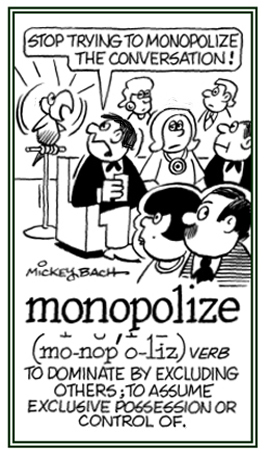
2. To demand or take all of something, such as someone's time, attention, or affection: Little Jimmy loved swinging in the garden and didn't let his sister swing at all and therefore he monopolized the swing completely!
Go to this Word A Day Revisited Index
so you can see more of Mickey Bach's cartoons.
By definition, monopoly is characterized by an absence of competition; which sometimes results in high prices and inferior products."
2. A product or service whose supply is controlled by only one company and which has an exclusive control of a commodity or service in a particular market or a control that makes possible the manipulation of prices: "Several governments attempt to prevent commercial monopolies from existing through the use of antitrust laws.3. In law, a legal right to the exclusive control of an industry or service, as granted by a government: "A situation in which a single company or group owns all or nearly all of the market for a given type of product or service."
"Public monopolies are set up by governments to provide essential services; such as, water, electricity, police services, garbage collecting, etc.; so, in such cases, a monopoly is probably more effcient than an oligopoly or multiopoly would be."
4. A law or a situation in which one supplier or producer controls over one third of a market: "Naturally, there are gray areas which take, for example, the granting of patents on new inventions. These provide a monopoly on a product for a set period of time.""The reasoning behind patents is to give innovators some time to recoup what are often large research and development costs. In theory, they are a way of using monopolies to promote innovation."
