
pater-, patri-, patro-, patr-, -patria
(Latin: father, dad, pop (family member); fatherland, country, nation)
Allopatric species often use the same kind of habitat and food resources in different areas; however, they are unable to interbreed because of distances or geographical barriers.
2. Occurring in separate, non-overlapping geographic areas: Usually applying to allopatric populations of related organisms that are unable to crossbreed because of distinct geographic separations.Allopatric speciations involve changes that take place with related organisms to the point where they are different enough to be considered separate species and this happens when populations of certain species are separated and adapt to their new environment or conditions (physiological, geographic, or behavioral).
Additional examples of allopatries can be seen when very steep and high mountain ridges separate small tropical valleys causing conditions that can form barriers.
Love for one's native country.
2. Relating to any of those biblical figures regarded as fathers of the human race; especially, Abraham, Isaac, and Jacob, and their forefathers, or the sons of Jacob.
2. A colleague.
3. Someone who is from the same country as another person or people.
A motto of Gonzaga University School of Law, Spokane, Washington, USA.
A carving in stone over the entrance to the Amphitheater at Arlington National Cemetery in Virginia; based on a writing by Horace in his Odes, III, ii, 13.
Dulce et Decorum Est
Knock-kneed, coughing like hags, we cursed through sludge,
Till on the haunting flares we turned our backs,
And towards our distant rest began to trudge.
Men marched asleep. Many had lost their boots,
But limped on, blood-shod. All went lame, all blind;
Drunk with fatigue; deaf even to the hoots
Of gas-shells dropping softly behind.
Gas! GAS! quick, boys! An ecstasy of fumbling,
Fitting the clumsy helmets just in time,
But someone still was yelling out and stumbling
And flound'ring like a man in fire or lime.—
Dim through the misty panes and thick green light,
As under a green sea, I saw him drowning.
In all my dreams before my helpless sight
He plunges at me, guttering, choking, drowning.
If in some smothering dreams, you too could pace
Behind the wagon that we flung him in,
And watch the white eyes writhing in his face,
His hanging face, like a devil's sick of sin,
If you could hear, at every jolt, the blood
Come gurgling from the froth-corrupted lungs
Bitten as the cud
Of vile, incurable sores on innocent tongues,—
My friend, you would not tell with such high zest
To children ardent for some desperate glory,
The old Lie: Dulce et decorum est
Pro patria mori.
Dulce (sweet)? Decorum (honorable)? Wilfred Owen himself died fighting for England in World War I, just one week before the armistice was signed and the war ended.
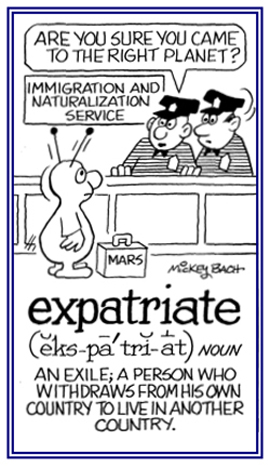
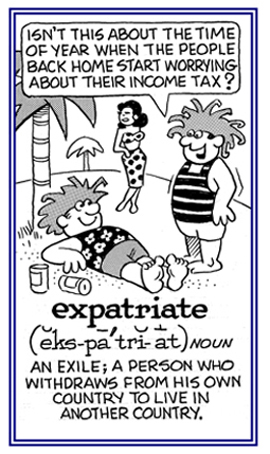
Go to this Word A Day Revisited Index
so you can see more of Mickey Bach's cartoons.
2. To withdraw oneself from his or her country for reasons of survival: There are many refugees who are fleeing their habitats because of terrible economic and living conditions where they have been living.
