
pass-, pati-
(Latin: suffering, feeling; enduring)
A recognition, perception, and deep sympathy or pity of the sufferings or troubles of another, accompanied by an urge to help: Mrs. Smith's neighbor was so kind-hearted and showed so much compassion after Mrs. Smith lost her husband in a plane crash.
Compassion is the sympathy with which some people remember the homeless because it costs nothing.
compassionable (adjective), more compassionable, most compassionable
Descriptive of a person who deserves sympathy or pity; pitiable: The old frail woman standing on the corner of the road seemed so compassionable, but nobody stopped to help her at all!
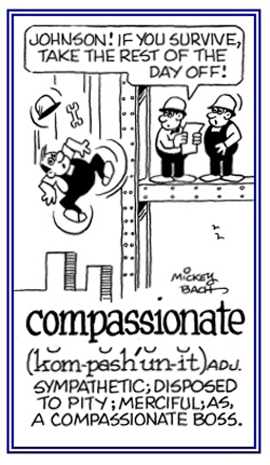
compassionate (adjective), more compassionate, most compassionate
1. Conveying a feeling or showing sorrow for the misfortunes of another person; sympathetic; kind-hearted; pitying: After the death of Mr. Smith, a colleague at work, Janet wrote a compassionate letter to his wife reflecting her sorrow at the loss of her husband.
2. Relating to, or characterized by, thoughts of helping others in their sufferings: Many refugees will never forget the compassionate and sympathetic support they received from the volunteers after their hardships of crossing the sea and landing in Europe.
© ALL rights are reserved.
Go to this Word A Day Revisited Index
2. Relating to, or characterized by, thoughts of helping others in their sufferings: Many refugees will never forget the compassionate and sympathetic support they received from the volunteers after their hardships of crossing the sea and landing in Europe.
Go to this Word A Day Revisited Index
so you can see more of Mickey Bach's cartoons.
compassionately (adverb), more compassionately, most compassionately
Descriptive of how someone says or does something in a sympathetic and kindly way: The nurse at the clinic looked at the patient compassionately and wheeled him to the doctor's office.
compassionless (adjective) (not comparable)
Relating to an individual who has or shows no sympathy or pity; cold-hearted: The couple didn't realize that their marriage became progressively compassionless and without love after spending almost 20 years together.
compassive (adjective), more compassive, most compassive
Regarding someone who feels or shows kindness, sympathy, and understanding; sympathetic; compassionate; pitiful: Following the depressing diagnosis, Dr. Green told the elderly Mrs. Smith that her husband demonstrated great compassive warmth and tenderness towards his wife.
A condition of suffering, or of being affected, together with another person: Mary's and Susan's compassivity was expressed in hugging each other while tears were flowing down their cheeks.
1. A state of feeling sympathy or understanding towards another person; like-mindedness: Jack and Jill appeared to have a lot of compatibility in their marriage, but Bill and Patty didn't get along with each other and separated within a year!
2. A condition of existing or functioning in harmony or in congenial combination: Lisa's computer programs do not have compatibility with the kind of programs Mary has on her computer, so Lisa can't use such programs on her own computer because they wouldn't work!
2. A condition of existing or functioning in harmony or in congenial combination: Lisa's computer programs do not have compatibility with the kind of programs Mary has on her computer, so Lisa can't use such programs on her own computer because they wouldn't work!
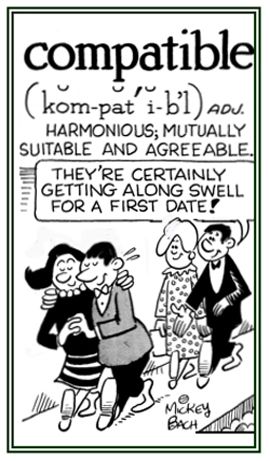
compatible (adjective), more compatible, most compatible
1. Referring to people who get along well together in agreement or harmony; rapport: The two friends, Janet and Mary, were very compatible and so they often spent their holidays together.
© ALL rights are reserved.
Go to this Word A Day Revisited Index
Jack and Sally loved and trusted each other believing that they could have a compatible marriage with an amicable relationship.
2. Regarding an adaptability for simple and effortless interaction: Jane had to get a new printer because her old one wasn't compatible with her new computer.Go to this Word A Day Revisited Index
so you can see more of Mickey Bach's cartoons.
1. The quality of existing together in peace and agreement: The compatibleness of the family members had a lot to do with their having respect for each other.
2. The capability of computer devices working together without complications or modifications: Lynn has an iPad and an iPhone which exhibit compatibleness with each other.
2. The capability of computer devices working together without complications or modifications: Lynn has an iPad and an iPhone which exhibit compatibleness with each other.
compatibly (adverb), more compatibly, most compatibly
Regarding how people or things perform together in a suitable or consistent way: Mrs. Smart, the teacher, was so relieved and happy when her students worked compatibly with each other on their projects.
A desire or affection opposed to, or the opposite of another: It was extremely hard for Tom to accept the counterpassion that Valerie showed towards him because he loved her so much!
Absence of passion; coolness; freedom of emotion: Bob seemed to be in a state of dispassion and apathy when at the dinner table because he didn't join in the conversation at all, didn't laugh, or show any feelings towards the others.
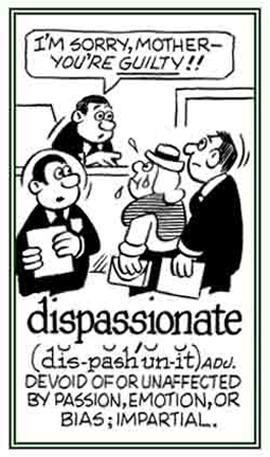
dispassionate (adjective), more dispassionate, most dispassionate
1. A reference to a condition of being free from emotions or bias: The teacher heard both sides of the argument that the two students were having in a dispassionate and reasonable way, and after listening to them, gave her advice for a solution which would satisfy each one.
2. Referring to an absence of influence by not showing strong feelings, especially not affected by personal or emotional involvements: The surgeon, who was performing the operation, maintained a dispassionate manner even though the patient was his son.
© ALL rights are reserved.
Go to this Word A Day Revisited Index
2. Referring to an absence of influence by not showing strong feelings, especially not affected by personal or emotional involvements: The surgeon, who was performing the operation, maintained a dispassionate manner even though the patient was his son.
Go to this Word A Day Revisited Index
so you can see more of Mickey Bach's cartoons.
dispassionately (adverb), more dispassionately, most dispassionately
Concerning how an individual presents himself or herself in an impartially unemotioal manner: Although he was looking at the other woman, he did it dispassionately.
He spoke dispassionately about the accident he had just had.
 If you would like to take a couple of self-scoring quizzes over some of the words in this section, then click on the Pati-Quiz links below.
 Self-scoring Pass-, Pati- Quiz #1.
 Self-scoring Pass-, Pati- Quiz #2.
