
-onym, -onymy, -onymic, -onymically, -onymous, -onymously, -nym
(Greek: name; word)
A word formed from the first (or first few) letters of a series of words, such as "radar" (radio detecting and ranging): Some people are confused by what appears to be too many acronyms, especially on the internet and from government organizations.
acronym, anagram
acronym (AK ruh nim) (noun)
A word formed from the first (or first few) letters of a series of words; such as, "radar" (radio detecting and ranging): Some people are confused by what appears to be one acronym after another; especially, on the internet and by government organizations.
anagram (AN uh gram") (noun)
A word or phrase made from another by rearranging its letters (Ex.: "now" can become "won"; "dread" can be transformed into "adder"): The anagram is just one of many kinds of word games that are around.
The television station issued a challenge to its viewers to suggest an acronym which would be the name of the new program for the fall that would feature an anagram contest.
A zealous or keen passion for creating acronyms: Olivia was very interested in words and she developed an acroymania trying to form as many terms as possible by combining the initial letters of a multipart name.
acronymic (adjective), more acronymic, most acronymic
1. Description of a word formed from the first (or first few) letters of a series of words: Examples formed in an acronymic way are radar, which comes from radio detecting and ranging, NATO, which comes from North Atlantic Treaty Organization, scuba, which comes from self-contained underwater apparatus, and sonar, which comes from sound navigation ranging.
2. Characteristic of words created from the initial letters of a phrase: Such acronymic examples are "Random Access Memory" which becomes RAM, pronounced as the word "ram", and the scientific term LASER that is a result of "Light Amplification by Stimulated Emission of Radiation".
2. Characteristic of words created from the initial letters of a phrase: Such acronymic examples are "Random Access Memory" which becomes RAM, pronounced as the word "ram", and the scientific term LASER that is a result of "Light Amplification by Stimulated Emission of Radiation".
acronymically (adverb), more acronymically, most acronymically
acronymous (adjective) (not comparable)
A reference to a word (tip-name) that is formed from the initials or other parts of several words: An example of an acronymous term is UNESCO, from the initials of the United Nations Eucational, Scientific, and Cultural Organization.
1. The name of another person, especially that of a significant historical figure, which is assumed by a writer: Examples include Mark Twain that was an allonym for Samuel Clemens and George Eliot, the allonym for Mary Ann Evans.
2. A book bearing the name of someone other than its author: An allonym can be a published work that uses the name of an individual different from the author.
2. A book bearing the name of someone other than its author: An allonym can be a published work that uses the name of an individual different from the author.
allonymous (adjective) (not comparable)
Pertaining to a publication that is indicated is the name of a writer other than the author: The article in the newspaper was presented with an allonymous identification instead of the actual writer.
allonymously (adverb) (not comparable)
A reference to how someone uses a name that belongs to another person: There are some writers who prefer to use an allonymously produced name of an historical person in order to attract more readers.
1. A word, formed from the first letters of a group of words, of which most people are unaware of what the original meaning of the word is, such as "laser" and "radar": The computer term "URL" (Uniform Resource Locator) is used on the internet as a website address, which has become an anacronym because very few people know what the letters stand for.
2. Etymology: said to be a combination of parts of the words anachronistic and acronym.
2. Etymology: said to be a combination of parts of the words anachronistic and acronym.
1. A name which is written backwards; often used to mean the same thing as another word or as a false name.
2. A name that has the letters reversed; often done for anonymity, or to create a new name with some information encrypted in it; such as, with a parent who is naming a child.
2. A name that has the letters reversed; often done for anonymity, or to create a new name with some information encrypted in it; such as, with a parent who is naming a child.
The naming of a part of the body which is used as a verb: such as, "toe the line"; "face the music"; and "foot the bill".
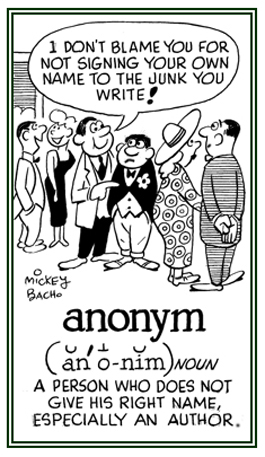
1. With no name known or acknowledged: The anonym on the package gave rise to speculation as to who could be the unidentified sender.
2. Given, written, etc. by a person whose name is not disclosed: The letter to the editor of the newspaper was signed as anonym, the authorship being withheld for a reason.
3. A name used by someone to hide his or her identity: The ransom note was signed with an X which was the anonym of the kidnapper.
4. Not easily distinguished from others or from one another since there is a lack of individual features or characteristics: Harry's face was a perfect anonym because it was very bland and undistinguished from other people.
© ALL rights are reserved.
Go to this Word A Day Revisited Index
2. Given, written, etc. by a person whose name is not disclosed: The letter to the editor of the newspaper was signed as anonym, the authorship being withheld for a reason.
3. A name used by someone to hide his or her identity: The ransom note was signed with an X which was the anonym of the kidnapper.
4. Not easily distinguished from others or from one another since there is a lack of individual features or characteristics: Harry's face was a perfect anonym because it was very bland and undistinguished from other people.
Go to this Word A Day Revisited Index
so you can see more of Mickey Bach's cartoons.
1. The state of not being known or identified by name: The writer of the letter to the editor was not revealed as the one who wrote the complaint.
2. A lack of distinctive features that makes things seem bland or interchangeable.
3. Someone who is unnamed or unacknowledged as the doer of something.
4. The state of blending into a crowd and going unnoticed.
2. A lack of distinctive features that makes things seem bland or interchangeable.
3. Someone who is unnamed or unacknowledged as the doer of something.
4. The state of blending into a crowd and going unnoticed.
anonymous (adjective), more anonymous, most anonymous
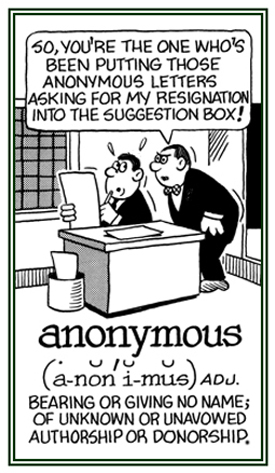
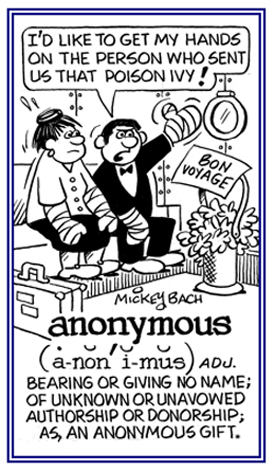
1. A reference to someone whose name is not known or not given: A substantial financial supporter of the university wanted to remain an anonymous donor.
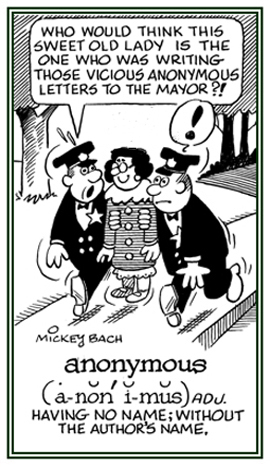
2. Referring to a performer’s or creator’s identity which is not revealed: Bert made an anonymous phone call to the police about a loud and threatening argument going on next door.
3. Concerning a lack of individuality or distinctiveness: Steve works in an anonymous building because it has no special features that separates it from other structures.
4. Descriptive of a person whose identity is obscured, not acknowledged, or who goes unnoticed: Despite his hard work and creativity, Aaron was just an anonymous person among his fellow workers.
© ALL rights are reserved.
© ALL rights are reserved.
© ALL rights are reserved.
Go to this Word A Day Revisited Index
2. Referring to a performer’s or creator’s identity which is not revealed: Bert made an anonymous phone call to the police about a loud and threatening argument going on next door.
3. Concerning a lack of individuality or distinctiveness: Steve works in an anonymous building because it has no special features that separates it from other structures.
4. Descriptive of a person whose identity is obscured, not acknowledged, or who goes unnoticed: Despite his hard work and creativity, Aaron was just an anonymous person among his fellow workers.
