
nom-, nomen-, nomin-, -nomia, -nomic
(Latin: name)
Don't confuse this element with the Greek nomo- which means "law"; or with nomo- meaning "meadow, pasture" and by extension, "acute ulcerative process" and "gangrene".
"Ferdinand the Great is another example of an agnomen which has been used since the Roman times."
2. Etymology: from Late Latin ag-, a form of ad-, "toward" ["addition to"] +nomen, "name".2. A reference to a lack of social or ethical standards when the absence of self-control has permitted desires to grow beyond all hope of satisfaction: There is such a thing as suicide that can result from suffering anomy when a person is convinced that there is no hope of satisfying his or her goals or objectives.
3. Apathy, alienation, or personal distress resulting from the loss of previously valued goals: Emile Durkheim popularized the term anomie when he listed it as a principal reason for suicide.
2. The expression of a proper name as a common noun to refer to someone or something with associated characteristics, e.g., in calling a handsome young man "an adonis".
2. A two-part name: A binomial is especially exemplified by the Latin name of a species of a living organism that consists of the genus followed by the specific title.
2. In biology, relating to a pair of Latin or Latinized words forming a scientific name in the classification of plants, animals, and microorganisms. The first word represents the genus and the second the species.
Man, Animals, and Scientific Investigations
From the earliest times, animals have been vitally important to man; cave art demonstrates the practical and mystical significance animals held for prehistoric man. Early efforts to classify animals were based on physical resemblance, habitat, or economic use.
Although Hippocrates and Aristotle did much toward organizing the scientific thought of their times, systematic investigation declined under the Romans and, after Galen's notable contributions, came to a virtual halt lasting through the Middle Ages (except among the Arab physicians).
With the Renaissance, a direct observation of nature was revived; landmarks were Vesalius' anatomy and Harvey's demonstration of the circulation of blood.
The invention of the microscope and the use of experimental techniques expanded zoology as a field and established many of its branches; such as, cytology and histology. Studies in embryology and morphology also revealed much about the nature of growth and the biological relationships of animals.
The system of binomial nomenclature was devised to indicate these relationships; Linnaeus was the first to make it consistent and apply it systematically.
Paleontology, the study of fossil organisms, was founded as a science by Cuvier about 1812.
Knowledge of physiological processes expanded greatly when physiology was integrated with the chemical and other physical sciences.
The establishment of the cell theory in 1839 and the acceptance of protoplasm as the stuff of life 30 years later gave impetus to the development of genetics.
Lamarck, Mendel, and Darwin presented concepts that revolutionized scientific thought. Their theories of evolution and of the physical basis of heredity prompted research into all life processes and into the relationships of all organisms.
The classic work of Pasteur and Koch opened up bacteriology as a field.
Modern zoology has not only concentrated on the cell, its parts and functions, and on expanding the knowledge of cytology, physiology, and biochemistry, but it has also explored such areas as psychology, anthropology, and ecology.
Binomial Nomenclature
The present system of binomial nomenclature identifies each species by a scientific name of two words, Latin in form and usually derived from Greek or Latin roots.
The first name (capitalized) is the genus of the organism, the second (not capitalized) is its species.
The advantages of scientific over common names are that they are accepted by speakers of all languages, that each name applies only to one species, and that each species has only one name.
This avoids the confusion that often arises from the use of a common name to designate different things in different places, or from the existence of several common names for a single species.
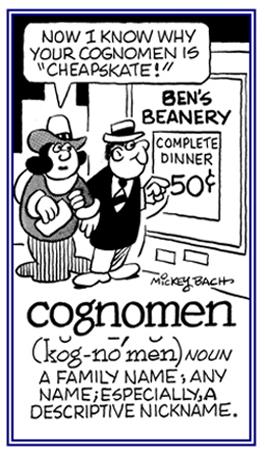
2. Any name; especially, a nickname: "Mike" is the cognomen for Michael.
3. The third and commonly the last name of a citizen of ancient Rome, indicating the person's house or family, as "Caesar" in "Gaius Julius Caesar" or "Cicero" in "Marcus Tullius Cicero".
The ancient Roman name, Publius Cornelius Scipio, presents "Scipio" as his cognomen.
The full name of the poet Virgil was Publius Vergilius Maro and Maro designates or specifies his cognomen.
Go to this Word A Day Revisited Index
so you can see more of Mickey Bach's cartoons.
2. An additional name or epithet bestowed on individuals, as Africanus, Cunctator (in later Latin called agnomen).
3. A surname or family name.
4. A nickname or name that describes someone, e.g., “Billy the Kid”.
