
audio-, aud-, audi-, audit- +
(Latin: hearing, listening, perception of sounds)
Audi alteram partem (Latin phrase)
Listen to the other side.
Also, "There are two sides to every question", which is a plea for reason and fairness in discussions.
Quality, fact, or degree of being heard or perceived by the ear; perceptibility: When part of the audience was placed behind the stage, the problem of audibility had to be reviewed again.
audible (adjective), more audible, most audible
Referring to something loud or clear enough to be heard: When she was telling the very sad news, her voice was barely audible because she was talking so softly and quietly.
Nature has given us two ears, two eyes and just one tongue, to the end that we should hear and see more than we speak.
Profanity makes ignorance audible.
The quality of being perceptible by the ear: The perceptibility or audibleness of the soloist in the recital could hardly be discerned by those who were sitting in the last rows of seats, especially when the soloist was playing pianissimo.
audibly (adverb), more audibly, most audibly
Characterizing how something is heard or capable of being heard: James and Susan audibly gasped with horror when the tremors of the earthquake made their house shake violently before finally collapsing.
A former term for a hearing aid: In the museum, Grace saw an audiclave which was a device for people to use to hear better.
A name used by various businesses dealing with listening to music, or other forms of entertainment using sounds: The firm's audicon was known by those who loved music and music performances.
1. A group of spectators at a public event; listeners or viewers collectively, as in attendance at a theater or concert: Just as the last couple joined the audience, the lights were turned off and the performance began.
2. The readership for printed matter, as for a book: The Harry Potter books have certainly had a huge and faithful audience!
3. A body of adherents; a following: James enlarged his audience by playing music from several popular movies.
4. A formal hearing, as with a religious or state dignitary; meeting; conference; consultation: The church dignitaries arranged to have an audience in order to express their knowledge of the issues at hand.
5. An opportunity to be heard or to express one's views: When the speaker stood in the local park, he realized that he lost his audience when he stated his opinions regarding those who liked to drink coffee in the morning!
6. The act of hearing or attending to words or sounds: In the play, Sally said, "Please give me your attention and audience and listen to what I have to say."
7. An opportunity to be heard; chance to speak to or before a person or a group; a hearing or listening to; Sam hoped to have an audience at the staff conference where he could give data on the number of accidents which occurred on the playground during the last month.
8. A formal interview with a sovereign, high officer of government, or other high-ranking person: Valerie enjoyed having an audience with the Pope.
2. The readership for printed matter, as for a book: The Harry Potter books have certainly had a huge and faithful audience!
3. A body of adherents; a following: James enlarged his audience by playing music from several popular movies.
4. A formal hearing, as with a religious or state dignitary; meeting; conference; consultation: The church dignitaries arranged to have an audience in order to express their knowledge of the issues at hand.
5. An opportunity to be heard or to express one's views: When the speaker stood in the local park, he realized that he lost his audience when he stated his opinions regarding those who liked to drink coffee in the morning!
6. The act of hearing or attending to words or sounds: In the play, Sally said, "Please give me your attention and audience and listen to what I have to say."
7. An opportunity to be heard; chance to speak to or before a person or a group; a hearing or listening to; Sam hoped to have an audience at the staff conference where he could give data on the number of accidents which occurred on the playground during the last month.
8. A formal interview with a sovereign, high officer of government, or other high-ranking person: Valerie enjoyed having an audience with the Pope.
The situation of listening and hearing: The audiency presented in the museum was much appreciated by the people who found that they could now understand more than before.
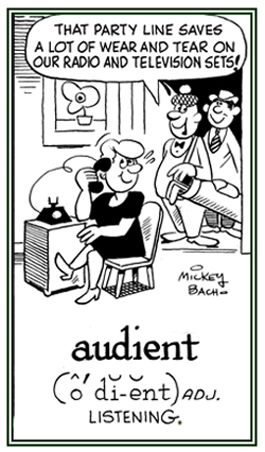
audient (adjective), more audient, most audient
A reference to a person who hears, listens and pays attention: Lisa seemed to be very audient when Mrs. Good was explaining the assignment the students were to do that day.
© ALL rights are reserved.
Go to this Word A Day Revisited Index
Go to this Word A Day Revisited Index
so you can see more of Mickey Bach's cartoons.
We have two ears and only one tongue so that we may hear more and speak less.
An individual having a tendency to form mental images derived from auditory sensations: Mandy, who was blind and considered to be an audile, had the capacity to form auditory impressions and pictures rather than visual ones.
1. The recording and reproduction of sound: When the children listened to the audio, they could hear their parents talking about Christmas!
2. The part of television or movie equipment that has to do with sound: The audio for making films is not the same as the visual portion (video) that is also part of a film.
3. The broadcasting, reception, or reproduction of sound: The elements related to audio are especially important in high-fidelity reproduction.
4. A sound signal: We lost the audio during the radio broadcast.
2. The part of television or movie equipment that has to do with sound: The audio for making films is not the same as the visual portion (video) that is also part of a film.
3. The broadcasting, reception, or reproduction of sound: The elements related to audio are especially important in high-fidelity reproduction.
4. A sound signal: We lost the audio during the radio broadcast.
The part of any wave or signal whose frequencies are within the audible range: Sandy wondered if the audio components were strong enough for her to receive the program she wanted to listen to.
Any of a wide variety of computer components that accept or produce sound: The audio device Jenny had on her computer was important for her to receive some very nice radio music!
A sound frequency between 20 and 20,000 cycles per second, or hertz: Audio frequency refers to the frequency of oscillation able to be detected by the ear of a human.
Audio-frequencies are those of electrical, sound, or other wave vibrations coming within the range of normal human hearing.
