
fa-, fam-, fan-, fant-, fat-, -fess; fab-, fabul-
(Latin: fari-, "to say, to talk"; telling, speak, say, spoken about; acknowledge)
The quality of being friendly or easy to get along with; approachable: John, the new neighbor, was so helpful, courteous, and generous and his affability was much liked and appreciated among the others living on the street.
affable (adjective), more affable, most affable
Descriptive of someone who shows warmth and friendliness with other people: As a supervisor, Mike Black was always affable with his subordinates in that he was always civil and courteous when he had conversations with them.
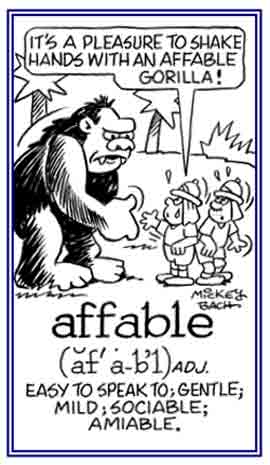
© ALL rights are reserved.
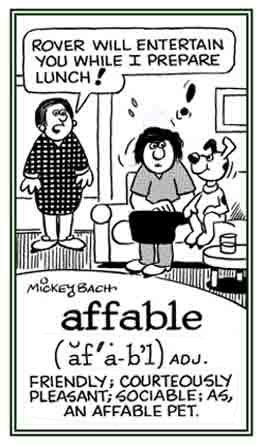
© ALL rights are reserved.
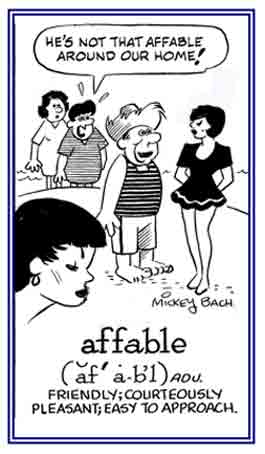
© ALL rights are reserved.
Go to this Word A Day Revisited Index
Go to this Word A Day Revisited Index
so you can see more of Mickey Bach's cartoons.
Having the characteristics of being friendly and easy to approach and to talk to.
affably (adverb), more affably, most affably
Conveying how an individual converses courteously and in a friendly way: Sadie greeted her new neighbors affably as she welcomed them to her community.
confabulate (kuhn FAB yuh layt") (verb), confabulates; confabulated; confabulating
1. To discuss or to have a chat about something: Linda loved to confabulate with her friends about their children while having afternoon tea once a week.
2. To give fictitious accounts of past events, believing they are true, in order to cover a gap in the memory caused by a medical condition; such as, dementia: Usually, when Sam visited his Aunt Jane in the home for elderly people, she loved to confabulate about her earlier life as a child, but Sam knew the stories didn’t really happen.
3. To unconsciously replace fact with fantasy in one's memory: Jackie didn’t remember much when she was a toddler, but she thought she did, and so she liked to confabulate stories about her life on the farm when she was two-years old.
4. To have a conference in order to talk something over: The administrators of the school departments confabulated on how much financial support each one should get and use for the year.
5. To talk socially without exchanging too much information: The two old friends sat on a park bench and began to confabulate about the weather conditions and other irrelevant things, but they mentioned very little about their personal lives.
6. Etymology: from Latin com, "together" + fabulari, "to talk".
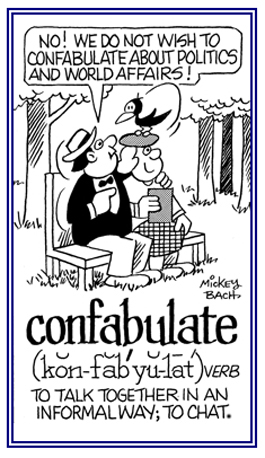
© ALL rights are reserved.
Go to this Word A Day Revisited Index
2. To give fictitious accounts of past events, believing they are true, in order to cover a gap in the memory caused by a medical condition; such as, dementia: Usually, when Sam visited his Aunt Jane in the home for elderly people, she loved to confabulate about her earlier life as a child, but Sam knew the stories didn’t really happen.
3. To unconsciously replace fact with fantasy in one's memory: Jackie didn’t remember much when she was a toddler, but she thought she did, and so she liked to confabulate stories about her life on the farm when she was two-years old.
4. To have a conference in order to talk something over: The administrators of the school departments confabulated on how much financial support each one should get and use for the year.
5. To talk socially without exchanging too much information: The two old friends sat on a park bench and began to confabulate about the weather conditions and other irrelevant things, but they mentioned very little about their personal lives.
6. Etymology: from Latin com, "together" + fabulari, "to talk".
Go to this Word A Day Revisited Index
so you can see more of Mickey Bach's cartoons.
1. The act of having a conversation or a discussion.
2. In psychiatry, the replacement of a gap in a person's memory by a falsification that he or she believes to be true.
2. In psychiatry, the replacement of a gap in a person's memory by a falsification that he or she believes to be true.
confess (verb), confesses; confessed; confessing
1. To declare or disclose (something which one has kept or allowed to remain secret as being prejudicial or inconvenient to oneself); to acknowledge, own, or admit (a crime, charge, fault, weakness, or the like).
2. To acknowledge or formally recognize (a person or thing) as having a certain character or certain claims; to own, avow, declare belief in or adhesion to.
3. In religion, to acknowledge sins orally as a religious duty, with repentance and desire of absolution.
4. To make formal confession of sins; especially, to a priest, in order to receive penance and absolution.
2. To acknowledge or formally recognize (a person or thing) as having a certain character or certain claims; to own, avow, declare belief in or adhesion to.
3. In religion, to acknowledge sins orally as a religious duty, with repentance and desire of absolution.
4. To make formal confession of sins; especially, to a priest, in order to receive penance and absolution.
Primarily in the Roman Catholic Church, a person who admits having committed a sin, or sins, to a priest: "Merle was acknowledging, repenting, and seeking God's forgiveness for his mistakes."
confessedly (adverb), more confessedly, most confessedly
1. By acknowledgment or admittedly.
2. Used to indicate that something is considered to be the case.
2. Used to indicate that something is considered to be the case.
1. An admission of having done something wrong or embarrassing: The three children appeared uneasy when they made a confession to their mother that they had eaten all the cookies she had baked without letting her know about it.
2. In law, a voluntary written or verbal statement admitting the commission of a crime: In order to avoid a long court procedure, Julia's lawyer convinced her to write a confession in which she stated that she had robbed two banks in the city.
3. A profession of emotions or beliefs; such as, love, loyalty, or faith: On Valentine's Day, Mark made his confession of love for Darlene and asked her to marry him.
4. A formal declaration of sins made confidentially to a priest or to God: Sara made her confession in her church the first Sunday of every month, as well as on her birthday, confiding to the priest what she believed were her sins and asking for God's forgiveness.
2. In law, a voluntary written or verbal statement admitting the commission of a crime: In order to avoid a long court procedure, Julia's lawyer convinced her to write a confession in which she stated that she had robbed two banks in the city.
3. A profession of emotions or beliefs; such as, love, loyalty, or faith: On Valentine's Day, Mark made his confession of love for Darlene and asked her to marry him.
4. A formal declaration of sins made confidentially to a priest or to God: Sara made her confession in her church the first Sunday of every month, as well as on her birthday, confiding to the priest what she believed were her sins and asking for God's forgiveness.
confessional (adjective) (not comparabloe)
Relating to or conveying something intimately autobiographical in nature or content: "Laurence wrote a confessional description regarding his private life in his autobiography."
A booth where a priest sits to hear believers declare their sins and to seek God's forgiveness: "Celia went to the confessional regularly where a priest heard her admit her short comings and to seek forgiveness."
1. A person to whom someone else confides her/his personal problems.
2. Someone who makes a confession or who makes a formal statement admitting that he/she is guilty of a crime.
3. A priest who hears confessions and sometimes acts as a spiritual adviser.
2. Someone who makes a confession or who makes a formal statement admitting that he/she is guilty of a crime.
3. A priest who hears confessions and sometimes acts as a spiritual adviser.
1. A verbal or written attack on someone’s good name, character, or reputation.
2. Communicated damage to the good reputation of someone; slander or libel.
2. Communicated damage to the good reputation of someone; slander or libel.
defamatory (adjective), more defamatory, most defamatory
Harmful statements regarding someone's good name, character, or reputation: During the Presidential elections, people hear many defamatory remarks being made by each candidate about the one who is running against him or her.
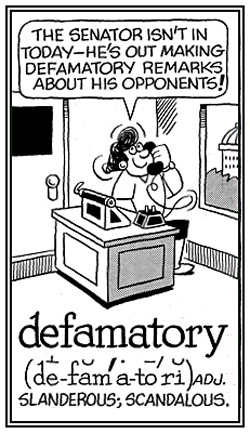
© ALL rights are reserved.
Go to this Word A Day Revisited Index
Go to this Word A Day Revisited Index
for a list of additional Mickey Bach illustrations.
Cross references of word families related directly, or indirectly, to: "talk, speak, speech; words, language; tongue, etc.":
cit-;
clam-;
dic-;
-farious;
glosso-;
glotto-;
lalo-;
linguo-;
locu-;
logo-;
loqu-;
mythico-;
-ology;
ora-;
-phasia;
-phemia;
phon-;
phras-;
Quotes: Language,Part 1;
Quotes: Language, Part 2;
Quotes: Language, Part 3;
serm-;
tongue;
voc-.
Cross references of word families that are related directly, or indirectly, to: "divination, diviner; seer, soothsayer, prophecy, prophesy, prophet": augur-; auspic-; Fates in action; futur-; -mancy; omen; -phemia; sorc-, sorcery; vati-.
