
dic-, dict-
(Latin: talk, speak, say, tell, declare; to proclaim)
A king can abdicate, renounce, or swear away his kingly privileges and duties.
2. To refuse to accept an obligation or responsibility: When Sharon was told to revise her book, as instructed by her editor, she suddenly abdicated her contract with the publisher because she didn't agree with the new format.3. To proclaim or declare to be no longer one's own, to disclaim, disown, cast off, especially to disown or disinherit children: Gary Brown abdicated his responsibilities as a husband and father and never returned to be with his wife and children again.
4. To give up a right, trust, office, or dignity; to leave, to lay down, to surrender, to abandon; at first implying voluntary renunciation, but now including the idea of abandonment by default: Governments, both national and local, seem to be abdicating their responsibilities to provide a good education for all of their citizens by greatly reducing the financial expenditures that are needed.
Tom abdicated his responsibilities as a salesman and left town to look for another place to live.
5. To leave one's position, office, or power: Yielding to the pressure of public opinion, the president of the country is abdicating his political authority.
The outraged citizens forced the talk-show host to abdicate his radio program.
6. Etymology: from Latin ab-, "away" + dicare, "to proclaim". When people abdicate their positions, they "proclaim away" their authorities.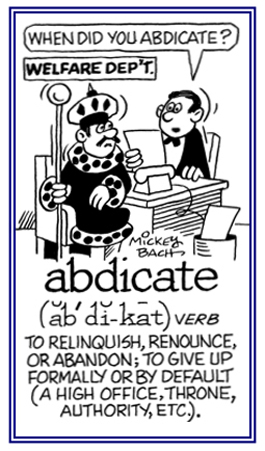
Go to this Word A Day Revisited Index
so you can see more of Mickey Bach's cartoons.
2. The action of formally renouncing, disowning, or casting off; now only applied to the disowning of a son in Roman Law: In choosing the abdication of his son as his successor, the landlord broke the line of succession of ownership.
3. Resignation, surrender, abnegation: The abdication of Joy Little's position as judge left her with a sense of relief.
4. Resignation or abandonment, either formal or virtual, of sovereignty or other high trust: The abdication of Gerald Room's position as Chief Executive Officer surprised everyone.
5. A formal yielding or relinquishment of the ownership of goods by an insurer to the underwriters: The insurance company determined that the abdication of ownership of the ship was the only way to cut their losses when the ship was wrecked.
It seemed like a long summer of abdications; first the prince's abdication of the throne to marry the woman he loved, then we had the CEO's abdication of his position as head of the company.
6. Etymology: from Latin abdicationem; from ab-, "away" + dicare, "proclaim".2. Anyone who fails to fulfill a duty or responsibility: The manager of the store lost his position because he was accused of being an abdicator of his duties.
Motto of Henry I (918-936) who forced the dukes of Bavaria and Swabia to recognize his authority. He protected Saxony against the Slavs by building several fortresses and by creating a powerful cavalry which he used to defeat the invading Magyars on the Unstrut River in 933.
King Henry succeeded in annexing the key Carolingian realm of Lorraine to the east Franconian realm. He is regarded as the actual founder of the German Empire.
In Roman law, addico was one of the three words used to express the extent of civil jurisdiction of the praetors who were ancient Roman magistrates acting as the chiefs of law officers of the state.
2. To determine by a judge; to pass on and to decide judicially: Jane's friend was discovered selling drugs and in court the judge addicered him guilty of the crime.2. Someone who is obsessed by and devoted to the habitual and excessive use of a narcotic: Tim's friend was found to be a drug addict when his parents found cocaine hidden in his bedroom.
Why is it that drug addicts and computer enthusiasts are both called "users"?
- Internet access has become a vital part of the modern world and an important tool in the education of children.
- Like addiction to drugs, alcohol, cigarettes, or caffeine, internet addicts are showing symptoms of increasing tolerance, withdrawal, mood changes, and interruption of social relationships.
- Children and adolescents who have become addicts of the internet often require increasing amounts of time online in order to feel satisfied.
- When they do not have access to the internet, they may have symptoms of withdrawal, which include anxiety, depression, irritability, trembling hands, restlessness, and obsessive thinking or fantasizing about the internet.
- Internet addiction is not limited just to introverted "computer-techies".
- The internet can provide a welcome escape for individuals who already suffer from a variety of psychological difficulties; including, anxiety, depression, and low self-esteem.
- Additionally, those who have struggled with other types of addiction may more easily become obsessed with the internet.
There is a significantly increasing number of people who are addicting themselves to foods that make them overly fat and unhealthy.
2. Etymology: from ad-, "to" + dicere, "to say, to declare".2. The conditions of being overwhelmed or uncontrollably committed to causes or to special objectives: Amy's main addiction is her excess devotion to operas where she spends a great deal of time and expenses attending them as often as possible.
Sally had an addiction for buying clothes, shoes, purses, and other items even though she didn't need them and didn't have enough space to put them where she could access them, as a result, she had very little money for other necessities; such as, food, making her car payments, paying her rent, etc.
3. Situations that involve compulsions and the need to continue taking drugs as a result of taking them in the past: Greg was trying to follow his doctor's advice to stop his crack addiction which he had had for years. Getting away from his old friends, who also had the same addictions, was extremely difficult and hindered him from turning away from that type of life.For more information, see these compositions: Addicts and Addiction.
It is possible that a man could live twice as long if he didn't spend the first half of his life acquiring habits (addictions) that shorten the other half.
Samuel Langhorne Clemens, alias dictus was Mark Twain (1835 - 1910), who was an American author who wrote The Adventures of Tom Sawyer among several other novels.
2. Etymology: from Latin alias, "otherwise, at another time". Also from Latin dictus, the perfect passive participle of dico, "to say".Bill planned to avenge his brother's death by setting the murderer's house on fire.
The settlers avenged the burning of the fort by destroying an Indian village.
2. Etymology: from Old French avengier, from a-, "to" + vengier, "to take revenge", accusative of vis dicta, literally "announced force"; that is, "announcement of force"; from Latin vindicare, "to claim, to avenge, to punish"; from vim dicare, "to show authority", from vim, accusative of vis, "force" + root of dicere, "to say".