cred-, credit-, creed-
(Latin: believe, belief; faith; confidence; trust)
2. Officially to recognize a person or organization as having met the standards needed to accomplish what is required: The new dictionary program was accredited by the lexicography institute.
3. To send an ambassador, or other important official, to represent a country: Victor will be accredited as the new official representative for his country next week.
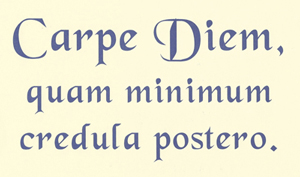
"Enjoy the present moment and don't depend on there being a tomorrow." -Horace
A continuing traditional theme in lyric poetry, dating back at least to Koheleth's "Eat, drink, and be merry" (based on Ecclesiastes 8:15). The phrase carpe diem exemplifies the spirit of hedonism and Epicureanism, i.e., the enjoyment of the moment and recognition of the transient nature of life.
So, carpe diem came from ancient times until the present with the advice often and variously expressed as: "Enjoy yourself while you have the chance"; "Eat, drink, and be merry, for tomorrow we die"; "Make hay while the sun shines"; "Enjoy yourself, it's later than you think."
William Safire had a different attitude regarding carpe diem when he wrote: "Seize the day has come to mean ‘strike while the iron is hot.' No longer is carpe diem the what-the-hell attitude of the dwellers in the present; it has become the battle cry of the gutsy opportunist with an eye on the future."
Many famous poems develop this "live it up now" theme; such as , the following by Robert Herrick (1591-1674):
Old Time is still a-flying,
And this same flower that smiles today
Tomorrow will be dying.
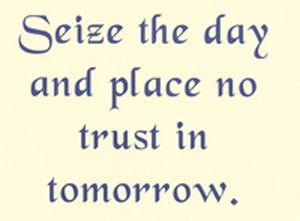
Translation:
Credence is close in meaning to belief; however, it is seldom applied in connection with faith in a religion or philosophy and it is more often used with reference to reports, rumors, and opinions.
2. Acceptance based on the degree to which something is believable: Claims that a political candidate can become the nest President of the U.S. gain credence only after he or she has won enough primaries.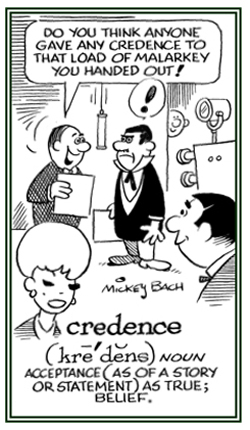
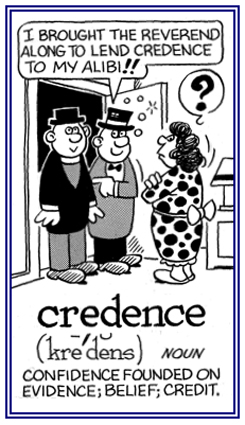
Go to this Word A Day Revisited Index
for a list of additional Mickey Bach illustrations.
2. Having credit or repute; credible.
The school administrator asked the college graduate if she had a teaching credential before the final decision was made to include her as a member of the faculty.
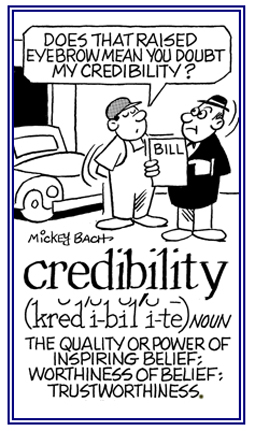
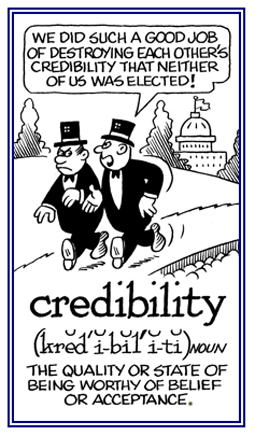
2. A willingness to accept something as true, believable, or plausible: The financial scandal damaged the credibility of the politician as an honest and and trustworthy candidate.