
anima-, anim-
(Latin: animal life, a living creature; living; breath; soul; mind)
The Latin element, anima-, refers to “a living being” from a Latin form meaning, “of air, having a spirit, living”; which in turn comes from another form meaning, “breath of air, air, soul, life”.
The inner self of a person: In Jung’s psychological terminology, the anima is the soul or that part of the psyche that is directed inwardly and is in touch with the unconscious.
The inner anima is contrasted with the "persona", which is the outer attitude or outer character.
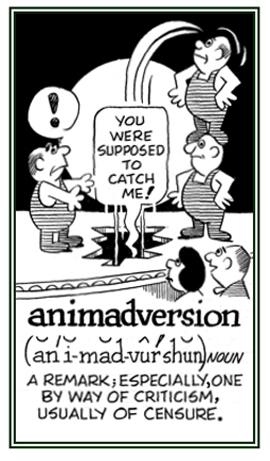
1. Strong criticism; censure, and disapproval: The Board of Directors expressed strong animadversion about the illegal actions of one of its members.
2. A critical comment, or comments; especially, those rebuking or shaming someone: The vegetarian expressed her animadversion about people whose diet is carnivorous because she believes they don't consider what is happening to animals that are being sacrificed to satisfy the desires of humans.

© ALL rights are reserved.
© ALL rights are reserved.
Go to this Word A Day Revisited Index
2. A critical comment, or comments; especially, those rebuking or shaming someone: The vegetarian expressed her animadversion about people whose diet is carnivorous because she believes they don't consider what is happening to animals that are being sacrificed to satisfy the desires of humans.
Go to this Word A Day Revisited Index
so you can see more of Mickey Bach's cartoons.
1. Pertaining to a critical or a censorious comment: James was known for his disapproving or animadversive remarks about people from foreign countries and so he didn’t have very many friends!
2. Descriptive of critical behavior towards others: Nobody liked Mrs. Black, the French teacher, because she was so animadversive about the mistakes that students made in their pronunciations and rarely ever complimented them about their work.
2. Descriptive of critical behavior towards others: Nobody liked Mrs. Black, the French teacher, because she was so animadversive about the mistakes that students made in their pronunciations and rarely ever complimented them about their work.
The state or quality of being severely critical or making remarks about how badly people are doing something: Jane didn’t like her mathematics class because of the animadversiveness that her teacher always showed when one of the students didn’t know the right answer or made a mistake while showing the use of numbers on the blackboard during class.
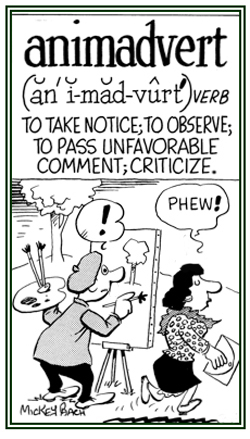
animadvert (an" uh mad VUHRT, an" im uhd VUHRT) (verb), animadverts; animadverted; animadverting
1. To remark unfavorably or to comment critically about; usually, with strong disapproval: Chester's neighbor was animadverting about the loud noise he was making while mowing his grass with his lawn mower; especially, since it was so early in the morning.
2. To turn one's mind or attention to; to observe and to be aware of: While standing on the seashore, Patricia animadverted the birds that were flying over the waves.
3. Etymology: from Latin animadvertere; literally, "to turn the mind toward"; "to notice, to pay attention to", from animus, "mind, mental" + advertere, "to turn toward, to turn to"; from ad-, "to" + vertere, "to turn"; either in a negative manner or a more positive way.
© ALL rights are reserved.
Go to this Word A Day Revisited Index
2. To turn one's mind or attention to; to observe and to be aware of: While standing on the seashore, Patricia animadverted the birds that were flying over the waves.
3. Etymology: from Latin animadvertere; literally, "to turn the mind toward"; "to notice, to pay attention to", from animus, "mind, mental" + advertere, "to turn toward, to turn to"; from ad-, "to" + vertere, "to turn"; either in a negative manner or a more positive way.
Go to this Word A Day Revisited Index
so you can see more of Mickey Bach's cartoons.
Someone who comments unfavorably or disapprovingly about a person or something: The animadverter was very negative about the woman's poor use of English and misinterpretations of vocabulary meanings.
1. An organism of the kingdom Animalia, distinguished from plants by certain characteristics: Animals have the power of locomotion, fixed structure, and limited growth.
3. Etymology: from Latin animale, "living being, a being which breathes."
An animal is a creature that is distinguished from plants by having independent movements and responsive sense organs.
2. Any member of the kingdom Animalia, comprising of multicellular organisms that have a well-defined shape and usually limited growth, can move voluntarily, actively acquire food and digest it internally, and have sensory and nervous systems that allow them to respond rapidly to stimuli: Some animals are restricted to being quadrupeds and applied especially to such as those that are used by man, as a horse, a donkey, or a dog.3. Etymology: from Latin animale, "living being, a being which breathes."
An older definition from the 1755 Dictionary of the English Language
Animals are such beings, which, besides the power of growing, and producing their kind, as plants and vegetables have, are endowed also with sensation and spontaneous motion.
animal bipes implume (Latin phrase)
A two-footed animal without feathers: The term animal bipes implume is a Latinized form of Plato's definition of mankind or the human race.
A branch of agriculture that specializes in the breeding, raising, and care of farm animals: After growing up on a farm with cows and studying agriculture at the university, James definitely wanted to go into animal husbandry and be in this occupation or profession.
Animal Index
See these animals from different perspectives.
A creature that is so small as to be visible only with the aid of a microscope: Certain animalcules, which cannot be seen normally, can be breathed in through the nose and mouth into the body and can cause illnesses.
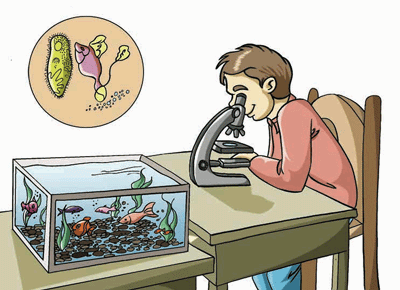
A theory that seeks to explain physiological or pathological phenomena via microscopic organisms; such as, amoeba or paramecium: Animalculism involves the research of germs in order to determine the causes of certain illnesses.
The branch of the food industry that involves the growing, or rearing, of animals for human consumption: Janet did a practicum in animalculture to find out if this area of producing livestock for grocery stores was something she could imagine doing later as a career.
1. An obsession or compulsion to know more regarding physical rather than spiritual needs: There are some people who accuse others of being more focused on their bodily conditions or animalisms than their religious dedication to God.
2. The theory that human beings are driven by physical appetites and not by nonmaterial issues: His animalism showed up in the way Jack ate his meals during which he was devouring his food as if he hadn’t eaten in days!
2. The theory that human beings are driven by physical appetites and not by nonmaterial issues: His animalism showed up in the way Jack ate his meals during which he was devouring his food as if he hadn’t eaten in days!
Someone who is a believer in, or one who has a greater interest, in physical rather than non-physical needs: Tom’s mode of living seemed to be more of that of an animalist because he was only concerned with enjoying good health and vigorous bodily activities.
