
acous-, acou-, acouo-, acoustico-, acouto-, acousti-, -acousia, -acousis, -acoustical, acu-, -acusis-, -acusia
(Greek: akoustikos, to hear, hearing; to listen, listening)
In psychiatry, a nonverbal auditory hallucination, such as a ringing or hissing in the ears: Dr. Thompson explained the acouasm in Bob's ears as tinnitus and that there was no special medical treatment for it.
A listening device which is dropped by parachute onto land or water: An acoubuoy is an instrument that is used by a military force with the objective of detecting sounds of enemy movements and then to transmit such information to an aircraft or to nearby installations for analyses.
The sense of hearing; auditory perception: Shirley had acute acouesthesia and it helped her to be an accomplished singer and performer.
You can hear cow bells but you can't hear cow horns.
We hear what we listen for.
A good listener is one who can give you his full attention without hearing a word you say.
An instrument used for estimating the power or extent of the sense of hearing: Jane's doctor used an acoumeter to determine why she was having so much trouble in perceiving what people were saying to her.
An obsolete, or outdated, term for an electric hearing aid: Margaret's grandmother had an old acouophone which the doctor advised her to turn in for a credit towards the purchase of a new and more modern hearing aid.
A medical procedure that involves hearing percussions or the act of listening to sounds produced within the body, especially the chest and abdomen, as a means of detecting evidence of physical disorders or pregnancies: Carol's doctor, applying a stethoscope, used an acouophonia on her chest and detected a heart murmur.
A simple auditory hallucination, such as ringing or buzzing sounds in the ears: At the height of his mental delusions, Edgar experienced acousma to which he reacted by trying to run away in an effort to avoid the sounds.
In psychology, an abnormal inability to understand spoken words or being unable to recognize meaningful sounds: Patricia was recently admitted to the hospital and appeared to be suffering from acousmatagnosis because she looked frightened and dazed because she could not understand what the doctor was saying. So the physician made an effort to communicate with her by writing what he wanted her to know.
1. Failure of the memory to call up the images of sounds: The doctor diagnosed a severe case of acousmatamnesia for Kerri and he had no suggestion as to how he could help her.
2. The inability to recall and to identify certain sounds: Eugene could see Sara struggle with her acousmatamnesia as she tried to remember how to pronounce the sounds of the alphabet.
2. The inability to recall and to identify certain sounds: Eugene could see Sara struggle with her acousmatamnesia as she tried to remember how to pronounce the sounds of the alphabet.
acousmatic (adjective), more acousmatic, most acousmatic
1. Relating to a class of scholars under Pythagoras who listened to his teachings without inquiring into their inner truths: The acousmatic pupils of the philosopher Pythagoras were required to sit in total silence while they listened to him deliver his lecture from behind a veil or screen so they might be able to concentrate better on what he was teaching them.
2. A reference to a sound, whether natural or produced, when the source of the sound is unseen or has no visually recognizable cause: In a mystery film, the prisoner could hear the acousmatic ringing of a bell from a source far above him.
2. A reference to a sound, whether natural or produced, when the source of the sound is unseen or has no visually recognizable cause: In a mystery film, the prisoner could hear the acousmatic ringing of a bell from a source far above him.
acoustic (adjective) (not comparable)
1. Pertaining to the sense of hearing: Dogs are known to have a much greater acoustic range for hearing than humans.
2. A reference to something that can be used to aid a person's hearing: The doctor prescribed an acoustic hearing aid for Mark so he could listen to others better.
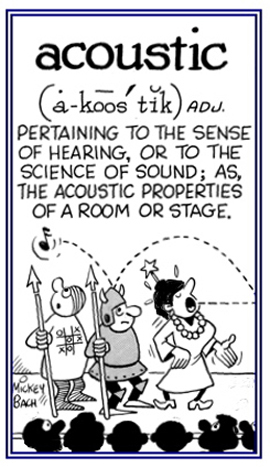
© ALL rights are reserved.
Go to this Word A Day Revisited Index
2. A reference to something that can be used to aid a person's hearing: The doctor prescribed an acoustic hearing aid for Mark so he could listen to others better.
Go to this Word A Day Revisited Index
for a list of additional Mickey Bach illustrations.
A process in which sound energy is reduced as sonic waves strike or pass through a surface: The engineer worked to develop a plan for better acoustic absorption in the large auditorium.
The inability to write from dictation or from what is heard: Dr. Davis is a specialist in treating acoustic agraphias with which several of his patients are afflicted.
Impairment in the understanding of auditory language and communication, including the inability to write from dictation in the presence of normal hearing: Acoustic aphasia consists of sounds that are heard but which convey no meaning, however spontaneous speech, reading, and writing are supposedly not affected.
The numerous body organs and structures consisting of hearing, especially the various parts of the ear: As future ear, eye, nose and throat specialists, some of the medical students found the acoustic apparatus to be the most difficult to master.
If you would like to take a self-scoring quiz over many of the words in this unit, then click on this Hearing Quiz link so you can see how much you know about some of these “acous-, acou-” words.
Related "hear, hearing; listen, listening" units: audio-; ausculto-.
