
-atic
(Greek > Latin: a suffix; pertaining to; of the nature of)
2. A reference to a sound, whether natural or produced, when the source of the sound is unseen or has no visually recognizable cause: In a mystery film, the prisoner could hear the acousmatic ringing of a bell from a source far above him.
2. Certain kinds of greenery that have adapted to living in or on water environments: The aquatic plants along the side of the river appeared to be water hyacinths.
2. A reference to an unpredictable, irregular, or inconsistent situation; especially, in being likely to depart from expected standards at any time: During the summer holidays, Jaden's schedule for practicing the piano was more erratic than during the normal school year.
3. Characteristic of something which changes direction and does not follow any definite course: Flying in the wind, Fay's kite was most erratic in its positions.
4. A reference to a constant reorientation which has no fixed or regular path; wandering: Ralph and Deborah decided to take a more erratic route home after the sun came out after the stormy weather.
5. Relating to the lack of consistency, regularity, or uniformity: Dr. Black, the cardiologist, was monitoring Jane's erratic heart beat.
6. Referring to variable or unpredictable conditions; such as, the progression of an illness or the site of pain: Oscar tried to describe the erratic itch he had on his right foot.
7. A description of a rock or boulder that was carried from its source by ice and deposited when the ice melted: Maribel picked up an erratic stone at the foot of the glacier to add to her collection.
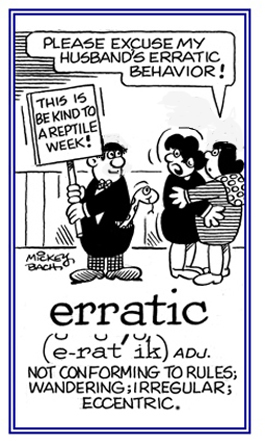
Go to this Word A Day Revisited Index
so you can see more of Mickey Bach's cartoons.
2. Someone who is marked or motivated by an extreme, unreasoning enthusiasm, as for a cause.
3. A fanatic, a zealot, a militant, a devotee; all refer to people who show more than ordinary support for, adherence to, or interest in a cause, a point of view, or an activity.
4. Marked by excessive enthusiasm for and intense devotion to a cause or idea.
5. Etymology: From about 1525, "insane person", from Latin fanaticus, "mad, enthusiastic, inspired by a god," originally, "pertaining to a temple," from fanum "temple," related to festus "festive". The current sense of "extremely zealous", especially in religion, is first attested in 1647. The noun is from 1650, originally in a religious sense, of nonconformists.
Fanatic and zealot both suggest excessive or overweening devotion to a cause or belief.
Fanatic further implies unbalanced or obsessive behavior or a wild-eyed fanatic. A zealot, only slightly less unfavorable by implication than the term fanatic, implies a single-minded partisanship; such as, "a tireless zealot for tax reform".
Militant stresses vigorous, aggressive support for or opposition to a plan or ideal and suggests a combative stance.
Devotee is a milder term than any of the previous terms, suggesting enthusiasm but not to the exclusion of other interests or possible points of view; for example, a jazz devotee.
Another perspective about the term fanatic
According to the simplest etymology, "fanatic" derives from the Latin fanum, "temple"; but the meaning "zealous" or "zealot" seems to derive from the peculiar behavior of priests who served the Roman war goddess Bellona at a fanum built by the military dictator Sulla in the first century B.C.
Every year the priests staged a festival during which they tore off their robes and hacked at themselves with axes, splattering blood everywhere. This behavior could only be a sign of divine inspiration, and so fanaticus came to mean something like "crazed by the gods".
When the word "fanatic" first appeared in English in the sixteenth century, it meant "crazed person", and then more specifically "possessed with divine fury".
"Religious maniac" is still the principal meaning of the term, but in the shortened form "fan", it also simply means, "devotee" or "adherent".
2. Pertaining to a problem; difficult to solve: A repair of Karen's car proved more problematic than first expected.
3. Not settled; unresolved or dubious: Jonathan has a problematic future as a computer expert.
4. Etymology: from Greek problematikos and from Latin problematicus, "relating to a problem."
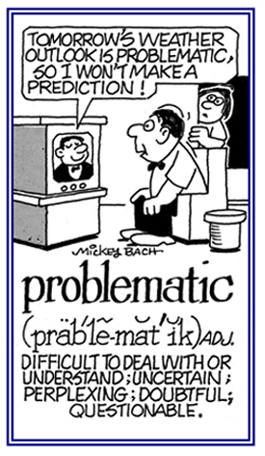
Go to this Word A Day Revisited Index
so you can see more of Mickey Bach's cartoons.
2. Growing or remaining under water.
3. Being under water, or beneath the surface of water; adapted for use under water; such as, a submarine or a subaqueous helmet.
4. Formed in or under water; such as, "subaqueous deposits".
5. The practice of going underwater with or without a breathing apparatus.
When done for sport, this is sometimes called subaquatics. There are different kinds of underwater diving.
- Snorkeling and free diving: swimming underwater without a breathing apparatus. An apparatus used by swimmers and skin divers, consisting of a long tube held in the mouth.
- Scuba diving and surface supplied diving: swimming or walking underwater with a breathing apparatus.
