
vinc-, vict-, -vince, -vincible, -vincibility +
(Latin: conquer, overcome)
ad victoriam
"To victory." More commonly translated into "for victory" which was the battlecry of the Romans.
Amor vincit omnia.(Latin statement)
Translation: "Love conquers all."
Normally, the order in Latin is "Omnia vincit amor."
Ante victoriam ne canas triumphum.
Do not sing your triumph before the victory.
In other words, "Don't start bragging before the contest is over."
Aut vincere aut mori.
Either to conquer or to die.
A Roman motto that may also be translated as, "Victory or death."
Christus vincit, Christus regnat, Christus triumphat.
Christ conquers, Christ reigns, Christ triumphs.
On Christmas day of the year 800, Charlemagne was crowned Roman Emperor by Pope Leo III and accepted all privileges and duties of protector and ruler over the entire occidental world.
He was a patron of arts and sciences and gathered at his court scholars and literary men of all nations. He founded schools at Aachen, Colgne, Fulda, Hersfeld, Reichenau, Salzburg, and St. Gallen (Germany) to spread religious and secular knowledge throughout his realm. He is buried in the Cathedral of Aachen, Germany, constructed during his reign.
convict
1. In law, to find or to prove (someone) guilty of a legal offense or crime; especially, by the verdict of a court: "The jury convicted the defendant of murder."
2. To show or to declare to be blameworthy; to condemn.
3. To make aware of one's sinfulness or guilt.
4. A person proved or declared guilty of an offense.
5. A person serving a prison sentence.
6. Etymology: from Latin convictus and convincere, "to overcome decisively", from com-, "with, together" + vincere, "to conquer".
2. To show or to declare to be blameworthy; to condemn.
3. To make aware of one's sinfulness or guilt.
4. A person proved or declared guilty of an offense.
5. A person serving a prison sentence.
6. Etymology: from Latin convictus and convincere, "to overcome decisively", from com-, "with, together" + vincere, "to conquer".
1. A belief or an opinion that is held strongly: Jane’s mother had a conviction that girls and women should always wear dresses or skirts, but not trousers, jeans, or slacks.
2. A firmness of an opinion; such as, something that is said with complete certainty or confidence: Mrs. Smith had a strong conviction that all of the people around the world should have the freedom of speech.
3. An act of finding someone guilty of a crime: The evidence pointed out that a conviction was certain because of Tim's drunk-driving when he was going home after being at the pub.
4. The act or process of persuading or the state of being convinced: The teachers of the school all shared a strong conviction that the principal should call a meeting to discuss and to solve the problems of so many refugees coming to their school all of a sudden.
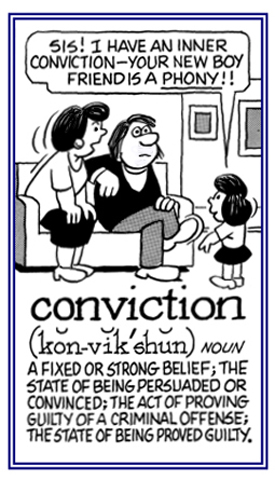
© ALL rights are reserved.
Go to this Word A Day Revisited Index
2. A firmness of an opinion; such as, something that is said with complete certainty or confidence: Mrs. Smith had a strong conviction that all of the people around the world should have the freedom of speech.
3. An act of finding someone guilty of a crime: The evidence pointed out that a conviction was certain because of Tim's drunk-driving when he was going home after being at the pub.
4. The act or process of persuading or the state of being convinced: The teachers of the school all shared a strong conviction that the principal should call a meeting to discuss and to solve the problems of so many refugees coming to their school all of a sudden.
Go to this Word A Day Revisited Index
so you can see more of Mickey Bach's cartoons.
convictism
Convicts as a class.
convince
1. To make (someone) agree, to understand, or to realize the truth or validity of something.
2. To make someone sure or certain of something.
3. To persuade a person to believe or to do something.
2. To make someone sure or certain of something.
3. To persuade a person to believe or to do something.
convincer
Someone who persuades, brings (as by argument) a belief, a consent, or a course of action.
convincible
1. Being susceptible to persuasion.
2. Capable of being convinced by someone of the truth of a statement, proposition, situation, etc.
2. Capable of being convinced by someone of the truth of a statement, proposition, situation, etc.
convincing
1. Capable of persuading.
2. Causing someone to believe the truth of something.
3. Believable; plausible.
4. Skilled at making people believe something.
2. Causing someone to believe the truth of something.
3. Believable; plausible.
4. Skilled at making people believe something.
convincingly
1. In a convincing manner.
2. Done in a way so as to be persuading of the truth, rightness, or reality of something.
2. Done in a way so as to be persuading of the truth, rightness, or reality of something.
convincingness
1. The power of argument or evidence to cause belief.
2. The state or quality of being convincing.
2. The state or quality of being convincing.
evict (verb), evicts; evicted; evicting
1. To force a tenant to leave a property, especially the tenant's residence, usually because he or she has failed to comply with the terms of a lease.
2. To force out; to eject, to expel.
3. In law, to recover (property, for example) by a superior claim or legal process.
4. Etymology: "recover property", from Latin evictus and evincere, "to recover property, to overcome and to expel, to conquer"; from ex-, "out" + vincere, "to conquer".
2. To force out; to eject, to expel.
3. In law, to recover (property, for example) by a superior claim or legal process.
4. Etymology: "recover property", from Latin evictus and evincere, "to recover property, to overcome and to expel, to conquer"; from ex-, "out" + vincere, "to conquer".
