
via- [-vey, -voy-]
(Latin: way, road, path)
1. A statement used to wish someone or a group to have an enjoyable and safe trip.
2. Etymology: from French, literally, bon, "good" + voyage, "journey".
2. Etymology: from French, literally, bon, "good" + voyage, "journey".
It is related to Late Latin viaticum, "a journey" (in classical Latin "provisions for a journey"), from a noun use of viaticus, "of or for a journey"; from via, "road, journey, travel".
convey (verb), conveys; conveyed; conveying
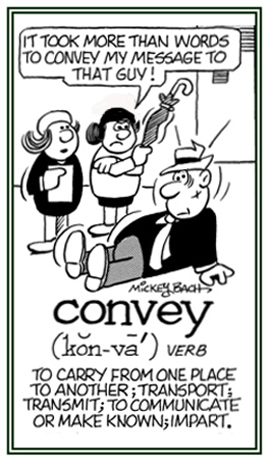
1. To take or to move someone or something to a destination or a place: The truck was able to convey all of the furniture and other property of Mike's family from their former residence to their new living quarters.
2. To make something known to others: Mark’s behavior always shows his desire to convey all the tenderness and love which he felt for his little girl.
3. To transfer or to transmit something along a wire, a pipe, a tube, or some other carrier: Margaret used her computer to convey her messages by e-mail.
© ALL rights are reserved.
Go to this Word A Day Revisited Index
2. To make something known to others: Mark’s behavior always shows his desire to convey all the tenderness and love which he felt for his little girl.
3. To transfer or to transmit something along a wire, a pipe, a tube, or some other carrier: Margaret used her computer to convey her messages by e-mail.
Go to this Word A Day Revisited Index
so you can see more of Mickey Bach's cartoons.
conveyable (adjective), more conveyable, most conveyable
Capable of being legally transferred to the ownership or title of another person: The condo Lynn owned was conveyable or assignable to her children.
A group of ships or vehicles traveling together, usually accompanied by armed troops, warships, or other vehicles for protection.
convoy (verb), convoys; convoyed; convoying
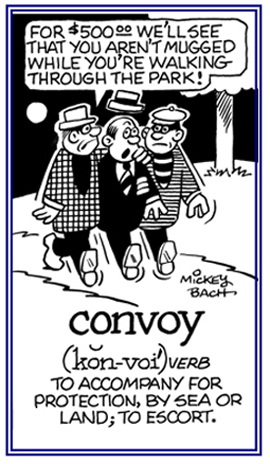
1. To travel with and to protect someone or something: The police and FBI agents have the duty to convoy the President to the White House.
2. Etymology: from Medieval Latin conviare, "to escort, to guard, to protect"; from Latin com-, "with, together" + via, "way".
© ALL rights are reserved.
Go to this Word A Day Revisited Index
2. Etymology: from Medieval Latin conviare, "to escort, to guard, to protect"; from Latin com-, "with, together" + via, "way".
Go to this Word A Day Revisited Index
so you can see more of Mickey Bach's cartoons.
deviant (adjective), more deviant, most deviant
1. Pertaining to a person or something that goes from doing something in a normal way.
2. Descriptive of an action that goes sharply from a customary, traditional, or generally accepted standard to one that is not acceptable.
2. Descriptive of an action that goes sharply from a customary, traditional, or generally accepted standard to one that is not acceptable.
deviate (verb), deviates; deviated; deviating
1. To turn aside from a course or a way.
2. To depart, as from a norm, purpose, or subject; to stray or to swerve from what is considered normal.
2. To depart, as from a norm, purpose, or subject; to stray or to swerve from what is considered normal.
deviating (adjective), more deviating, most deviating
