
vexill-
(Latin: flag, flags; standards, banners)

|

|

|

|

|

|

|

|

|

|

|

|
Hank's web site emphasized content about cybervexes and their related ensign knowledge.
Vexilla regis prodeunt,
Fulget crucis mysterium,
Qua vita mortem pertulit
Et morta vitam protulit.
Abroad the royal banners fly
And bear the gleaming Cross on high-
That Cross whereon Life suffered death
And gave us life with dying breath.
2. A Roman standard-bearer; originally, a member of a special Roman military unit under a separate cavalry: The stone carvings on a pillar showed mounted vexillaries marching in a parade.
2. A regular division of cavalry; also, a company of veterans of a legion: One vexillation of the old infantrymen wore the bright colors of their regiment when they marched in the military parade.
While the earliest flags were vexilloids, the emblem at the top of the staff varied. It might have been the tail of a tiger, a metal vane, a ribbon, a carved animal, a windsock of woven grasses or crude cloth, or a construction combining more than one material.
Since kinship, real or imagined, constituted the principal organizing technique of primitive societies, very frequently the animal, from which the clan claimed descent and for which it was named as the chief symbol of the vexilloid.
The people who carried the totem believed they derived their powers from it; hence, "vexilloids acquired a religious significance which they have never lost".
Like Roman religion, these vexilloids were not jealous or exclusivistic because official recognition was given in the Roman pantheon to the totemic vexilloids of barbarian troops serving in the Roman army.
It was a matter of great surprise to the Romans when the monotheistic Jews rioted in ca. 26 A.D. upon the introduction of the sacred Roman vexilloids into the Temple on order of Pilate.
2. Etymology: from Latin vexil, "flag" + -latgry, "worship".
Vexilloids of the Roman Empire were sophisticated in design and usage. Animals were used on standards until 104 B.C. when the consul Marius ordered the eagle to become the sole standard of Roman legions. Names and wreaths of honor were included on some Roman vexilloids, while in later years the emperors insisted that their portraits be used.
2. Etymology: from the word vexillum, the only cloth flag apparently carried by the Romans, which is derived the word vexillology, the study of flag history and symbolism.2. The scholarly study of the history, symbolism, etiquette, design, manufacture, and other aspects of standards: Vexillology can include a wide variety of fields that apply to flags and their uses.
3. Etymology: from Latin vexillum, a term used by the Romans to refer to a kind of standard with a fabric hung from a horizontal crossbar on a pole. It is the closest equivalent in the classical languages to what we call a flag today.
In his book, Dr. Smith says, "While the use of flags goes back to the earliest days of human civilization, the study of that usage in a serious fashion is so recent that the term for it (vexillology, coined by the author of this book) did not appear in print until 1959. This has resulted in a lack of uniformity in flag terms and, worse still, a lack of source material concerning actual usage on which standardization might be based."
A Few Examples of the Flag Terms Used in Vexillology
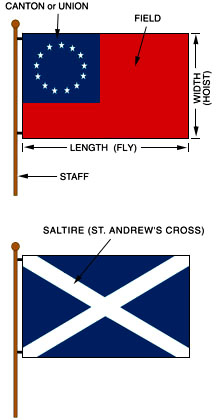
Also see additional information about flags at this Vexillology Information page.
Here are special links to Flags, Places, and Languages of the World pages.

For comments or suggestions, contact us at [email protected].
