
vent-
(Latin: air, wind)
A rapid ventricular rhythm, approximately 60 to 110 beats per minute: Accelerated idioventricular rhythm usually results from premature beats or an escape rhythm generated by the slowing of the sinus pacemaker or acceleration of a ventricular pacemaker.
anteroventral (adjective), more anteroventral, most anteroventral
1. In anatomy, concerning the underside of the front part of the head: In his anatomy class, Jack learned about the anteroventral section of a person's head.
2. A structure located in front and toward the lower surface of the head: Jane saw some insects that had anteroventral body parts in her garden.
2. A structure located in front and toward the lower surface of the head: Jane saw some insects that had anteroventral body parts in her garden.
Mechanical ventilation used in assisting breathing when deficient: Assisted-controlled ventilation can also completely assume control of breathing in the presence of apnea (non breathing).
Mechanical ventilation that takes the place of natural inspiration and expiration: Controlled ventilation can be employed in the management of pulmonary insufficiency.
A geyser on the sea bottom through which super-hot aqueous solutions rise from the magma beneath the crust; hydrothermal vent:
Deep-sea vents create a surrounding system of mineral-rich water that helps to support a distinctive type of ecosystem not found in typical cold-water environments at the same ocean depth.
exhausting ventilation, vacuum ventilation (s) (noun); exhausting ventilations; vacuum ventilations (pl)
A system employing an exhaust fan that forces out foul or used air from a room in a building and provides fresh air from outside: Some firms, where dangerous or noxious processes take place, use vacuum ventilation in order to provide a healthy environment for the workers.
1. A fissure in the sea bottom through which hot aqueous solutions rise from the magma beneath the crust; a hot spring: Hydrothermal vents are located on the seabed mainly along the central axes of the ridges in mid-ocean.
2. A geyser on the sea bottom through which super-hot aqueous solutions rise from the magma beneath the earth's crust: The hydrothermal vents create a surrounding system of mineral-rich water which helps to support a distinctive type of ecosystem not found in typical cold-water environments at the same ocean depth.
2. A geyser on the sea bottom through which super-hot aqueous solutions rise from the magma beneath the earth's crust: The hydrothermal vents create a surrounding system of mineral-rich water which helps to support a distinctive type of ecosystem not found in typical cold-water environments at the same ocean depth.
hyperventilate (verb), hyperventilates; hyperventilated; hyperventilating
To breathe unusually deeply or rapidly because of anxiety or of an organic disease and in excess of the body's requirements, causing too much loss of carbon dioxide: Janet started to hyperventilate because she was suddenly under stress.
1. Extremely rapid or deep breathing that over oxygenates the blood: Hyperventilation causes dizziness, fainting, tingling in the lips, hands and feet, a headache, fainting, etc.
2. An excessive rate and depth of respiration: Hyperventilation leads to an abnormal loss of carbon dioxide from the blood and an increase of oxygen in the blood.
2. An excessive rate and depth of respiration: Hyperventilation leads to an abnormal loss of carbon dioxide from the blood and an increase of oxygen in the blood.
1. Abnormally slow and shallow respiration, resulting in an increased level of carbon dioxide in the blood: Hypoventilation can result due to a medical condition, by a drug overdose, or even by holding one's breath!
2. A condition in which there is a reduced amount of air entering the pulmonary (lung) alveoli (small cell containing air in the lungs), causing decreased levels of oxygen and increased levels of carbon dioxide in the blood Hypoventilation can be a result of breathing that is too shallow (hypopnea), or too slow (bradypnea), or by diminished lung function.
2. A condition in which there is a reduced amount of air entering the pulmonary (lung) alveoli (small cell containing air in the lungs), causing decreased levels of oxygen and increased levels of carbon dioxide in the blood Hypoventilation can be a result of breathing that is too shallow (hypopnea), or too slow (bradypnea), or by diminished lung function.
An apparatus for artificial ventilation of a patient who has weak or paralyzed respiratory muscles: A tank ventilator consists of a rigid tank which encloses the body from the neck down.
Changes of pressure of air within the tank ventilator bring about inspiration and expiration.
vending, venting
vending (VEND ing) (verb)
To sell by means of a machine that sells items for money or by peddling: He was vending more wholesome food than the others.
venting (VENT ing) (VEND ing) (verb)
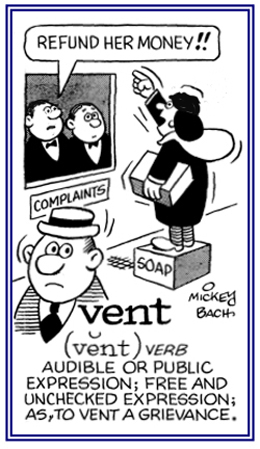
1. To express (one's thoughts or feelings, for example), especially forcefully; usually in a loud or angry manner: She was venting her frustrations by yelling at the driver who suddenly cut in front of her car.
2. To release or to discharge (steam, for example) through an opening: We were venting the fumes from the chemical mixture by opening the windows.
2. To release or to discharge (steam, for example) through an opening: We were venting the fumes from the chemical mixture by opening the windows.
The woman found herself venting her anger when the vending machine took her money and didn't even give her the bag of chips that she wanted.
vent (verb), vents; vented; venting
1. To express one's feelings or emotions: Susan called up her best friend to vent her anger of how her brother treated her unfairly.
2. To present a person's complaints: Jan vented her displeasure to the store's sale's department because she wanted her money back for the dress which she purchased that didn't fit her daughter properly.
3. To air out something or expose it to fresh air: Jackie hung out her dress to vent it in the cool breeze.
4. Etymology: from Latin ventus, "wind".
© ALL rights are reserved.
Go to this Word A Day Revisited Index
2. To present a person's complaints: Jan vented her displeasure to the store's sale's department because she wanted her money back for the dress which she purchased that didn't fit her daughter properly.
3. To air out something or expose it to fresh air: Jackie hung out her dress to vent it in the cool breeze.
4. Etymology: from Latin ventus, "wind".
Go to this Word A Day Revisited Index
so you can see more of Mickey Bach's cartoons.
A passageway for wind or air, a ventilation duct: A ventiduct can be a pipe for refreshing apartments or rooms.
In a building, a ventiduct can be a conduct for wind or air, like for a subterraneous spiracle for aerating apartments.
A stone or pebble that has been shaped, cut, or polished by wind-blown, or wind-driven, sand: While walking along the sea shore, Alice found a very smooth ventifact that she added to her collection of rocks.
Cross references of word groups that are related, directly or indirectly, to: "air, wind": aello-; aeolo-; aero-; anemo-; atmo-; austro-; flat-, flatu-; phys-; pneo-, -pnea; pneumato-; turb-; zephyro-.

Showing page 1 out of 2 pages of 25 main-word entries or main-word-entry groups.