
vener-, venari-
(Latin: love, loveliness, beauty, attractiveness, charm; by extension, "reverence; to worship")
2. Worthy of reverence, especially by religious or historical association: There were many venerable and antiquated relics to be seen in the church around the corner.
3. Referring to places, buildings, etc.; hallowed by religious, historic, or other lofty associations: On the tour of the abbey, June admired the venerable halls which were full of bygone days and brimming with tales of fate.
4. Venerable, abbreviated, Ven. or V., in the Roman Catholic Church and used as a form of address for an individual who has reached the first stage of canonization: Bishop Fulton J. Sheen and Princess Louise of France are two examples of Venerables.
5. Pertaining to a form of address for an archdeacon in the Anglican Church or the Episcopal Church: The venerable ecclesiastical dignitary had been assigned the lowest degrees of acknowledgement for sanctitude.
6. Impressive or interesting because of age, antique appearance, etc.: The old and venerable grandfather clock stood at a special spot in the living room.
There was a venerable oak tree in the family's garden.
7. Extremely old or obsolete or ancient: Thomas remembered that there was a venerable and timeworn house which had been taken down many, many years ago.
2. To revere suggests awe coupled with profound honor.
3. Etymology: from Latin veneratus, venerari, "to reverence, worship, venerate", from venus, veneris, "love, sexual desire, loveliness, attractiveness, beauty, charm"; whence Venus, Veneris, "the goddess of love".
2. The expression of profound respect or reverence for someone or something.
3. A condition of being respected or revered.
2. Etymology: from Latin venereus, from Latin Venus, in ancient Roman mythology, the goddess of beauty and love; especially, sensual love, from venus, "love, sexual desire, loveliness, beauty, charm".
2. The act of worshiping, to worship.
2 To hold in exalted honor without fear: In Christianity, believers venerealize Jesus with total reference and obedience.
2. A person who studies diseases or who is a specialist the diagnosis and treatment of such illnesses that are communicated by sexual intercourse.
2. From Medieval Latin veneria, from Latin venus, vener-, "desire, love".
3. The term venery, is also considered to be an archaic term from Middle English venerie from Old French venerie; which came from Latin venari, "to hunt, to pursue".
Remember that this word is not the same as the venery terms indicated in other entries of this unit!
Go to the following link for more information about the "hunting" venery.
2. Etymology: from Old French venial, which came from Latin venialis, "pardonable", from venia, "forgiveness, indulgence, pardon".
Related to venus, "sexual love, desire".
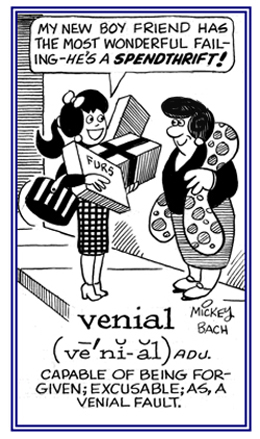
Go to this Word A Day Revisited Index
so you can see more of Mickey Bach's cartoons.
2. In the Roman Catholic Church, an offense that is judged to be minor or committed without deliberate intent and so it does not estrange the soul from the grace of God.
3. A transgression against the law of God that does not deprive the soul of divine grace either because it is a minor offense or because it was committed without full understanding of its seriousness or without full consent of the will.
4. Etymology: from Old French venial, which came from Latin venialis, "pardonable; graciouis, kind", from venia, "forgiveness, indulgence, pardon".
Related to venus, veneris, "love, desire" or venerari, "to reverence, to worship".
2. An ancient Italian goddess of gardens and spring, identified by the Romans with the Greek Aphrodite as the goddess of love and beauty.
3. An exceptionally beautiful woman.
4. In archaeology, a statuette of a female figure, usually carved of ivory and typically having exaggerated breasts, belly, or buttocks; often found in Upper Paleolithic cultures from Siberia to France.
5. The second planet from the sun, having an average radius of 6,052 kilometers (3,761 miles), a mass 0.815 times that of Earth, and a sidereal period of revolution about the sun of 224.7 days at a mean distance of approximately 108.2 million kilometers (67.2 million miles).
Related "love, fondness" units: agape-; amat-; philo-; venus.
Here is an attempt to clarify the different "hunt, hunting" and the "love, fondness" terms: venat-, "hunt, hunting"; Names for Groups or "Venery names"; Introduction to Venereal and Other Group Terms or "Venery names"; Venereal Terms or "names for a variety of groups".