
veh-, vect-
(Latin: quantity having magnitude and direction; carrier, bearer, conveyer; from the stem of vehere, "to carry, to convey, to cart")
1. The movement in a gas or liquid in which the hotter parts move upward and the colder elements go down: The chemist explained that convection consists of "circulatory movements" that are related to the rising of the warmer, less dense particles; and the sinking of cooler, more dense particles.
2. Etymology: from Late Latin convectio which comes from convehere, "to carry, to bring together".
2. Etymology: from Late Latin convectio which comes from convehere, "to carry, to bring together".
A cooking device that moves hot air around so food can cook more evenly: Greg's mother used a convection oven which produced better quality meals then those cooked on top of stoves.
convective (adjective), more convective, most convective
Descriptive of the process by which heat is generated or transferred by the movement of particles in various mediums; such as, liquid or gas: Water is considered a convective medium for electrical currents.
convectively (adverb), more convectively, most convectively
A reference to the activity caused within a fluid by the tendency of hotter and, therefore less dense material, to rise; and colder, denser material to sink under the influence of gravity, which consequently results in the transfer of heat: The electrical current convectively moved through the water and created considerable heat.
1. A partly enclosed, heated surface from which warm air circulates: The convector in the ceiling, and the fan located there, ensured that the heated ventilation produced by the convector was being distributed more efficiently in the large living room.
2. A space heater that transfers heat to the surrounding area: Mark bought a new convector for his work room when the weather turned cold.
2. A space heater that transfers heat to the surrounding area: Mark bought a new convector for his work room when the weather turned cold.
convex (adjective), more convex, most convex
1. Descriptive of a surface that curves in an outwardly fashion: Standing in front of the convex mirror makes Milly look overweight, even though she is very slim.
2. Pertaining to an outline or surface that is curved like the exterior of a circle or sphere: Steve understood that the outward curve of a bowl was an example of an object that has a convex shape.
3. Etymology: from Latin convexus, "vaulted, arched", from convehere, "to bring together", from com-, "together" or "thoroughly" + vehere, "to bring".
2. Pertaining to an outline or surface that is curved like the exterior of a circle or sphere: Steve understood that the outward curve of a bowl was an example of an object that has a convex shape.
3. Etymology: from Latin convexus, "vaulted, arched", from convehere, "to bring together", from com-, "together" or "thoroughly" + vehere, "to bring".
The state or condition of having an outwardly bulging or curving surface: The side of the grand piano had a perfect convexity to it.
In photography, there are convexities for camera lenses which can be used for a variety of situations.
convexly (adverb), more convexly, most convexly
In a manner that swells out toward the outside: The convexly curved mirror was positioned so that a person could see into the corners of the room.
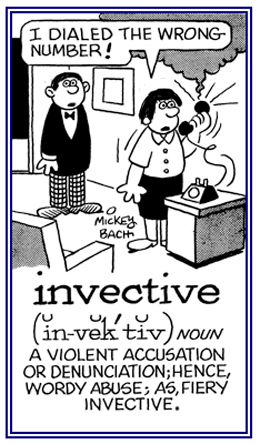
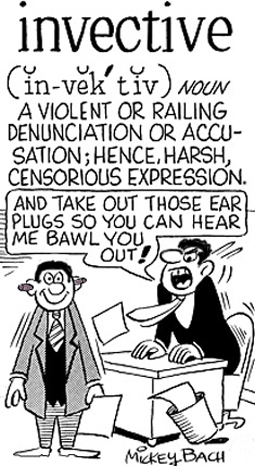
1. Swearing or abusive language that is harsh or insulting: James was very upset with the invectives his wife was saying to him because he forgot that it was her birthday.
2. Any vehement accusations or denunciations including bitterly abusive or sarcastic speech: The politicians were throwing invectives at each other during their TV debate.
© ALL rights are reserved.
© ALL rights are reserved.
Go to this Word A Day Revisited Index
2. Any vehement accusations or denunciations including bitterly abusive or sarcastic speech: The politicians were throwing invectives at each other during their TV debate.
Go to this Word A Day Revisited Index
so you can see more Mickey Bach illustrations.
invective (adjective), more invective, most invective
Characterized by rude, offensive, furious speech: When angered because of the criticism by some of her coworkers, the supervisor, Mrs. Jackson, spoke in a very invective way about her colleagues.
invectively (adverb), more invectively, most invectively
Pertaining to a situation that expresses anger, insults, or sarcastic comments: The sales clerk had the most invectively rude manners that Sharon had ever experienced before.
Language that is abusive, contemptuous, and intended to inflict harm: When accused of the crime of robbing a bank during the trial, the defendant, Mr. Smith, responded with an invectiveness which shocked his lawyer, the judge, and the members of the jury.
inveigh (verb), inveighs; inveighed; inveighing
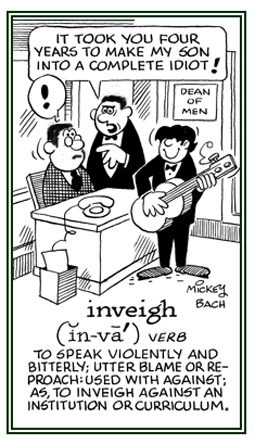
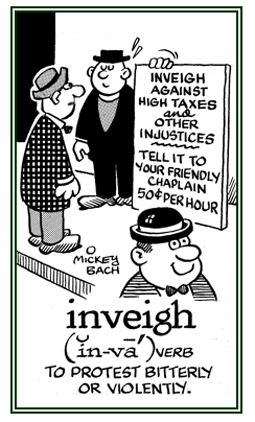
To rail and to protest, often in an angry and affronting manner: The students at the private school, including Jacky and Simon, inveighed against the poor food in the cafeteria.
© ALL rights are reserved.
© ALL rights are reserved.
Go to this Word A Day Revisited Index
The office staff inveighed against the company's requirement for them to work overtime.
Go to this Word A Day Revisited Index
so you can see more of Mickey Bach's cartoons.
Someone who speaks up to protest a situation in an uncontrollable and insulting manner: The chief of police met with the two inveighers who had lead the protests on the street about the unsanitary conditions of the subways.
A term for a motor vehicle which has a relatively small production output and that is sold to a just a few people in the general market: A niche vehicle usually is a very expensive item; such as, an expensive sports car, that only a limited number of purchasers can afford to pay the such a high price.
