
valid-, val-, vale-, -vail, -valent, -valence
(Latin: valere, to be strong, to be well, to be worth; strong; power, strength; and "fare well" [go with strength])
Used by legal specialists and suggests that a right should not be withheld from people because of others who abuse it.
The social worker was urged to consider ab actu ad posse valet illatio when assessing a case of potential child abuse.
Many states and federal governments tax energy extraction in this manner.
Ad valorem also refers to taxes as "In proportion to invoiced value of goods." A term used when imposing customs and stamp duty, the duty increasing according to the value of the transaction of goods involved.
Appropriate for a tombstone.
2. The presence of two opposing ideas, attitudes, or emotions at the same time: Matthew has an ambivalence regarding where he should invest his money for his retirement.
3. A feeling of uncertainty about something because of a mental conflict: James was having an ambivalence about when he should have his hip operation because the doctor told him that he should try non-invasive treatments first.

Oh, Honeycup! How could my baby get so dirty!?
Stay down, you dirty dog! Don't jump on me!
When it comes to responding to the dog, the woman obviously has two ways of dealing with it.
Mary had been ambivalent about getting married during her early years; now, since she is thirty, she is eager to accept Leslie's proposal of marriage.
2. Relating to the uncertainty as to what course to follow; conveying an indecision: The senator had an ambivalent feeling about which way he would vote on the new bill.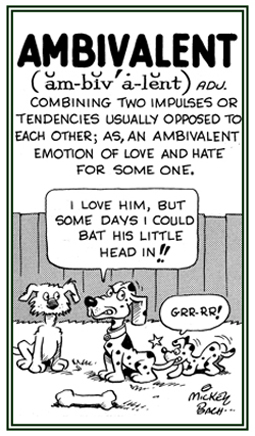
Go to this Word A Day Revisited Index
so you can see more of Mickey Bach's cartoons.
2. To be useful or to be helpful to another person or to something: "Sadly, the doctor informed the family that there was nothing he could do to avail the condition of the mother's illness."
The availability of affordable housing attracted Mike and his family to the town.
2. Descriptive of something or someone being present or ready for use: The welfare organization indicated that it had a list of available workers who could work to complete the project for the homeless people in the city.
Ave, "hail", was the Roman equivalent of "hello", and vale the equivalent of "goodbye"; as well as the Roman farewell to the dead. Catullus used this expression in closing a poem on the death of his brother: Atque in perpetuum, frater, ave atque vale or "And forever, brother, hail and farewell!"
The Roman's used Ave, "Hail" as the equivalent of "Hello" and vale as the equivalent of "goodbye" and, in addition, as the Roman farewell to the dead.
It is stated that Catullus used this expression in closing a poem on the death of his brother: Atque in perpetuum, frater, ave atque vale. or "And forever, brother, hail and farewell!"
2. The degree to which a drug is in place throughout the body and is ready for action at the desired receptor sites: After receiving an injection, the doctor advised the patient to rest while she monitored the bioavailability of the medication.
3. The extent to which a nutrient or medication can be used by a person: In order to adjust the medications properly, the doctor monitored the bioavailability of the medication that was prescribed for the patient.
Bioavailability is used to determine whether different brand-name drugs, a generic name as opposed to a brand-name drug, or, in some cases, different batches of the same brand-name drug, will produce the same therapeutic effects.
