
vaga-, vag-, vago-
(Latin: wander, move around; unsettled, wandering [nerve])
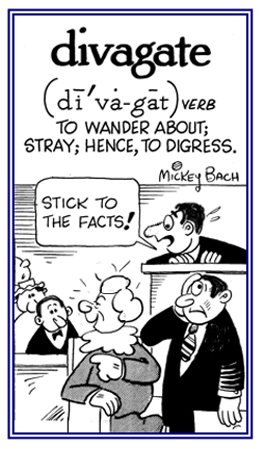
divagate (verb), divagates; divagated; divagating
1. To lose clarity, or to turn aside; especially, from the main subject of attention or course of argument in writing, thinking, or speaking: Mayor Wellington was beginning to divagate in his speech about the casino for the city.
2. To wander or drift around; to ramble; to digress: During his class presentation, Mr. Dombert seemed to be divagating from his history lesson into a lecture about geography.
© ALL rights are reserved.
Go to this Word A Day Revisited Index
2. To wander or drift around; to ramble; to digress: During his class presentation, Mr. Dombert seemed to be divagating from his history lesson into a lecture about geography.
Go to this Word A Day Revisited Index
so you can see more of Mickey Bach's cartoons.
1. A record of the electric changes occurring in the vagus nerve: The technician, Mr. Jackson, studied the electrovagogram of the patient before conferring with Dr. Smith.
The vagogram shows how the vagus nerve supplies nerve fibers to the pharynx (throat), larynx (voice box), trachea (windpipe), lungs, heart, esophagus, and the intestinal tract as far as the transverse portion of the colon. This nerve also brings sensory information back to the brain from the ear, tongue, pharynx, and larynx.
2. Etymology: from Latin vagus, "wandering" and it is appropriate because the vagus nerve wanders all the way down from the brainstem to the colon, which is a long wandering way.
1. Excessive or wasteful spending of money: Mark warned his wife that the extravagance of her shopping could result in a shortage of funds for the things that they really needed.
2. Something that is expensive or wasteful: An expensive car can be an extravagance in today's economic conditions.
3. An exaggerated, excessive, or extremely flamboyant nature of something: Mildred's cousin had a wild extravagance and unreasonableness in her speech and behavior.
2. Something that is expensive or wasteful: An expensive car can be an extravagance in today's economic conditions.
3. An exaggerated, excessive, or extremely flamboyant nature of something: Mildred's cousin had a wild extravagance and unreasonableness in her speech and behavior.
extravagant (adjective), more extravagant, most extravagant
1. Characterized by lavish or free-handed spending: Harry's extravagant marketing resulted in bankruptcy for his company.
2. Unreasonably high in price or cost: When reviewing the wasted battle ground, the general stated that this was another example of the most extravagant war he had ever experienced.
3. Denoting something which is beyond being reasonable or that which is overstated or irrational: Henry made extravagant promises in an effort to win his bid for mayor of the city.
4. Etymology: from Medieval Latin (Latin as written and spoken about 700 to about 1500) extravagantem, originally a word in Canon Law for "uncodified papal decrees", from extravagari, "wander outside or beyond"; from Latin, extra, "outside of" + vagari, "to wander, to roam".
2. Unreasonably high in price or cost: When reviewing the wasted battle ground, the general stated that this was another example of the most extravagant war he had ever experienced.
3. Denoting something which is beyond being reasonable or that which is overstated or irrational: Henry made extravagant promises in an effort to win his bid for mayor of the city.
4. Etymology: from Medieval Latin (Latin as written and spoken about 700 to about 1500) extravagantem, originally a word in Canon Law for "uncodified papal decrees", from extravagari, "wander outside or beyond"; from Latin, extra, "outside of" + vagari, "to wander, to roam".
A wandering monk having no fixed monastery as his residence: The elderly gyrovague appealed to the local people for a place to rest and some food before going on to the next village.
1. Either of the longest pair of cranial nerves mainly responsible for parasympathetic control (activities that occur when the body is at rest) over the heart and many other internal organs, including thoracic and abdominal viscera or abdominal cavity below the diaphragm but not including the pelvic tissues: The nervi vagi communicate through thirteen main branches, connecting to four areas in the brain.
2. Etymology: from Latin, vagus, "wandering" + nervus, "nerve".
2. Etymology: from Latin, vagus, "wandering" + nervus, "nerve".
noctivagant (adjective), more noctivagant, most noctivagant
Going, or wandering, around during the night: The hedgehog is one example of a noctivagant animal.
solivagant (adjective), more solivagant, most solivagant
1. Roving around alone: There are historical stories about solivagant individuals who were rambling around in California in search of gold.
2. Characterized by doing things by oneself: Shirley tended to be a very solivagant person when she was preparing for examinations at the university.
2. Characterized by doing things by oneself: Shirley tended to be a very solivagant person when she was preparing for examinations at the university.
solivagous (adjective), more solivagous, most solivagous
Drifting around by oneself or being alone as someone who goes here and there; being solitary: Sharon has seen someone who appears to be a solivagous man because he is always going from his cottage and into a neighborhood store and then back again, always by himself and never with anyone else.
1. A rambler or a rover who has no permanent place to live; a nomad: Louis, the vagabond, wandered from town to town, earning some money by playing his accordion with a container in front of him for donations.
2. A beggar for food and money: The townsfolk, including Becky's mother, were not tolerant of the vagabond and almost everyone avoided him.
2. A beggar for food and money: The townsfolk, including Becky's mother, were not tolerant of the vagabond and almost everyone avoided him.
vagabond (adjective), more vagabond, most vagabond
1. Irregular in course or behavior; unpredictable: Marilyn had a vagabond behavior in that she would sometimes clean her apartment and then not do it at all for several weeks.
2. Being wayward or capricious by nature: Norbert's vagabond personality seemed to make him unable to settle down and to live in one place for very long.
2. Being wayward or capricious by nature: Norbert's vagabond personality seemed to make him unable to settle down and to live in one place for very long.
vagabond (verb), vagabonds; vagabonded; vagabonding
1. To drift from place to place: It seems that there are more people these days who are vagabonding around the city than during previous years.
2. Moving around aimlessly or without any destination, often in search of food or employment: Larry, the homeless man, has vagabonded here in the town for most of his life.
2. Moving around aimlessly or without any destination, often in search of food or employment: Larry, the homeless man, has vagabonded here in the town for most of his life.
1. Traveling around without any clear destination: Henry is still living in a state of vagabondage and continues to travel from city to city.
2. The state or condition of being a vagrant; that is, moving around in idleness: Teresa and Thomas continue to roam around in vagabondage as they have been doing ever since they have been married.
2. The state or condition of being a vagrant; that is, moving around in idleness: Teresa and Thomas continue to roam around in vagabondage as they have been doing ever since they have been married.
vagabondize (verb), vagabondizes; vagabondized; vagabondizing
To wander around without employment: As a result of the economic conditions, there seem to be more people who are vagabondizing throughout the country these days.
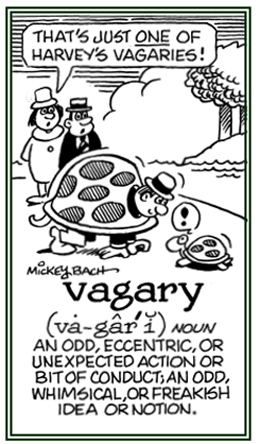
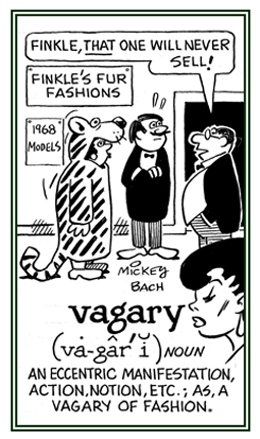
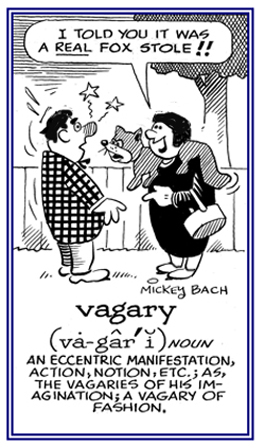
1. An unpredictable or eccentric change, action, or idea: People must learn to live with the vagaries of weather conditions.
2. A wild or fanciful notion or act; a whim: Joe had a sudden vagary that influenced his decision to move to Australia.
3. Etymology: from Latin vagari "to wander, to stroll about, to roam," from vagus "roving, wandering."
© ALL rights are reserved.
© ALL rights are reserved.
© ALL rights are reserved.
Go to this Word A Day Revisited Index
2. A wild or fanciful notion or act; a whim: Joe had a sudden vagary that influenced his decision to move to Australia.
3. Etymology: from Latin vagari "to wander, to stroll about, to roam," from vagus "roving, wandering."
