
-uous +
(Latin: a suffix; tending to, inclined to)
ambiguous (am BIG yoo uhs) (adjective), more ambiguous, most ambiguous
1. Concerning statements which have several possible meanings or interpretations; equivocal: Mary gave her parents an ambiguous answer instead of a clear explanation as to why she came home so late.
2. Relating to something of a doubtful or uncertain nature; regarding an aspect difficult to comprehend, to distinguish, or to classify: It was clear from Jim's note to his parents that he had left the country, but as to where his destination would be, he was ambiguous.
3. Pertaining to a situation which lacks clearness or definiteness; obscure; indistinct: Ambiguous can refer to a person or the contents in a piece of writing.
4. Etymology: from Latin ambiguus, "having double meanings, shifting, changeable, doubtful"; derived from ambigere, "to dispute about"; literally, "to wander"; from ambi-, "about" + agere, "to drive, to lead, to act".
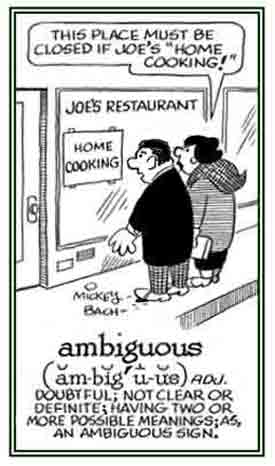
© ALL rights are reserved.
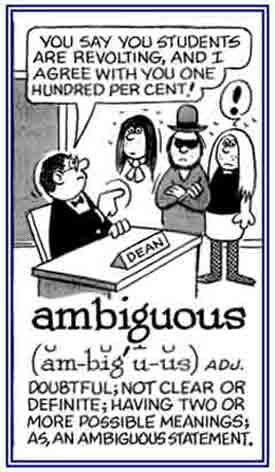
© ALL rights are reserved.
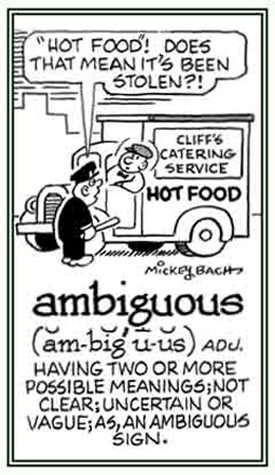
© ALL rights are reserved.
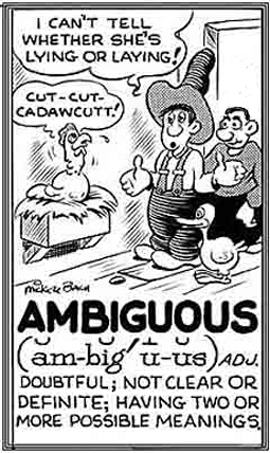
© ALL rights are reserved.
Go to this Word A Day Revisited Index
2. Relating to something of a doubtful or uncertain nature; regarding an aspect difficult to comprehend, to distinguish, or to classify: It was clear from Jim's note to his parents that he had left the country, but as to where his destination would be, he was ambiguous.
3. Pertaining to a situation which lacks clearness or definiteness; obscure; indistinct: Ambiguous can refer to a person or the contents in a piece of writing.
4. Etymology: from Latin ambiguus, "having double meanings, shifting, changeable, doubtful"; derived from ambigere, "to dispute about"; literally, "to wander"; from ambi-, "about" + agere, "to drive, to lead, to act".
"Ambivalent" refers to people and their attitudes while ambiguous refers to something said or written.
Go to this Word A Day Revisited Index
for a list of additional Mickey Bach illustrations.
Word History
Latin amb-, "about, around," combined with agere, "to drive", formed ambigere, literally, "to drive around, to waver". Out of this word grew the Latin ambiguus, "hesitating, uncertain". English borrowed it as ambiguous, with the meaning "equivocal, capable of being understood in either of two or more possible senses, vague."
assiduous (adjective), more assiduous, most assiduous
1. Relating to being constant in application or attention; unremittingly diligent: Shirley was an assiduous worker who strived for perfection.
2. A reference to working diligently at a task and persevering to achieve an objective: Max was always doing assiduous researches for his chemistry projects so he could have the best possible results.

© ALL rights are reserved.

© ALL rights are reserved.

© ALL rights are reserved.
Go to this Word A Day Revisited Index
2. A reference to working diligently at a task and persevering to achieve an objective: Max was always doing assiduous researches for his chemistry projects so he could have the best possible results.
Bob was an assiduous student in high school and that's why he graduated as an honor student.
3. Etymology: From Latin assiduus, "busy, incessant, and continually" from assidere, "to sit down to"; therefore, "constantly occupied" at one's work.
Go to this Word A Day Revisited Index
for a list of additional Mickey Bach illustrations.
bilinguous (adjective)
A reference to speaking two languages or having two tongues.
conspicuous (adjective), more conspicuous, most conspicuous
1. Easily or clearly visible or very noticeable: People noticed the conspicuous modifications in the redesigned city hall.
2. Attracting attention because of being unusual or remarkable: The real estate agent placed the "For Sale" sign in a very conspicuous position so no one could miss seeing it.

© ALL rights are reserved.

© ALL rights are reserved.
Go to this Word A Day Revisited Index
2. Attracting attention because of being unusual or remarkable: The real estate agent placed the "For Sale" sign in a very conspicuous position so no one could miss seeing it.
The new store in town has been a conspicuous success with more sales than any of the others that are like it.
Go to this Word A Day Revisited Index
for a list of additional Mickey Bach illustrations.
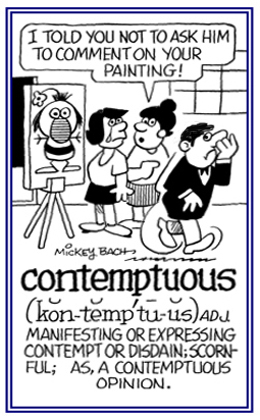
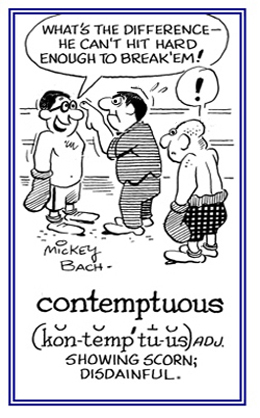
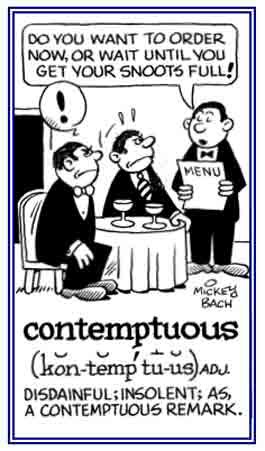
contemptuous (kuhn TEMP choo uhs) (adjective), more contemptuous, most contemptuous
1. Descriptive of deep hatred or negative feelings expressed by a person toward something or someone else; scornful: Paulette's contemptuous tone of voice was dripping with unkindness and disrespect for the neighbor who would not keep his yard clean.
2. Pertaining to how a person feels, expresses, or demonstrates a strong dislike or utter lack of respect for somebody or something: Alexandra thinks it is utter nonsense for anyone to make such contemptuous remarks about that fine actor.

© ALL rights are reserved.
© ALL rights are reserved.
© ALL rights are reserved.
© ALL rights are reserved.
Go to this Word A Day Revisited Index
2. Pertaining to how a person feels, expresses, or demonstrates a strong dislike or utter lack of respect for somebody or something: Alexandra thinks it is utter nonsense for anyone to make such contemptuous remarks about that fine actor.
Go to this Word A Day Revisited Index
so you can see more of Mickey Bach's cartoons.
continuous (noun) (not comparable)
1. A function or curve; extending without pausing or any having any irregularities.
2. Pertaining to something that goes on without changing, stopping, or being interrupted by space or time: "There were several days of continuous rain and winds in Sharon's part of the country."
3. Having no gaps, holes, or breaks.
2. Pertaining to something that goes on without changing, stopping, or being interrupted by space or time: "There were several days of continuous rain and winds in Sharon's part of the country."
3. Having no gaps, holes, or breaks.
A constructive, or contractor, term for two or more fixtures that use a single continuous line as the waste line or the area below the point where the fixture drains into the pipe is the waste line: When designing and building the new home, the architects and contractors were careful to include a system for continuous waste that would drain properly.
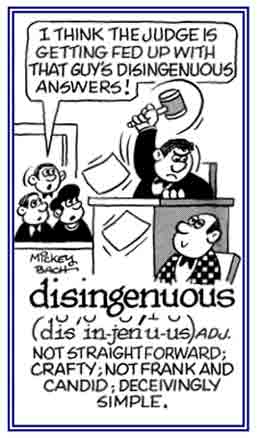
disingenuous (adjective), more disingenuous, most disingenuous
1. A reference to not being straightforward or honest and being insincere or calculating: Jack didn’t want to tell a lie, so he decided to give a disingenuous response to his wife’s question about where he had been the night before; so, all he said was that he had been visiting with a friend, although he actually had been to the local pub all evening.
2. Pertaining to giving a false appearance of being explicit and unambiguous: Jane’s boyfriend had evidently put on a disingenuous smile when he said he liked her a lot, but he wasn’t taking her out anymore.
3. Descriptive of pretending to be unaware of something or trying to give the impression of being innocent regarding what has happened: When Sally’s mother asked her if she had broken the cup, she gave a disingenuous answer that she didn’t even know the cup had been broken!
© ALL rights are reserved.
Go to this Word A Day Revisited Index
2. Pertaining to giving a false appearance of being explicit and unambiguous: Jane’s boyfriend had evidently put on a disingenuous smile when he said he liked her a lot, but he wasn’t taking her out anymore.
3. Descriptive of pretending to be unaware of something or trying to give the impression of being innocent regarding what has happened: When Sally’s mother asked her if she had broken the cup, she gave a disingenuous answer that she didn’t even know the cup had been broken!
Go to this Word A Day Revisited Index
so you can see more of Mickey Bach's cartoons.
flexuous
1. Having turns or windings: "The flexuous bed of the stream."
2. Curving, winding, or turning.
2. Curving, winding, or turning.
fructuous (adjective), more fructuous, most fructuous
1. A reference to large amounts of goods or other commodities; profitable: The students had a very fructuous discussion about the effects of smoking and even continued their conversation on this topic after the teacher left at the end of the lesson!
2. Relating to crops that have produced much fruit: The winegrowers were convinced that they had had a fructuous year after having harvested such a large quantity of grapes at the end of the season.
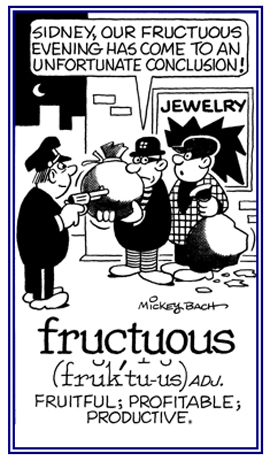
© ALL rights are reserved.
Go to this Word A Day Revisited Index
2. Relating to crops that have produced much fruit: The winegrowers were convinced that they had had a fructuous year after having harvested such a large quantity of grapes at the end of the season.
Go to this Word A Day Revisited Index
so you can see more of Mickey Bach's cartoons.
ignifluous
Flowing with fire.
incestuous (adjective), more incestuous, most incestuous
1. Relating to or involving a sexual relationship between two people who are considered, for moral or genetic reasons, too closely related to have such a relationship.
2. Having had a sexual relationship with someone who is considered to be too close as a relative.
3. Unhealthily intimate or interconnected; especially, so as to exclude the involvement or influence of others; an incestuous friendship.
4. Being so close or intimate as to prevent proper functioning: There has been an incestuous relationship between organized crime and some governments.
2. Having had a sexual relationship with someone who is considered to be too close as a relative.
3. Unhealthily intimate or interconnected; especially, so as to exclude the involvement or influence of others; an incestuous friendship.
4. Being so close or intimate as to prevent proper functioning: There has been an incestuous relationship between organized crime and some governments.
innocuous (adjective), more innocuous, most innocuous
1. A reference to having no adverse effect; harmless: Where Manfred lives, it has been an innocuous summer with mild temperatures and occasionally some rain which usually fell at night when most people were asleep.
2. Not intended to cause offense nor to provoke a strong reaction and unlikely to do so: Because little Joey was only four years old, his mother’s oldest friend was not displeased or annoyed when he asked her an innocuous question about her age.
3. A reference to probably not being irritating nor to offend; inoffensive: Jane and Janice exchanged innocuous conversations about their husbands during lunch.
4. Descriptive of being uninteresting and not stimulating nor significant; pallid; insipid: Mike and his wife said they just saw an innocuous movie that bored them very much.
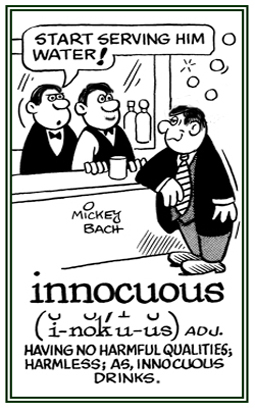
© ALL rights are reserved.
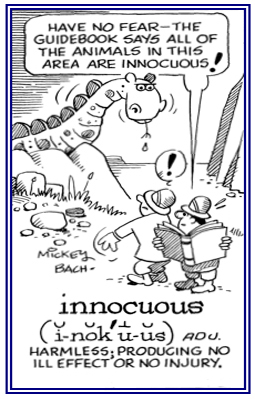
© ALL rights are reserved.
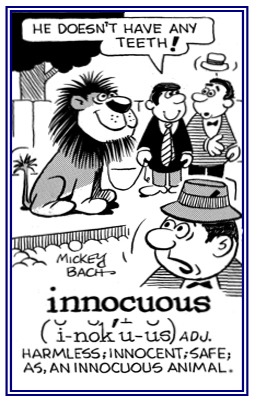
© ALL rights are reserved.
Go to this Word A Day Revisited Index
2. Not intended to cause offense nor to provoke a strong reaction and unlikely to do so: Because little Joey was only four years old, his mother’s oldest friend was not displeased or annoyed when he asked her an innocuous question about her age.
3. A reference to probably not being irritating nor to offend; inoffensive: Jane and Janice exchanged innocuous conversations about their husbands during lunch.
4. Descriptive of being uninteresting and not stimulating nor significant; pallid; insipid: Mike and his wife said they just saw an innocuous movie that bored them very much.
Go to this Word A Day Revisited Index
so you can see more of Mickey Bach's cartoons.
nocuous
1. Harmful; likely to cause injury or damage.
2. Likely to cause damage or injury; harmful; noxious.
2. Likely to cause damage or injury; harmful; noxious.
sanguifluous (adjective), more sanguifluous, most sanguifluous
Referring to the flowing or movements of blood.

Showing page 1 out of 2 pages of 23 main-word entries or main-word-entry groups.