
tum-, tume-, -tumescence
(Latin: swelling, to swell; swollen)
A benign round, firm growth which develops at the bifurcation (two branches) of the common carotid artery or either of the two arteries located in the front of the neck, through which blood from the heart goes to the brain: "A carotid-body tumor may cause dizziness, nausea, and vomiting if it impedes, or hinders, the flow of blood and if pressure is increased in the vascular system, or the circulatory system that transports blood in the body and which is composed of the heart, arteries, capillaries, and the veins."
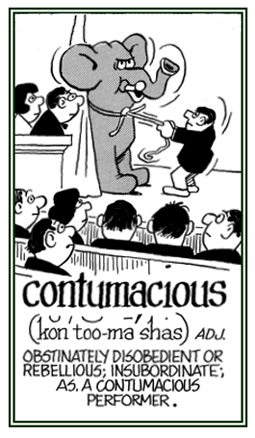
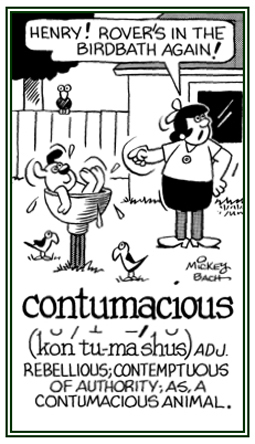
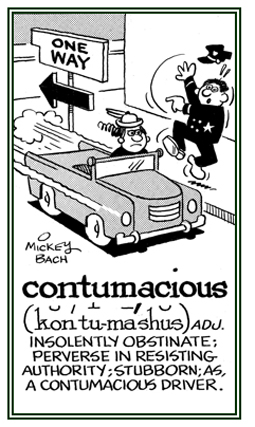
contumacious (adjective), more contumacious, most contumacious
1. Disobedient, rebellious or stubborn behavior: Bruce's contumacious conduct with his teacher, when she asked him to put his cell phone away, resulted in him being sent to the principal's office.
2. Descriptive of willfully not following the legal orders or summons of a court: Bert's contumacious refusal to appear in court to testify has resulted in his going to jail.
© ALL rights are reserved.

© ALL rights are reserved.
© ALL rights are reserved.
© ALL rights are reserved.
Go to this Word A Day Revisited Index
2. Descriptive of willfully not following the legal orders or summons of a court: Bert's contumacious refusal to appear in court to testify has resulted in his going to jail.
Go to this Word A Day Revisited Index
so you can see more of Mickey Bach's cartoons.
Stubborn and disrespectful resistance to an authority of any kind: Some teenagers at school are very disobedient and show too much contumacity towards their teachers or even towards the principal of the school.
1. Obstinate disobedience, stubborn and unreasonable resistance or rebelliousness; insolence: The decision of the company to cut down on the number of working hours, and so of pay, resulted in a contumacy of the employees of the company who refused to accept the pay cuts.
2. The stubborn resistance and refusal to obey a legitimate authority of any kind: Jerome’s contumacy to appear in court, even when he had received a judicial order requiring his presence to provide evidence regarding a robbery that he witnessed, was not understood by his family who had encouraged him to do so.
3. Etymology: from Latin contumacia, "insolent"; from con-, "intensive" +tumere, "to swell" + -acy, "quality, condition".
2. The stubborn resistance and refusal to obey a legitimate authority of any kind: Jerome’s contumacy to appear in court, even when he had received a judicial order requiring his presence to provide evidence regarding a robbery that he witnessed, was not understood by his family who had encouraged him to do so.
3. Etymology: from Latin contumacia, "insolent"; from con-, "intensive" +tumere, "to swell" + -acy, "quality, condition".
This contumacy term should not be confused with "contumely" even though both words are nouns which are derived from the Latin verb tumere, "to swell".
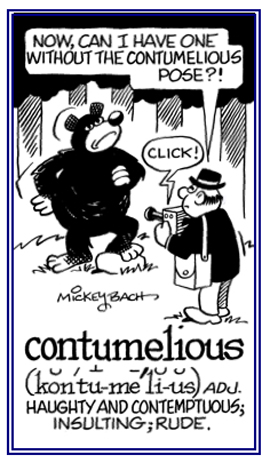
contumelious (adjective), more contumelious, most contumelious
1. A reference to having an attitude of considering something or someone as worthless or inferior: Sam made a contumelious remark to the police officer when he was stopped for driving too fast in town.
2. Conveying a scornful and insulting behavior: Mrs. Balderson sent James to the principal’s office because of his contumelious treatment of his classmates even though he had already been scolded by his teacher a few times that day.
© ALL rights are reserved.
Go to this Word A Day Revisited Index
2. Conveying a scornful and insulting behavior: Mrs. Balderson sent James to the principal’s office because of his contumelious treatment of his classmates even though he had already been scolded by his teacher a few times that day.
Go to this Word A Day Revisited Index
so you can see more of Mickey Bach's cartoons.
contumeliously (adverb), more contumeliously, most contumeliously
Descriptive of behaving in a disdainful, insolent, and disrespectful way: After acting so scornfully and contumeliously towards his brother, Janet was severely scolded by her parents and sent to her room without dinner.
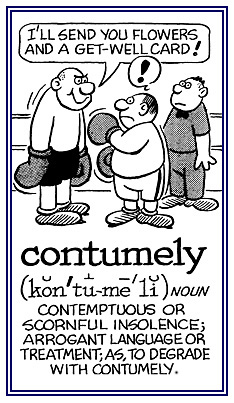
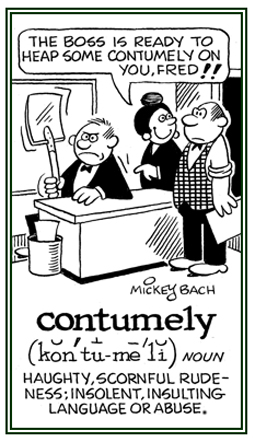
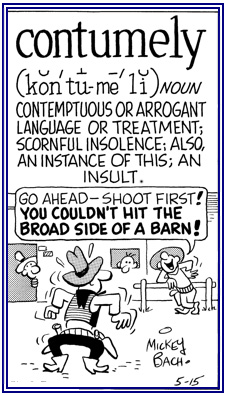
1. Contempt and rudeness that comes from being scornful or insulting: Roy used contumelies to express his scorn and disrespect for his political opponent.
© ALL rights are reserved.
© ALL rights are reserved.
© ALL rights are reserved.
Go to this Word A Day Revisited Index
A contumely remark is a short, cutting expression that contains blunt words.
2. Etymology: from Old French contumelie, which came from Latin contumelia, "a reproach, an insult"; it is probably related to contumax, "haughty, stubborn"; from com-, "together, together with" + tumere. "to swell up".
Go to this Word A Day Revisited Index
for a list of additional Mickey Bach illustrations.
1. A nonmalignant cystic tumor containing elements derived from the ectoderm; such as, hair, teeth, or skin.
2. Tumors consisting of displaced ectodermal structures along the lines of embryonic fusions, the walls being formed of epithelium-lined connective tissues, including skin appendages and containing keratin, sebum, and hair.
3. A benign cystic teratoma with skin, skin appendages, and their products as the most prominent components, usually involving the ovary or the skin.
2. Tumors consisting of displaced ectodermal structures along the lines of embryonic fusions, the walls being formed of epithelium-lined connective tissues, including skin appendages and containing keratin, sebum, and hair.
3. A benign cystic teratoma with skin, skin appendages, and their products as the most prominent components, usually involving the ovary or the skin.
1. The reduction or lessening of a swelling; especially, the restoration of a swollen bodily organ or part back to its normal size.
2. A change towards something smaller or lower.
3. Etymology: from Latin detumescere, "to become less swollen", from de-, "down, from" + tumescere, "to swell".
2. A change towards something smaller or lower.
3. Etymology: from Latin detumescere, "to become less swollen", from de-, "down, from" + tumescere, "to swell".
detumescent (adjective), more detumescent, most detumescent
Characterized by a reduction or lessening of a swelling; especially, the restoration of a swollen body organ or part back to its normal size.
intumesce (verb), intumesces; intumesced; intumescing
1. To bubble up, to expand, to enlarge; especially, from the effect of heating.
2. To foam, to swell, to froth, or to bubble up as a result of heat, liquid, air, or a chemical action.
2. To foam, to swell, to froth, or to bubble up as a result of heat, liquid, air, or a chemical action.
1. A swelling, normal or abnormal: "Intumescence is the swelling of certain substances when they are heated and intumescences are often accompanied by the release of water."
2. A swollen organ or body part: "Intumescence consists of the swelling up with blood or other fluids; such as, with congestion or spinal enlargements."
3. In chemistry, the swelling of certain substances when heated, often accompanied by the escape of water vapor.
2. A swollen organ or body part: "Intumescence consists of the swelling up with blood or other fluids; such as, with congestion or spinal enlargements."
3. In chemistry, the swelling of certain substances when heated, often accompanied by the escape of water vapor.
intumescent (adjective), more intumescent, most intumescent
1. A reference to a substance that swells as a result of heat exposure; therefore, increasing in volume, and decreasing in density.
2. Pertaining to something that becomes enlarged or swollen.
2. Pertaining to something that becomes enlarged or swollen.
tumefacient (adjective), more tumefacient, most tumefacient
A reference to the production of or the tendency to produce a swelling or enlargement.
1. The acts or processes of puffing or swelling.
2. The organic process whereby tissues become swollen by the accumulation of fluid within them.
2. The organic process whereby tissues become swollen by the accumulation of fluid within them.
