
turb-, turbin-, turbo-, turbu-
(Latin: uproar, commotion, disorderly, agitated, confusion; whirl, whirlwind)
Haziness in the atmosphere due to aerosols, such as dust: When atmospheric turbidity is zero, the sky has no dust, as measured by a sun photometer, an instrument that measures luminous intensity or brightness, luminous flux, light distribution, color, etc.
A common type of turbine with axial flow through the runner blades axially to the turbine shaft: An axial-flow turbine normally has 1-3 rotating stages and the flow of gas is essentially axial.
The mixing of a soil or sediment by the digging, feeding, or other activities of living organisms: Bioturbation can be exemplified by worms and burrowing clams in the bottom of a lake or in a seabed.
A steam turbine in which the exhaust steam is condensed and the water formed from this process is then used to supply the feedwater for the generator: Condensing turbines were built in the USSR at the Leningrad Metal Works in 1924.
In geology, a disturbance of the soil surface or subsoil; frost churningl: Cryoturbation occurs by the action of freezing or of alternate freezing and thawing in the fissures or cracks of rocks in the ground.
disturb (verb), disturbs; disturbed; disturbing
1. To interrupt the quiet, rest, peace, or order of; to unsettle: The loud construction work outside the classroom disturbed the students while they were taking their exam.
2. To interfere with; to interrupt; to hinder: Wendy didn't want anyone to disturb her while she was working on her book.
3. To interfere with the arrangement, order, or harmony of; to disarrange: The new cleaning lady disturbed Mrs. Lawson's organization of the dishes in the kitchen cupboard.
4. To perplex; to trouble: to be disquieted by strange behavior: The thriller on TV disturbed Jenny so much that she couldn't get to sleep that night.
5. To cause a disturbance to someone's sleep, rest, etc.: Tom saw the sign on the door: "Do not disturb".
2. To interfere with; to interrupt; to hinder: Wendy didn't want anyone to disturb her while she was working on her book.
3. To interfere with the arrangement, order, or harmony of; to disarrange: The new cleaning lady disturbed Mrs. Lawson's organization of the dishes in the kitchen cupboard.
4. To perplex; to trouble: to be disquieted by strange behavior: The thriller on TV disturbed Jenny so much that she couldn't get to sleep that night.
5. To cause a disturbance to someone's sleep, rest, etc.: Tom saw the sign on the door: "Do not disturb".
1. A worried and unhappy state: There was so much anger and disturbance that Grace, the daughter of the arguing parents, left the house.
2. The state of disorder; a commotion: The was such a disturbance, racket, and, loud uproar outside that night that the older couple couldn't relax and sleep at all!
3. Something that interferes with something else: The loud disturbance outside the room made it very difficult to understand the speaker.
4. An outbreak of disorder; a breach of public peace: During the disturbance in the street, the crowd of people behaved violently and two were hurt seriously.
5. In meteorology, any cyclonic storm or low-pressure area, usually a small one: The strong wind disturbances finally passed and when the forest rangers saw the damaged trees, they started to clear up the forest.
6. In geology, a crustal movement of moderate intensity, somewhat restricted in area: The earthquake caused quite a disturbance , with deep faults and folds of the earth surface.
2. The state of disorder; a commotion: The was such a disturbance, racket, and, loud uproar outside that night that the older couple couldn't relax and sleep at all!
3. Something that interferes with something else: The loud disturbance outside the room made it very difficult to understand the speaker.
4. An outbreak of disorder; a breach of public peace: During the disturbance in the street, the crowd of people behaved violently and two were hurt seriously.
5. In meteorology, any cyclonic storm or low-pressure area, usually a small one: The strong wind disturbances finally passed and when the forest rangers saw the damaged trees, they started to clear up the forest.
6. In geology, a crustal movement of moderate intensity, somewhat restricted in area: The earthquake caused quite a disturbance , with deep faults and folds of the earth surface.
Noncultural activities, such as freeze-thaw cycles, landslides, and simple erosion, are also such disturbances of the earth.
7. An electrical or acoustic activity that can disturb communication: One disturbance can be the undesired echoes that interrupted the signals on a radar screen.
8. In archeology, the changing or altering of an archeological context by the effect(s) of an unrelated activity at a later time:
Examples of such disturbances include dam building, farming, and heavy construction.
A disturbance is also the nonscientific removal of an artefact from its archaeological context.
disturbed (adjective), more disturbed, most disturbed
1. Pertaining to the symptoms of a mental illness; demented: Mary's aunt is disturbed and unbalanced because she is affected with an emotional disorder and must take medicine prescribed by her doctor.
2. Concerning the state of being shocked or very alarmed; distressed: Jane was very disturbed when she heard of the plane crash and thought her parents might have been on it.
3. Referring to the disarrangement of items in a place: When Susan went into her bedroom, she noticed the disturbed pens and notebooks on her desk because they weren't where she usually put them.
2. Concerning the state of being shocked or very alarmed; distressed: Jane was very disturbed when she heard of the plane crash and thought her parents might have been on it.
3. Referring to the disarrangement of items in a place: When Susan went into her bedroom, she noticed the disturbed pens and notebooks on her desk because they weren't where she usually put them.
disturbedly (adverb), more disturbedly, most disturbedly
Referring to how someone or an animal is disquieted or agitated: Grandfather sat in his rocking chair and pondered disturbedly on the sad events of the day.
A trouble maker who disquiets or interferes with peace and quiet; someone who causes commotion and disorder: Tom's son was a mischief-maker, or disturber, who was always disrupting the guests with annoying tricks.
disturbingly (adverb), more disturbingly, most disturbingly
Descriptive of how something happens or is said in an upsetting manner: Tina altered her expression disturbingly and was troubled emotionally when she heard of the severe accident her brother was involved in.
A steam turbine in which a portion of the working fluid is tapped between stages of an expansion process and used for purposes other than generating mechanical power: The extraction turbine has provided many rooms with heating because of the devices that allow the hot vapor to be utilized.
A minor disturbance of the surface of the Earth, or soil, by animals; In Russel's biology class at school, the teacher told the students that faunalturbation occurred especially by the burrowing and tunneling of rabbits, gophers, mice, etc.
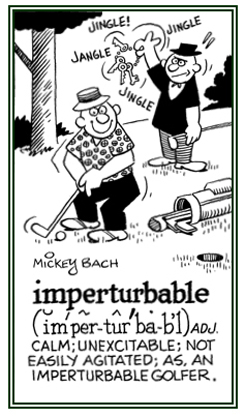
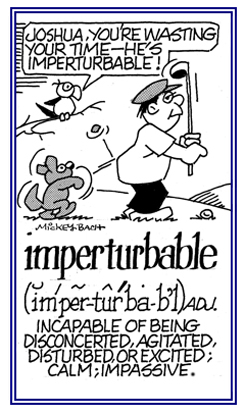
imperturbable (adjective), more imperturbable, most imperturbable
1. Not easily excited or upset: Despite the bad weather conditions, Rodney had an imperturbable attitude about preparing for his trip.
2. Marked by extreme calm and composure: Aurora had an imperturbable reaction to the criticisms presented by her fellow workers about having to work overtime.
© ALL rights are reserved.
© ALL rights are reserved.
Go to this Word A Day Revisited Index
2. Marked by extreme calm and composure: Aurora had an imperturbable reaction to the criticisms presented by her fellow workers about having to work overtime.
Go to this Word A Day Revisited Index
so you can see more Mickey Bach illustrations.
Unfalteringly composed and collected: Mr. Tall was noted for his imperturbableness when making business deals with with other firms, so he was usually the one sent to talk to them.
