
trit-
(Latin: to rub; to thresh, to grind; to wear away; from tritus, past participle of terere, "to rub")
Don't confuse this trit- with another trit- which means "third".
2. To reduce or to make smaller because of a loss of something or someone: The economic planning department anticipated that the staff would attrite over the year resulting in fewer members on the payroll.
3. To feel or say one is sorry for a behavior out of fear of punishment: Carla was attriting to her mother because she spilled the cat's dish of food.
2. An abrading away, wearing or grinding down, by friction: The attrition of water on rocks by the ocean often results in their being worn down and becoming smooth.
3. In military applications, the gradual wearing away of morale and the powers of resistance by persistent attacks: General Smith ordered a gradual process of attrition against the enemy in order to exhaust and wear them down.
4. In the workplace, the gradual reduction of the size of a workforce by not replacing personnel lost through retirement or resignation: The Personnel Department at Sandra's company charted the attrition of employees.
Biodetritus involves matter that is produced by or which remains after the wearing away or disintegration of tissue or other substances from the living organisms.
2. Crushed or broken in spirit by a sense of sin, and so brought to complete penitence: Grace, the contrite member of the church, confessed to her minister about the sinful act that she had committed when she stole a book from the library.
3. Etymology: from Latin contritus; literally, "worn out, ground to pieces", past participle of Latin conterere, "to grind"; from com-, "together" + terere, "to rub".
Literally, bruised, crushed; worn, or broken by rubbing.
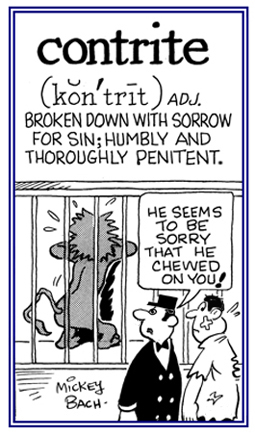

Go to this Word A Day Revisited Index
so you can see more of Mickey Bach's cartoons.
2. Done or said out of a sense of guilt or remorse: The student's apology was contritely uttered because Zeb was truly sorry for cheating on his final examination.
3. Deeply ashamed of past evils and determined not to do wrong in the future: One of the expectations of her church was that Wendy would speak contritely with the pastor, being sincere as she promises not to do vile things in the future.
2. A lamentation for sins that have been committed which sometimes comes from a fear of eternal damnation: Sanchez expressed deep contriteness to the leader of his church for the harm he had caused other members of his family.
2. Sorrow or affliction of mind for some fault or injury that has been done; specifically, penitence for sin: Mary's tears of contrition for neglecting her mother's birthday were sincere.
3. Etymology: from Latin terrere, "to rub"; literally, the action of rubbing things together, or against each other; grinding, pounding or bruising (so as to pulverize).
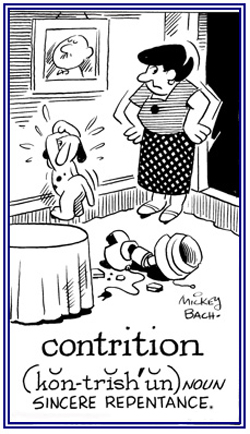
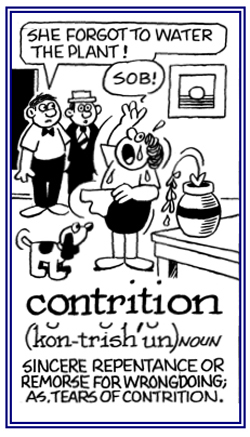
Go to this Word A Day Revisited Index
so you can see more of Mickey Bach's cartoons.
2. Something that causes harm or injury: Not wearing a helmet when riding a bicycle can possibly result in detriment to that person's head.
3. Etymology: from Latin detrimentum, from detri-, stem of detere, "to wear away"; from de-, "away" + terere, "to rub, to wear".
It is a well-known fact that overeating can result in detrimental conditions for one's health.

Go to this Word A Day Revisited Index
so you can see more of Mickey Bach's cartoons.
Fly maggots are examples of detriophagous consumers of animal matter.
It is known that detriophagy is involved in the decomposition of heaps of compost and all natural forms of this kind, including leaf mold, rotting seaweeds, etc., all of which are breeding places for many flies.
Other detriophagies take place in carrion or animal flesh of varying stages of the decaying processes.
Cross references of word families that are related directly, or indirectly, to: "rub, rubbing; wear away; wipe": bruxo, brux-; frica-, frict-; terg-; tribo-; -tripsy.
