
tra-, tract-, trac-, -tractive, -traction, -tracting, treat-, trai-
(Latin: drag, draw together; a drawing out or pulling)
2. A concept which is not easy to understand and is based on general principles or theories rather than on specific instances: The abstract about light absorption was understood by very few people and so it was read exclusively by a select group.
3. A brief statement of the essential thoughts of a book, article, speech, court record, etc.: The clerk will prepare an abstract for the judge to read.
4. A summary of a longer text, especially of an academic article: The students were instructed to write short abstracts outlining the main points in the article that was presented to them.
5. A concept or term that does not refer to a concrete object but denotes a quality, emotion, or idea, such as truth, passion, loathing, etc.: The aria from the opera emoted on the abstracts of love, hate, and revenge.
6. A presence existing only in the mind and separated from embodiment: Clarence referred to abstracts like "truth" and "justice".
7. A work of art, especially a painting, in a style that expresses the artist’s ideas or feelings instead of showing the exact appearance of people or things and does not represent or imitate external reality or the objects of nature: The artist's style of painting could only be described as abstract; because it was so difficult to understand.
8. Etymology: the word abstract was formed from two Latin word parts, ab-, "off, away from" + tract, "to draw, to pull".
Abstract originally meant "drawn" or "taken from", such as part of a text taken or "abstracted" from a larger piece of writing. Then abstract came to mean "difficult to understand" or "pulled away from easy understanding".
Later in the late 1800s, the word's meaning changed to refer to a new artistic style, that is abstract art when it suggested that the artists' pulled away from reality and were more concerned with presenting forms and ideas than in representing actual people and things.
2. To write a short summary of a speech, report, or other piece of writing: Einstein's theory of relativity is said to be abstracted from data gathered in several scientific experiments.
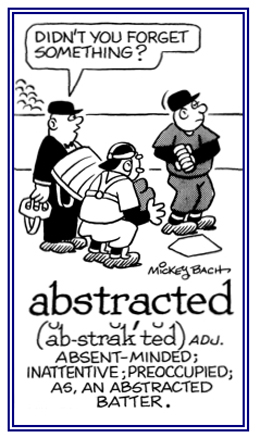
Go to this Word A Day Revisited Index
so you can see more of Mickey Bach's cartoons.
2. An emotional or mental condition that takes a person's attention away from what is happening around him or her: Mildred was looking out of the classroom window in abstraction whileD she was thinking about her sick mother during the teacher's presentation.
3. The act of obtaining or removing something from a source: Dr. Black told Sam, his patient, that the abstraction of the tumor during surgery went well and that it was not malignant!
2. Those who do not represent or imitate external reality or the objects of nature: The abstractionists were criticized for not presenting realistic ideas for improving the parks, streets, and other aspects of the city that had been deteriorating for years.
2. Pertaining to how a reference to something is difficult to understand: Lynn had difficulty comprehending the doctor's abstractly presented diagnosis of her illness.
2. To arouse or to compel the interest, admiration, or attention of: "We were attracted to the display of lights."
If a girl attracts admirers, she draws them toward her.
The magnetic pins that Lynn bought cling beautifully to the attractable metal door frames!
2. Referring to something or someone that has the power to appeal, allure, or to entice: Valerie's charm and humor were quite attractable to those who knew her and everybody always had a good time when they got together.
