
the-; them-, themat-, thes-, thet-
(Latin: placing, setting; to place, to put)
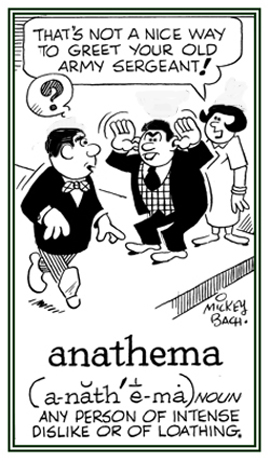
1. Someone or something that is greatly disliked or detested and is therefore shunned or avoided: The thought of physically punishing their children was absolutely an anathema and repulsive for the parents to even consider.
2. A curse from a religious authority that condemns something or excommunicates someone: Patrick must have done something very sinful and horrible because his church decided that the only way to deal with him was the pronouncement of an anathema that would expel and remove him as a member of the congregation.
3. Etymology: from Latin anathema, "an excommunicated person, the curse of excommunication"; from Greek anathema, "a thing accursed"; originally, "a thing devoted". Literally, "a thing set up (to the gods)" from ana-, "up" + tithenai, "to place".
© ALL rights are reserved.
Go to this Word A Day Revisited Index
2. A curse from a religious authority that condemns something or excommunicates someone: Patrick must have done something very sinful and horrible because his church decided that the only way to deal with him was the pronouncement of an anathema that would expel and remove him as a member of the congregation.
3. Etymology: from Latin anathema, "an excommunicated person, the curse of excommunication"; from Greek anathema, "a thing accursed"; originally, "a thing devoted". Literally, "a thing set up (to the gods)" from ana-, "up" + tithenai, "to place".
Go to this Word A Day Revisited Index
so you can see more of Mickey Bach's cartoons.
1. The formal act of pronouncing (someone or something) accursed.
2. Rejection by means of an act of banishing or proscribing (excluding) someone.
2. Rejection by means of an act of banishing or proscribing (excluding) someone.
anathematize (verb), anathematizes; anathematized; anathematizing
To declare a curse; to condemn: Mr. Hill anathematised and proclaimed the thieves who stole his cell phone to be more than vile!
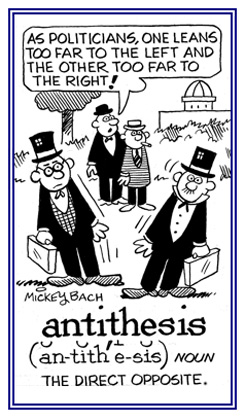
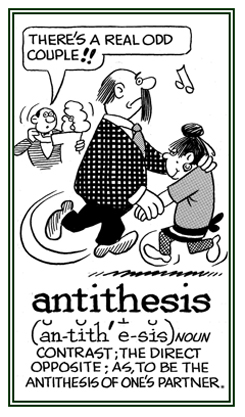
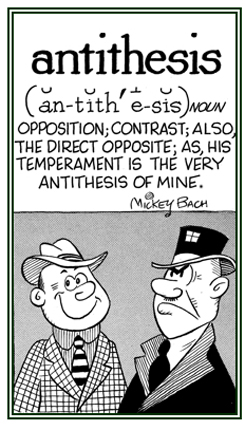
1. The complete or exact opposite of something or someone; opposition; contrast: Herald's behavior is the antithesis of right and wrong.
2. A use of words or phrases that contrast with each other to create a balanced effect: The Patrick Henry speech in 1775, "Give me liberty or give me death", is an example of using an antithesis to consider the political way of living in one's country.
3. A proposition that is the opposite of another already proposed thesis: Harry's proposal to climb Mt. Everest before getting into good physical condition was the antithesis of common sense.
4. Etymology: from Late Latin antithesis which came from Greek antithesis, "opposition"; literally, "a placing against", a noun of action from antitithenai, "to set against, to oppose"; a term in logic, from anti-, "against" + tithenai, "to place".
© ALL rights are reserved.
© ALL rights are reserved.
© ALL rights are reserved.
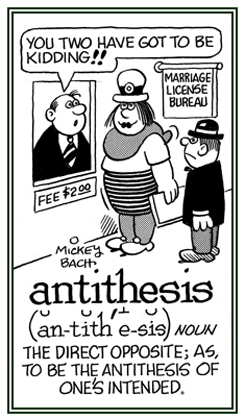
© ALL rights are reserved.
Go to this Word A Day Revisited Index
2. A use of words or phrases that contrast with each other to create a balanced effect: The Patrick Henry speech in 1775, "Give me liberty or give me death", is an example of using an antithesis to consider the political way of living in one's country.
3. A proposition that is the opposite of another already proposed thesis: Harry's proposal to climb Mt. Everest before getting into good physical condition was the antithesis of common sense.
4. Etymology: from Late Latin antithesis which came from Greek antithesis, "opposition"; literally, "a placing against", a noun of action from antitithenai, "to set against, to oppose"; a term in logic, from anti-, "against" + tithenai, "to place".
Go to this Word A Day Revisited Index
for a list of additional Mickey Bach illustrations.
1. A drugstore or a place where prescriptions can be filled and where they are stored: Brent went to the apothecary to talk to the druggist about some medical drugs that might diminish his headache.
2. Etymology: "shopkeeper, especially one who stores, compounds, and sells medicaments"; from Old French apotecaire; Modern French apothicaire; from Late Latin apothecarius, "storekeeper"; from Latin apotheca, "storehouse"; which came from Greek apotheke "storehouse". Literally, "a place where things are put away", from apo- "away" + tithenai "to put".
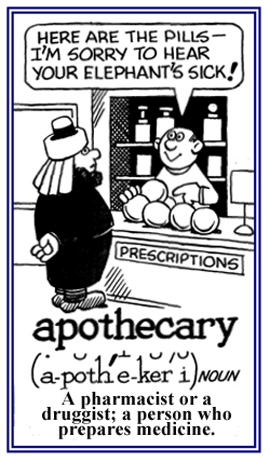
© ALL rights are reserved.
Go to this Word A Day Revisited Index
2. Etymology: "shopkeeper, especially one who stores, compounds, and sells medicaments"; from Old French apotecaire; Modern French apothicaire; from Late Latin apothecarius, "storekeeper"; from Latin apotheca, "storehouse"; which came from Greek apotheke "storehouse". Literally, "a place where things are put away", from apo- "away" + tithenai "to put".
Go to this Word A Day Revisited Index
so you can see more of Mickey Bach's cartoons.
1. A small retail shop that specializes in gifts, fashionable clothes, accessories, or food, for example.
2. A small shop located within a large department store or supermarket.
3. A small business offering specialized products and services.
4. Etymology: from Old French botique, "small shop"; from Old Provençal botica, from Latin apothca, "storehouse". Related to the etymological origin of apothecary.
2. A small shop located within a large department store or supermarket.
3. A small business offering specialized products and services.
4. Etymology: from Old French botique, "small shop"; from Old Provençal botica, from Latin apothca, "storehouse". Related to the etymological origin of apothecary.
1. A susceptibility to a disease or set of diseases such as allergies or gout.
2. A constitutional predisposition or tendency, as to a particular disease or affection.
3. A constitution or condition of the body which makes the tissues react in special ways to certain extrinsic stimuli and therefore tends to make a person more than usually susceptible to certain diseases.
4. Etymology: from Greek, "disposition, condition"; from diatithenai, diathe-, "to dispose"; from, dia-, "through, across" + tithenai, "to place".
2. A constitutional predisposition or tendency, as to a particular disease or affection.
3. A constitution or condition of the body which makes the tissues react in special ways to certain extrinsic stimuli and therefore tends to make a person more than usually susceptible to certain diseases.
4. Etymology: from Greek, "disposition, condition"; from diatithenai, diathe-, "to dispose"; from, dia-, "through, across" + tithenai, "to place".
dictionary, glossary, lexicon, thesaurus
dictionary (DIK shuh ner" ee) (noun)
A book containing the alphabetical listing of words used in a language, providing definitions, pronunciations, etc.: She received a new English dictionary when she graduated from high school.
glossary (GLAH suh ree, GLOS uh ree) (noun)
A collection of specialized words and their meanings: There was a glossary at the end of the book to help the reader understand the text.
lexicon (LEK si kahn", LEK si kon") (noun)
Another term for "dictionary" which includes any book typically containing all the morphemes (smallest meaningful parts) of a language: The scholar sought a lexicon in the library to assist her in writing her thesis on the Gaelic language.
thesaurus (thi SAUR uhs, thi SOR uhs) (noun)
A book containing a store of words; especially, of synonyms and antonyms arranged in categories: Linda and Greg found out that there was more than one kind of thesaurus available to find logical structures and word associations.
While Jill was looking up synonyms in the thesaurus, she also consulted a new dictionary which was helpful in that it had a special glossary of specialized words which she had not seen when she reviewed the old lexicon that her friend had given to her.
1. An artificial device to replace a missing bodily part which is placed inside the body.
2. A hollow stent inserted into a bile duct to allow biliary drainage across an obstruction.
2. A hollow stent inserted into a bile duct to allow biliary drainage across an obstruction.
A stent is an open tubular structure made of stainless steel or plastic which is inserted into an artery or another bodily tube to keep it from becoming blocked by a disease.
1. A name or title given to express some quality considered characteristic of a person or thing: Here are two examples of epithets; "Richard, the Lion Hearted" and "America, the Beautiful".
2. Sometimes a disparaging name: An "egghead" is an epithet for someone who is an intellectual.
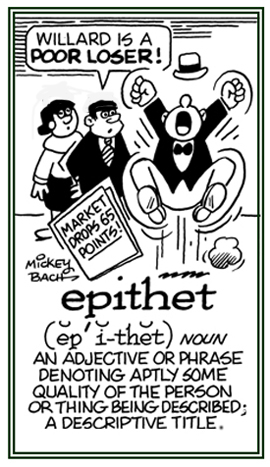
© ALL rights are reserved.
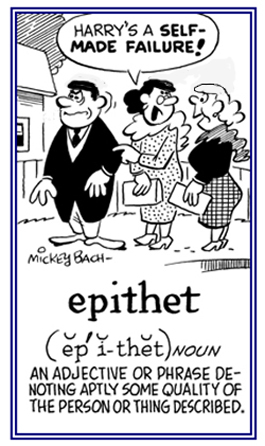
© ALL rights are reserved.
Go to this Word A Day Revisited Index
2. Sometimes a disparaging name: An "egghead" is an epithet for someone who is an intellectual.
Strictly speaking, an epithet is not necessarily a derogatory term, but it is commonly used as a simple synonym for some term of abuse or slur; such as, there is no place for racial epithets on the radio or TV programs.
3. Etymology: from epitithenai, "to add on"; from epi-, "in addition" + tithenai, "to put".
Go to this Word A Day Revisited Index
so you can see more of Mickey Bach's cartoons.
epithetic, epithetical (adjectivess)
1. Any word or phrase applied to a person or thing to describe an actual or attributed quality: "Richard the Lion-Hearted" is an epithet of Richard I.
2. A characterizing word or phrase firmly associated with a person or thing and often used in place of an actual name, title, or the like; such as, "man's best friend" when referring to a "dog".
3. A word, phrase, or expression used invectively as a term of abuse or contempt, to express hostility, etc.
2. A characterizing word or phrase firmly associated with a person or thing and often used in place of an actual name, title, or the like; such as, "man's best friend" when referring to a "dog".
3. A word, phrase, or expression used invectively as a term of abuse or contempt, to express hostility, etc.
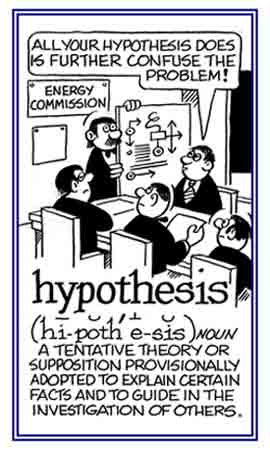
1. A tentative theory about the natural world; an idea that is not yet verified, but which, if true, would explain certain facts about what is going on: In order to solve the problem regarding the scientific hypothesis in their physics book, the students had to do experimental testing in order to prove it a theory.
2. An assumption intended to account for certain observations or facts: It was only a hypothesis that the cat ate the meat intended for the family's dinner because nobody else was at home during that time!
3. A speculation stating a view founded on insufficient evidence: Mrs. Smart supposed or guessed that Bruce copied from his neighbor's test, which was only a hypothesis, because it could have easily been the other way around!
4. Etymology: from Middle French hypothese, from Late Latin hypothesis, from Greek hypothesis, "base, basis of an argument, supposition". Literally, "a placing under", from hypo-, "under" + thesis, "a placing, proposition".
© ALL rights are reserved.
Go to this Word A Day Revisited Index
2. An assumption intended to account for certain observations or facts: It was only a hypothesis that the cat ate the meat intended for the family's dinner because nobody else was at home during that time!
3. A speculation stating a view founded on insufficient evidence: Mrs. Smart supposed or guessed that Bruce copied from his neighbor's test, which was only a hypothesis, because it could have easily been the other way around!
4. Etymology: from Middle French hypothese, from Late Latin hypothesis, from Greek hypothesis, "base, basis of an argument, supposition". Literally, "a placing under", from hypo-, "under" + thesis, "a placing, proposition".
Go to this Word A Day Revisited Index
so you can see more of Mickey Bach's cartoons.
hypothesize, hypothesizes; hypothesized; hypothesizing (verbs)
1. To theorize, speculate, guess, suppose, and to presume.
2. To give a possible but not yet proved explanation for something
2. To give a possible but not yet proved explanation for something
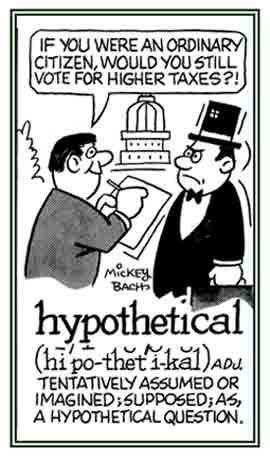
hypothetical (adjective); more hypothetical, most hypothetical
Of, relating to, or based on uncertain facts or theories that might happen during certain situations: The presumed reason for Jerry's absence from the meeting was purely hypothetical because no one really knew why he wasn't there.
© ALL rights are reserved.
Go to this Word A Day Revisited Index
Go to this Word A Day Revisited Index
so you can see more of Mickey Bach's cartoons.
The exchange of the central area of an opacified (opaque, unclear) cornea of the eye with special plastic: Because Sally was not able to see anymore after her injury in a car accident, she had to have surgery known as keratoprosthesis performed in order to restore at least some of her sight.
