
ten-, tent-, tin-, -tain, -tainment, -tenance, -tinence
(Latin: hold, grasp, have)
abstain (ab STAYN, uhb STAYN) (verb), abstains; abstained; abstaining
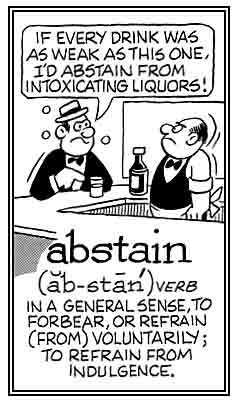
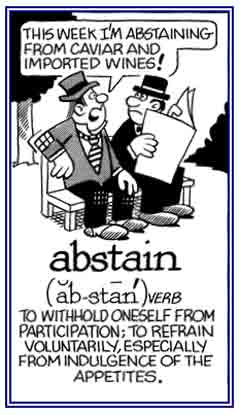
1. To refrain from doing or having something: Clarence is abstaining from taking part in the discussion.
2. To withhold from voting for or against something: Seven members casted ballots for the proposal, three were against it, and four abstained.
3. To forebear or to voluntarily do without something by refraining from doing it: It is a struggle to abstain from eating a large slice of chocolate birthday cake.
4. Etymology: from Latin abs-, "from" + tenere, "to hold".
© ALL rights are reserved.
© ALL rights are reserved.
Go to this Word A Day Revisited Index
2. To withhold from voting for or against something: Seven members casted ballots for the proposal, three were against it, and four abstained.
3. To forebear or to voluntarily do without something by refraining from doing it: It is a struggle to abstain from eating a large slice of chocolate birthday cake.
4. Etymology: from Latin abs-, "from" + tenere, "to hold".
Go to this Word A Day Revisited Index
for a list of additional Mickey Bach illustrations.
1. A person who chooses to avoid doing something regarded as improper or unhealthy, especially the consumption of alcoholic beverages or the smoking of cigarettes: The members of the club were all abstainers from the use of tobacco.
2. An individual who practices self-denial as a religious discipline: The spiritual hermit on the mountain was renowned as an abstainer from eating meat.
2. An individual who practices self-denial as a religious discipline: The spiritual hermit on the mountain was renowned as an abstainer from eating meat.
abstaining (adjective); more abstaining, most abstaining
Relating to a person who avoids some activity and does not use harmful substances, such as alcohol, drugs, or fatty foods, etc.: The abstaining couple, Mr. and Mrs. Lawson, improved their health and well-being by not using hard liquor or any other kind of intoxicants anymore.
abstemious (adjective); more abstemious, most abstemious
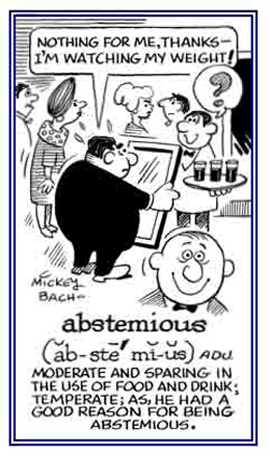
1. Relating to moderateness when eating and drinking; sober, temperate: Ted's family ate abstemious meals in order to cut down on their overweight conditions.
© ALL rights are reserved.
Go to this Word A Day Revisited Index
Abstemious people restrict themselves to the bare necessities of life and prefer an austere, simple, or unassuming lifestyle.
2. Etymology: abs-, ab-, "from, away from" + temetum, "intoxicating drink, mead, wine".
Go to this Word A Day Revisited Index
for a list of additional Mickey Bach illustrations.
1. A voluntary decision to do without something: Susan's abstention from chocolate was a choice she made because it was causing skin problems.
2. A refusal to ballot either for or against a proposal: The committee vote resulted in five ayes, ten nays, and four abstentions.
3. A deliberate rejection: The abstention by the mayor during the vote resulted in the proposal being defeated.
2. A refusal to ballot either for or against a proposal: The committee vote resulted in five ayes, ten nays, and four abstentions.
3. A deliberate rejection: The abstention by the mayor during the vote resulted in the proposal being defeated.
1.The action or process of voluntarily refraining from some behavior or practice; self-control: While trying to lose weight, Steve's sister applied abstinence from excessive red meat and junk food, instead she ate a diet rich in fruits, vegetables, and whole grains all of which made her feel better and even look better.
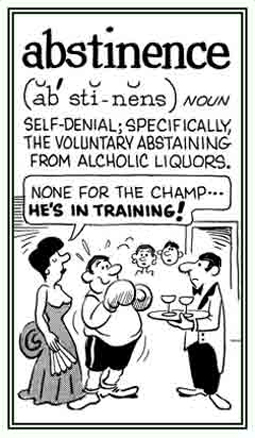
2. The self-denial of something that is wanted or enjoyable: Jeremy started to drink again after a long period of total abstinence from alcohol consumption.
© ALL rights are reserved.
Go to this Word A Day Revisited Index
2. The self-denial of something that is wanted or enjoyable: Jeremy started to drink again after a long period of total abstinence from alcohol consumption.
Abstinence may refer to a rejection of certain foods and drinks thought to be harmful to a person's health, however it can also refer to refraining from a behavior that is considered immoral.
Go to this Word A Day Revisited Index
for a list of additional Mickey Bach illustrations.
A person who is self-disciplined and does not indulge in one's appetite for food or drink: As an abstinent, Greg, the coach, was described as a role model for the players on the football team.
abstinently (adverb); more abstinently, most abstinently
A reference to how someone restrains his or her appetites or desires: Russell abstinently practiced self-denial so he could provide for his family's needs.
appertain (verb), appertains; appertained; appertaining
1. To relate to something.
2. To belong as a proper function or part; such as, problems appertaining to social reform.
3. Etymology: from Old French apartenir, from Late Latin adpertinere, "to pertain to"; from ad-, "to, completely" + pertinere, "to belong to"; from per-, "through" + tenere, "to hold".
2. To belong as a proper function or part; such as, problems appertaining to social reform.
3. Etymology: from Old French apartenir, from Late Latin adpertinere, "to pertain to"; from ad-, "to, completely" + pertinere, "to belong to"; from per-, "through" + tenere, "to hold".
To belong to as parts to the whole, or as members to a family or class.
An object or objects that are used with or for something: "The office is equipped with all of the appurtenances that are essential for an efficient business environment in this modern world."
"Appurtenances also include equipment or gear; such as, clothing, tools, or instruments, that are used for specific purposes or tasks."
appurtenant (adjective), more appurtenant, most appurtenant
Supplying added support or relating to something that is added to or belongs to something else; such as, in situations like a building addition that fits, or belongs to the original structure; or a legal decision about whether a claim of discrimination is appurtenant to a particular law: "The contractor was about to build in the appurtenant parts of the building including the doors, windows, ventilators, partitions, electrical connections, etc."
"Janice was told by her physician that physical health results in appurtenant mental well-being."
attentive (adjective), more attentive, most attentive
1. Paying attention; being observant; listening to or watching carefully and with concentration.
2. Considerate, courteous, devoted, behaving toward a person, or people, in a way that shows special regard or affection, etc.
2. Considerate, courteous, devoted, behaving toward a person, or people, in a way that shows special regard or affection, etc.
contain (verb), contains; contained; containing
To have within itself, to hold as contents; to include: Caron's newspaper contains a great deal of information about weather conditions and what they have done in her geographical area.
A box, can, jar, etc. used to hold, to have, or to keep something in it.
The confinement of a hostile, or a potentially dangerous political or military force, within an existing geographical boundary or area.
